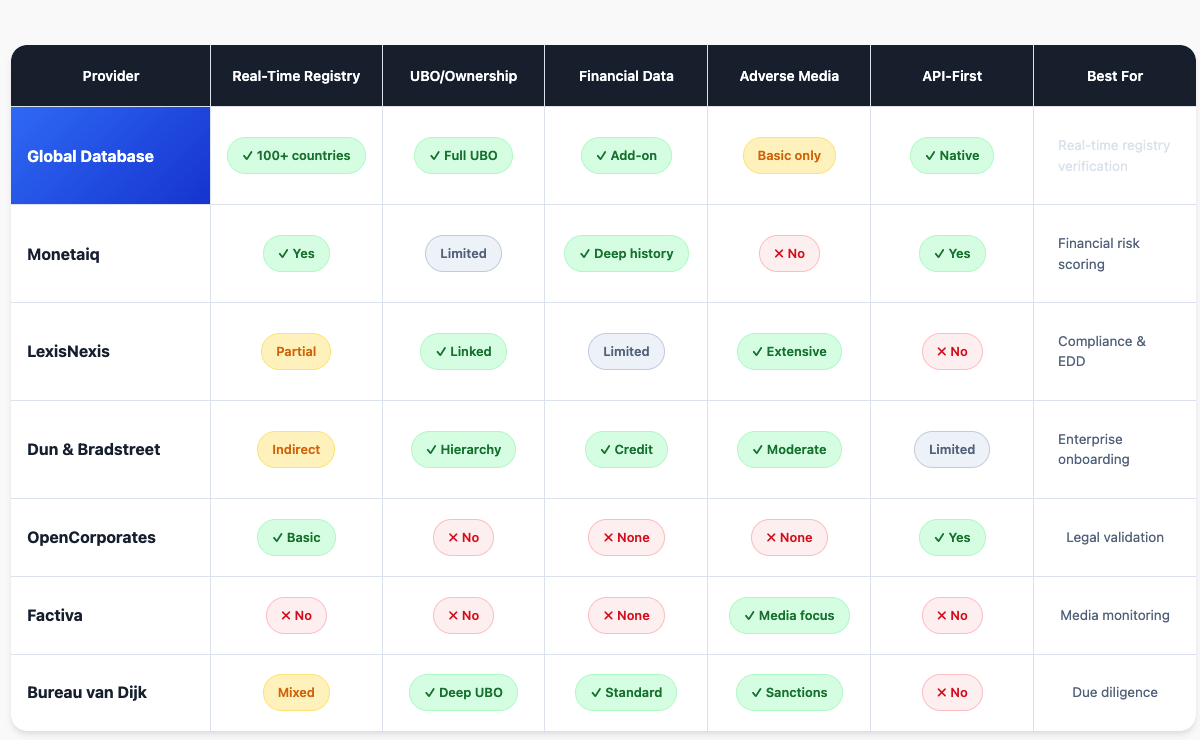
A KYB API helps a fintech identify a legal business and collect evidence for onboarding or ongoing review. It does not make the compliance decision for you: company identity, ownership, sanctions, adverse media, financial risk and tax-registration status are separate evidence layers, and provider coverage varies by country and product.
This 2026 comparison reviews seven business-verification data providers and adjacent due-diligence tools. Use it to build a shortlist, then test each provider against the same representative entities, jurisdictions and edge cases. Product names, capabilities and licensing can change; verify the current documentation and contract before relying on a feature.
We compare the providers by primary use case, source transparency, ownership or UBO evidence, integration model, licensing constraints and the handling of unavailable data. The aim is not to declare one universal winner, but to help a fintech choose an evidence stack that fits its risk policy and implementation constraints.
KYB API evaluation checklist for fintech teams
Before comparing vendor claims, define what the API must prove and what your own workflow must decide. Run every shortlisted provider against the same country mix and entity sample.
| Evaluation area | What to test | Evidence to retain |
|---|---|---|
| Entity resolution | Exact names, trading names, registration numbers and ambiguous matches | Candidate list, chosen entity and match rationale |
| Registry evidence | Priority countries, legal forms, field provenance and unavailable values | Source, source date where supplied and retrieval time |
| Ownership | Direct and indirect owners, control thresholds and incomplete chains | Relationship path, disclosed limit and manual-review state |
| Integration | Authentication, idempotency, errors, rate limits and webhook behaviour | Test responses, retry policy and operational owner |
| Commercial use | Volume bands, retention, redistribution and derived-data rights | Contract terms for the exact planned use |
What should a representative test set include?
Include straightforward entities, similar names, recently changed records, large ownership trees, missing fields and jurisdictions that matter to your customers. Label the expected answer before testing, and do not score an unavailable field as a negative value.
For Zephira’s current workflow, review business verification and KYB, country coverage and the API documentation. Confirm the fields and commercial terms needed for your own implementation.
Global Database

Best for: Real-time KYB from official registries in 100+ countries
Global Database is a first-party data provider built for compliance, onboarding, and risk workflows. Unlike many legacy players, Global Database connects directly to over 100 government registries worldwide — offering verified, structured company data including registration numbers, legal status, addresses, UBOs, and shareholders.
The platform’s KYB API allows fintechs to instantly verify legal entities, validate tax IDs (including VAT, EIN, CNPJ, etc.), retrieve ownership structures, and monitor changes in real time. It also supports advanced use cases like UBO resolution, credit risk profiling, and international supplier verification.
What sets Global Database apart is its API-first delivery model, flexible licensing (including reseller and derivative product rights), and broad global coverage of registry-sourced data — making it a strong alternative to both legacy providers and scraped data vendors.
Highlights:
- Real-time data from 100+ official registries
- UBO & shareholder discovery
- Legal entity validation, tax ID checks (VAT, EIN, CNPJ, etc.)
- API, bulk, and CRM integrations (Salesforce, HubSpot, Dynamics)
Considerations:
- Contact data and enrichment available, but charged separately
- UI is secondary — best value is in API and bulk delivery
Monetaiq

Best for: Financial KYB insights and credit risk analysis across global entities
Monetaiq focuses on providing deep financial intelligence for KYB, credit scoring, and corporate risk assessment. Unlike standard registry data providers, Monetaiq combines verified company registration details with over 20 years of financial history, credit scores, and digital signals — making it ideal for fintechs that need to assess not just legal existence, but financial health.
Monetaiq sources financials directly from government registries and filings, and enhances them with proprietary algorithms to deliver structured, comparable data across borders. It also provides credit limits, payment behavior indicators, and business activity signals, giving fintech platforms the tools needed to automate underwriting, evaluate suppliers, or assess B2B prospects.
With integrations available via API, bulk files, or directly embedded into internal tools, Monetaiq helps fintechs build smarter KYB and risk workflows that go beyond surface-level checks.
Highlights:
- 20+ years of company financial data
- Credit scores, limits, and payment behavior tracking
- Verified registry data across multiple jurisdictions
- Financial comparison across time and markets
- Available via API, bulk, and platform integrations
Considerations:
- Focused primarily on financial KYB, not broader ownership mapping
- Less suitable for UBO or shareholder identification use cases
LexisNexis

Best for: Regulatory compliance and enhanced due diligence
LexisNexis is a well-established provider in the compliance and legal intelligence space. Its KYB solutions are built for enterprise-grade use cases, offering access to business profiles, legal entities, and adverse media coverage from a vast network of proprietary and public sources.
While it does include corporate registry data, LexisNexis shines in high-risk screening and investigation. Its tools are often used for AML compliance, sanctions checks, PEP screening, and enhanced due diligence (EDD), making it popular among banks, insurers, and heavily regulated fintechs.
LexisNexis products are typically embedded into broader compliance systems and come with strong documentation, audit trails, and investigation tools — but often lack the flexibility or pricing transparency of API-first platforms.
Highlights:
- Extensive legal, regulatory, and adverse media coverage
- PEP and sanctions screening built-in
- Trusted by large enterprises and financial institutions
- Strong audit, reporting, and case management tools
Considerations:
- Registry data coverage varies by country and is not always real-time
- Higher cost and longer integration times
- Less developer-friendly compared to modern API-first providers
Dun & Bradstreet (DNB)

Best for: Global corporate hierarchies and standardized business identifiers
Dun & Bradstreet is one of the oldest and most recognized names in business information. Its KYB offerings are centered around the D-U-N-S Number — a unique identifier used globally to track legal entities, subsidiaries, and corporate hierarchies. DNB’s strength lies in its ability to map complex ownership structures and provide standardized data across jurisdictions.
Fintech companies often turn to DNB when they need consistent entity records across multiple markets, especially for onboarding large enterprises or managing supplier risk. DNB offers firmographic data, legal entity status, credit risk indicators, and some UBO-related information, although its ownership data can be limited depending on the country.
While comprehensive, DNB’s API and licensing structure can be rigid, and its data may not always come directly from primary registries, which may affect freshness in fast-changing markets.
Highlights:
- Global D-U-N-S identifier system
- Extensive database of corporate linkages and hierarchies
- Firmographics, credit risk scores, and limited ownership data
- Widely used by banks, insurers, and large enterprises
Considerations:
- Registry-sourced data is not always used directly
- Limited transparency on update frequency and source attribution
- Higher cost and licensing restrictions, especially for data redistribution
OpenCorporates

Best for: Open access to basic company registry data
OpenCorporates is the largest open database of companies in the world, with over 200 million legal entities indexed from national registries. Its mission is transparency, making it a go-to resource for basic company information like registration numbers, legal names, and incorporation dates — all openly licensed and accessible.
For fintechs evaluating OpenCorporates, access requires an API key and account-specific limits. Free open-data/public-benefit access has conditions, while commercial plans permit internal and external use. Its API documents control relationships and known-UBO fields where available; do not assume complete ownership coverage or none at all.
Its strength lies in legal identifiers and basic transparency, but it’s not suited for more advanced KYB requirements where deeper insight, financials, or risk signals are needed.
Highlights:
- Access to company data from 140+ jurisdictions
- Transparent source attribution with links to original registries
- Open licensing for basic data use
- Useful for legal ID validation and basic KYB
Considerations:
- Ownership and control information depends on the source and entity; test the documented relationship fields for your countries.
- No financials, credit scores, or risk indicators
- Limited enrichment, and data freshness depends on registry sync schedules
Factiva

Best for: Adverse media checks and reputational risk monitoring
Factiva, a product of Dow Jones, is a powerful tool for KYB teams that need to go beyond basic registry checks and assess reputational or media risk. It aggregates content from over 30,000 premium news sources, including global newspapers, trade publications, and regulatory watchlists — making it ideal for adverse media screening during onboarding or periodic reviews.
While not a registry data provider, Factiva is often used alongside KYB APIs to enrich due diligence workflows. Fintechs and compliance teams use it to flag potential red flags, such as fraud, litigation, or regulatory sanctions tied to the entity or its key stakeholders.
Its strength lies in uncovering what structured data may miss — but Factiva is a research tool more than a standalone KYB solution, and doesn’t offer real-time company verification or legal entity validation.
Highlights:
- Global news coverage from 200+ countries
- Strong for reputational risk and EDD use cases
- Adverse media screening for both companies and individuals
- Integration options for compliance workflows
Considerations:
- No registry or ownership data
- Not suitable for core KYB tasks like legal entity verification
- More of a media intelligence tool than a KYB API
Bureau van Dijk (Moody’s)

Best for: Deep ownership structures, financials, and compliance-grade data
Bureau van Dijk (BvD), a Moody’s Analytics company, is known for its Orbis platform — one of the most comprehensive databases for corporate ownership, financials, and entity-level risk data. It sources information from local registries, credit agencies, and proprietary research to create highly detailed company profiles, often used in high-stakes compliance and financial analysis.
For fintechs operating in regulated markets or serving enterprise clients, BvD offers unmatched depth in mapping corporate hierarchies, beneficial ownership, and cross-border linkages. It also includes standardised financials, industry classification, and sanctions screening modules.
However, BvD is not API-first. Its solutions are typically used via web platform or bulk data feeds, and licensing is expensive and restrictive, especially for product integration or redistribution.
Highlights:
- Extensive global coverage of UBOs, shareholders, and corporate structures
- Historical financials and standardized reports
- Strong reputation in banking, insurance, and compliance sectors
- Detailed entity risk and screening data
Considerations:
- Not designed for real-time KYB via API
- Licensing is complex and restrictive for embedding or resale
- Best suited for back-office analysis, not developer-first workflows
What is an API for Fintechs?
An API (Application Programming Interface) for fintechs is a software interface that allows financial platforms to securely exchange data with third-party services in real time. These APIs are used for tasks like business verification (KYB), identity checks (KYC), payments, credit scoring, and risk assessment — helping fintechs automate compliance, streamline onboarding, and scale operations efficiently.
Why use a KYB API in fintech?
Using a KYB API allows fintech companies to instantly verify business entities, identify Ultimate Beneficial Owners (UBOs), and access real-time company data directly from official sources. This is essential for:
-
AML and FATF compliance
-
Fraud prevention
-
Faster onboarding of merchants or business clients
-
Reducing manual data collection and human error
-
Building automated, scalable compliance workflows
What is Business Verification?
Business verification — often referred to as Know Your Business (KYB) — is the process of validating the legal existence, ownership structure, and risk profile of a company. This involves confirming registration details, tax identifiers, shareholders, UBOs, and checking for sanctions, adverse media, or regulatory red flags. In fintech, business verification is a legal and operational requirement for working with B2B customers or partners.
How do data vendors collect and compile data?
Data vendors collect information from multiple sources, including:
-
Government and commercial registries (first-party data)
-
Financial filings and credit bureaus
-
Open data platforms and corporate websites
-
Proprietary databases and third-party aggregators
Some vendors offer real-time registry connections, while others rely on batch updates or web scraping. The best KYB providers prioritize structured, verified, and regularly refreshed data to ensure compliance and accuracy.
What types of data do KYB providers typically offer?
Typical data points include:
-
Legal entity name, registration number, and status
-
Tax IDs (e.g., VAT, EIN, CNPJ)
-
Registered addresses and contact details
-
Shareholders and UBOs
-
Financial statements and credit risk indicators
-
Sanctions, PEP, and adverse media flags
-
Company hierarchies and global linkages
What makes a KYB API suitable for fintech use?
The best KYB APIs for fintechs in 2026 share the following features:
-
Real-time access to government registries and primary sources
-
Global coverage across 100+ jurisdictions
-
UBO and shareholder transparency
-
API-first delivery with easy integration into compliance workflows
-
Flexible licensing for use in internal tools, apps, or onboarding systems
-
Reliable data freshness and update frequency
-
Optional enrichment layers like credit scores, media checks, or financial history
Which KYB API is best for my fintech platform?
It depends on your specific use case:
-
For real-time registry data: Global Database
-
For financial insights and credit scoring: Monetaiq
-
For sanctions and enhanced due diligence: LexisNexis or Factiva
-
For UBO mapping and deep ownership: Bureau van Dijk (Moody’s)
-
For basic registry lookups: OpenCorporates
-
For global enterprise mapping: Dun & Bradstreet (DNB)
How to test a KYB API before choosing a provider
Use the same representative entity set for each evaluation: your priority jurisdictions, legal forms and difficult matches. Record which fields were returned, their source and age, the treatment of unavailable ownership data, and the review path for ambiguous results. Compare authentication, error handling, licensing and expected usage against your application requirements.
To evaluate Zephira, check country coverage and read the API documentation. Discuss a KYB API evaluation with your countries, required fields and expected volume.
Conclusion: choose the evidence stack, not a universal winner
Start with the decision your fintech must make. A registry-data API may support legal-entity resolution; a screening provider may support sanctions, PEP or adverse-media review; and a financial-data product may support credit assessment. Those are different jobs, even when a vendor packages several of them together.
- For entity onboarding: test matching, source transparency, country coverage and ambiguity handling.
- For ownership review: test direct and indirect relationships, control definitions, missing links and review states.
- For ongoing monitoring: test which changes are observed, the refresh cadence, delivery guarantees and false-positive workflow.
- For embedded products: confirm authentication, rate limits, retention, redistribution and derived-data rights in the current contract.
No provider should be selected from a feature list alone. Run a documented proof of concept using the same representative companies, retain unavailable and ambiguous outcomes, and have compliance, engineering and procurement review the evidence separately. A fast API response is useful; it is not proof that every field is current, complete or sufficient for a regulated decision.