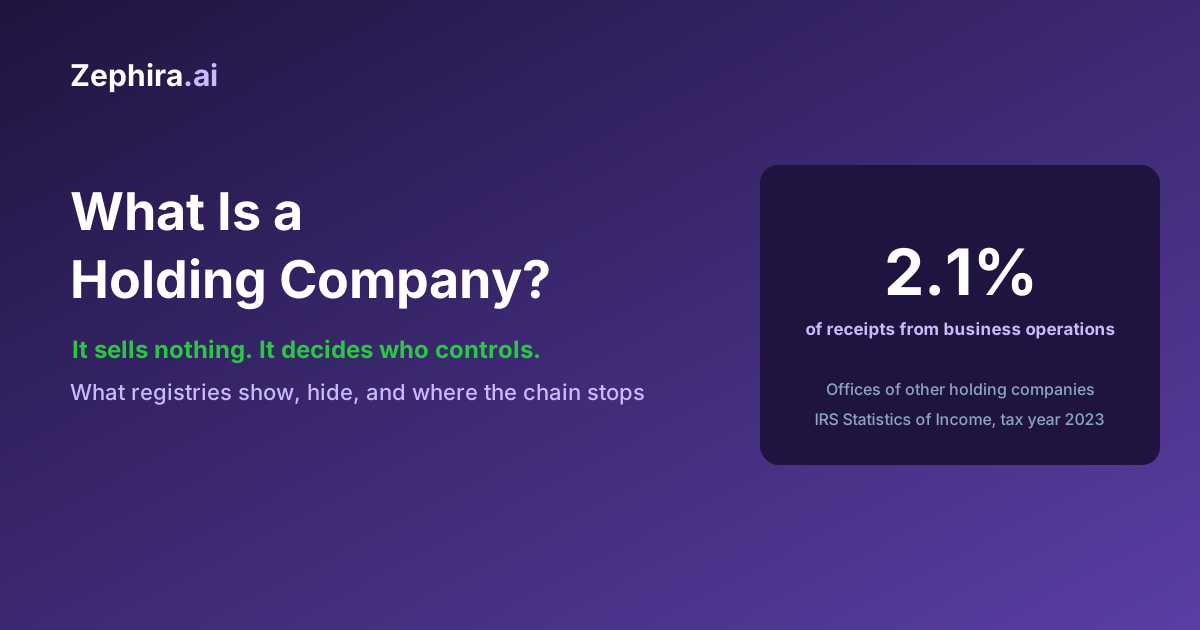
A holding company makes nothing, sells nothing and often employs almost nobody. It is also the entity that decides who runs the business you are about to sign with. The IRS counted 76,847 active corporate returns from "other" holding companies for tax year 2023, and only 2.1% of their receipts were business receipts. The power sits in the share register, not the sales ledger.
The catch, for anyone checking a counterparty, is that a structure built to separate control from operations also separates the registry record from the answer. The contract names one entity. Control sits two or three entities higher, in another jurisdiction if the group chooses, and no federal US filing now covers the domestic part of that chain. This guide reads holding companies from the side of the question that matters: who really owns this, and can you verify it before you do business with them?
What is a holding company?
A holding company is a company whose main business is owning controlling stakes in other companies rather than running operations itself. No single US statute defines the general term. The definitions that exist were each written for one job:
- Bureau of Economic Analysis (BEA): holds securities or financial assets of other companies to control or influence them, does not manage their daily operations, and earns more than 50% of total income from equity investments.
- UK Companies Act 2006, s.1159: a company is a "holding company" if it holds a majority of another's voting rights, can appoint or remove a majority of its board, or alone controls a majority of votes by agreement.
Those tests point in opposite directions. BEA's excludes a firm with mostly operating income. The UK's includes a trading company with one subsidiary.
Counting them exposes the same problem. Census County Business Patterns (CBP) found 6,582 establishments under NAICS 551112 (other holding companies) in 2023, and 4,390 had fewer than five staff. They average 14 employees; corporate managing offices (551114) average 89. CBP excludes businesses with no paid employees, so a holding company with no payroll never appears.
What does holdings mean in a company name?
Legally, nothing. "Holdings" is a label the founders chose, not a status a registry tests. Delaware's 8 Del. C. §102(a)(1) requires a word such as "company", "corporation" or "limited", and "holdings" is not on the list. Alphabet Inc. does not use the word, while XXVI Holdings Inc., named in a February 2019 SEC Schedule 13G/A as Google LLC's managing member, does. Read the filed accounts.
What does a holding company do?
A holding company owns shares, votes them, appoints subsidiary boards, collects dividends and allocates capital. It leaves production, staff and customers to the subsidiaries. The IRS figures show the result.
Of the 76,847 returns for tax year 2023, under 40% reported net income: 30,639.
How does a holding company work?
It works through the vote. The shareholder of a subsidiary elects that subsidiary's board, so whoever controls the top entity controls every board beneath it without appearing on any of them. Delaware law reflects that position: under 8 Del. C. §271(c), a wholly owned subsidiary's assets count as the parent's when deciding whether a sale of substantially all assets needs a stockholder vote.
Alphabet is the public example. On 2 October 2015, Google Inc. reorganized under Delaware's §251(g), which forms a holding company without a stockholder vote. Each Google share converted automatically into an equivalent Alphabet share, and Google survived as a wholly owned subsidiary, per its Form 8-K. Google Inc. became an LLC in September 2017, per the FY2017 10-K.
What is the purpose of a holding company?
The purpose is to keep ownership decisions and operating risk in different legal entities. That lets a group ring-fence one business, move dividends upward, sell a subsidiary by selling its shares, and concentrate control in one place. For a counterparty, the last matters most.
Holding company vs parent company
Every holding company with a subsidiary is a parent. Not every parent is a holding company. "Parent" describes a relationship; "holding company" describes an activity.
| Test | Pure holding company | Operating parent |
|---|---|---|
| Main activity | Owning stakes | Its own trade, plus stakes |
| Registry clue | Accounts dominated by investments in subsidiaries | Accounts show turnover and trading assets |
| UK s.1159 label | Holding company | Also holding company |
| BEA test | Holding company if equity income exceeds 50% | Fails the test |
What is a holding company LLC?
A holding company LLC is a limited liability company whose main assets are shares or membership interests in other entities. Activity and legal form combine freely.
Can an LLC be a holding company?
Yes, and tax decides the design. Under Treas. Reg. §301.7701-3, a domestic LLC defaults to partnership treatment with two or more members and is disregarded with one, unless it elects to be taxed as a corporation. The dividends-received deduction in IRC §243 belongs to corporations, and §1504 consolidation requires includible corporations. A pass-through LLC sends dividends to its members rather than sheltering them.
The statistics cannot size this group. CBP sorts 2023 establishments under 551112 into C corporations and other corporate forms (2,481), S corporations (2,495), partnerships (1,155) and smaller groups. There is no LLC line.
The registers are thinner still. A Delaware certificate of formation under 6 Del. C. §18-201 sets out a name, a registered office and a registered agent. Wyoming's articles under W.S. 17-29-201 ask for much the same. An LLC holding company in either state is a blank node on the public record, as the Delaware and Wyoming guides show.
Holding company benefits, and the catch on each
Holding company benefits are real and conditional. A registry extract reveals none of the conditions.
| Benefit | What it rests on | The catch |
|---|---|---|
| Liability isolation | United States v. Bestfoods, 524 U.S. 51 (1998) | Veil piercing; direct liability if the parent runs operations; several group tax liability (Treas. Reg. §1.1502-6); joint and several pension liability (29 U.S.C. §1362) |
| Tax-light dividends | IRC §243: 50%, 65%, 100% | Corporate recipients only; 45-day holding rule and income cap in §246 |
| Consolidated return | IRC §1504: 80% of vote and value | Both prongs must be met; foreign corporations and S corporations are excluded |
| Asset protection | Separate entity; charging-order statutes | Fla. Stat. §605.0503 allows foreclosure on a single-member LLC; Manichaean Capital v. Exela (Del. Ch. 2021) allows reverse veil piercing in limited circumstances |
| Control on less capital | Majority stakes stack | Three 51% layers give 13.3% of the economics, and UK person with significant control (PSC) rules still count the top controller in full |
| Passive ownership | Simple balance sheet | 20% personal holding company tax (§541); investment company status above the 40% test (15 U.S.C. §80a-3; Rule 3a-1) |
Bestfoods states that a parent "is not liable for the acts of its subsidiaries" as a general rule. Courts pierce the veil only when the corporate form is misused, and they presume dual officers act for the subsidiary. So a contract with the operating company gives you no claim on the group behind it. If the group's balance sheet is why you said yes, get a parent guarantee in writing.
Control has no single percentage
A stake that means control in one regime means nothing in another.
Three edges cause errors. A holder of exactly 25% is a beneficial owner under the EU regulation but not a UK PSC, which needs more than 25%. A 79% stake delivers practical control and no consolidated return. And the bank test is broader than its number: the Federal Reserve can find control through a "controlling influence" below 25%, and only under 5% is there a presumption against it. Ultimate beneficial owner (UBO), PSC and legal shareholder are three different things, as this comparison sets out.
What a registry shows, and what it hides
A registry shows the entity in front of it. A holding structure places the answer one entity further away.
| Record | Shows | Hides |
|---|---|---|
| UK company | Officers, accounts, PSC entries, shareholder details (s.853F, non-traded companies) | Owners above a UK corporate PSC |
| Delaware corporation | Name, registered agent, directors on the annual report | Stockholders: "not on file" per the Division of Corporations |
| Delaware LLC | Name, registered office, registered agent; no annual report | Members and managers |
| Delaware LP | General partners (§17-201) | Limited partners |
| Luxembourg company | Registre de Commerce et des Sociétés (RCS) record and filed documents | Beneficial ownership register: access is gated |
| US-listed issuer | Exhibit 21 subsidiaries; holders above 5% | Non-significant subsidiaries: Alphabet's FY2025 exhibit lists three |
| US bank holding company | FR Y-6 organization chart; holders of 5% or more | Items granted confidential treatment |
Worked example: tracing an illustrative group
You are onboarding Example Freight Ltd, an English haulier. Every name here is invented. Example Holdings Ltd owns all of it. A Luxembourg company, Example Lux S.à r.l., owns all of Holdings. Example Partners LLC of Delaware holds 60% of the S.à r.l. and Example Fund LP holds 40%. Partner A holds 60% of Example Partners and Partner B holds 40%.
- Example Freight. The PSC entry names Example Holdings Ltd as a relevant legal entity, because a UK company has its own disclosure duties (s.790C). No individual appears.
- Example Holdings. Its member list names the S.à r.l., the legal owner. An unlisted Luxembourg company is not a relevant legal entity, so the PSC register looks through it to a beneficial owner: Partner A, through an unbroken chain of majority stakes, at 75% or more.
- Example Lux. The RCS gives the company record and, in this example, filed documents naming both shareholders. The ownership register stays closed.
- Example Partners and Example Fund. Delaware shows Example Partners's registered agent and Example Fund's general partner. No members or investors appear. The public chain stops.
Here is the pivot that surprises people: Partner A has 36% of the economics, and the UK reports 75% or more. Schedule 1A, paragraph 18 counts the shares held down a majority-stake chain in full and does not multiply. The EU calculation, applying from July 2027, multiplies. Partner B sits at 24% on the EU figure and at nothing on the UK one. That partner is invisible in every public record here.
Record the entity where the chain stopped, the register that stopped it and the date. A gap is a finding. The wider method is in the corporate hierarchy guide.
Where the chain stops
It should stop at a natural person. In practice, it stops wherever a register does.
United States. The Corporate Transparency Act set out to build a federal ownership register. FinCEN's March 2025 interim final rule exempted domestic companies from it. A final rule, announced 11 August 2026 and effective on Federal Register publication on 14 August, made that permanent. Banks still identify owners of 25% or more and one control person under 31 CFR 1010.230, but those records are not public.
European Union. The Court of Justice ruled in WM and Sovim (C-37/20 and C-601/20, 22 November 2022) that general public access to beneficial ownership registers was invalid. Access now turns on national rules.
United Kingdom. The PSC register "can never be blank", per government guidance. A statement that no PSC could be identified is still an entry, and a finding to escalate.
A chain across borders sits in registers with different fields. Zephira's corporate linkages map parents and subsidiaries using registries in 220 countries and territories, which matters because a single-country search cannot see a break at a border. Ownership and UBO due diligence traces shareholders link by link.
A clean check also ages. Sell Example Lux and Example Freight's own record does not change, because its PSC is still Example Holdings. Company monitoring tracks filings across the chain, which closes the gap a point-in-time check on the contract party leaves open.
Three specialised holding structures
What is a bank holding company?
A bank holding company is any company that controls a bank: 25% or more of any class of voting securities, control over electing a majority of directors, or a Federal Reserve finding of controlling influence (12 U.S.C. §1841). The Federal Reserve Board must approve it first (§1842(a)), and the organization chart is a filed report: the FR Y-6. The New York Fed reports regulated holding companies fell from 6,307 in 1990 to 3,801 in 2024.
In IRS data for tax year 2023, bank holding companies filed 2.9% of the sector's returns and took 92.5% of its receipts.
What is a real estate holding company?
A real estate holding company is an entity that owns property and little else. The label has no general legal meaning. The nearest statutory test is tax: a "United States real property holding corporation" under IRC §897(c)(2) has US real property interests worth 50% or more of the measured assets. A deed names the title-holding entity, not who stands behind it, as the property ownership guide shows.
Are private equity firms holding companies?
No. The firm is the adviser, and the fund it runs is the investor. A "private fund" under the Advisers Act is an issuer that escapes investment company status only through §3(c)(1) (no more than 100 holders) or §3(c)(7) (qualified purchasers). Holding companies appear below the fund, as acquisition vehicles. BEA treats a chain containing only private funds and holding companies as having no operating companies.
How to set up a holding company
Form a new entity, move the shares into it, and fix the tax treatment before the first dividend.
- Choose the form: a corporation, or an LLC with a corporate tax election if §243 matters.
- Transfer the shares. IRC §351 gives no gain or loss only if transferors hold at least 80% control afterward (§368(c)).
- For a Delaware corporation with many stockholders, consider §251(g).
- Keep separate books, accounts and decisions, because veil piercing grows from misuse.
- If a bank is involved, get Federal Reserve approval first.
Frequently Asked Questions
Can a holding company be an LLC?
Yes. The form changes the tax result: by default a multi-member LLC is a partnership and a single-member LLC is disregarded, so it receives no dividends-received deduction unless it elects corporate treatment.
Is an LLC holding company better than a corporate one?
The goal decides. An LLC offers pass-through taxation and thin public filings. A corporation gets the deduction under IRC §243 and can consolidate under §1504.
Can creditors of a subsidiary reach the holding company?
Not as a general rule, per United States v. Bestfoods (1998). They can reach it through veil piercing, direct liability where the parent ran the operations, or a guarantee. Group tax and pension liabilities also reach across by statute.
Does a holding company pay tax on dividends from subsidiaries?
A US C corporation deducts 50%, 65% or 100%, depending on the stake. At the 21% rate, that leaves $10.50, $7.35 or nothing per $100 of dividend. Stock held 45 days or less around the ex-dividend date fails §246(c).
How can I find out who owns a holding company?
Start with its own register, then walk upward one entity at a time. Use PSC entries and shareholder lists in the UK, SEC filings for listed groups and FR Y-6 reports for bank groups. For private Delaware or Wyoming entities, ask the counterparty for an ownership certification.
Do US holding companies report beneficial owners to FinCEN?
No, not if they were formed in the United States. FinCEN's final rule, effective August 2026, removed the requirement for US companies and US persons. Foreign reporting companies still report foreign individuals.
Is a holding company the same as a shell company?
No. Under SEC Rule 12b-2, a shell company has no or nominal operations and no or nominal assets, or only cash and nominal assets. A holding company with real subsidiaries holds substantial assets through them.
Can a holding company be classed as an investment company?
Yes, by accident. Investment securities above 40% of adjusted total assets meet the test in 15 U.S.C. §80a-3(a)(1)(C). Majority-owned subsidiaries that are not investment companies are excluded, so minority stakes create the exposure. Rule 3a-1 offers 45% asset and income tests.
Why does the UK PSC register show a company and not a person?
Because a UK company above it is a relevant legal entity with its own disclosure duties. The register records the first such entity and stops. To find the individual, open that entity's own PSC record, and repeat until a person, an overseas entity or a statement appears.
Does a 25% stake always make a company a bank holding company?
It triggers the first prong of the control test if the stake is 25% or more of any class of voting securities of a bank. Below 25%, control can still be found through director election rights or a controlling influence. Under 5% is presumed not to be control.