A UK company costs £100 to form online, per the Companies House fee schedule in force since 1 February 2026. A dormant public shell can cost far more: the SEC said in May 2012 that manipulators may pay up to $750,000 to gain control of one. Neither price says anything about whether the company is clean.
FinCEN wrote in November 2006 that most shell companies are formed for legitimate reasons, then listed red flags for the rest. A vehicle carrying a merger is built like one carrying bribe proceeds. The catch, for anyone doing due diligence, is that legal status separates neither. "Active" on a register says the file is in order. It does not say why the company exists.
This guide therefore works from what you can observe. It covers recognition and checking, not formation.
What is a shell company?
A shell company is a validly formed company with no real operations of its own. No single global definition exists, and the most quoted one has a narrow reach.
SEC Exchange Act Rule 12b-2 and Securities Act Rule 405 use the same text: a registrant, other than an asset-backed issuer, with no or nominal operations and either no or nominal assets, assets consisting solely of cash and cash equivalents, or any amount of cash plus nominal other assets. "Registrant" limits the rule to SEC filers, so a private company falls outside it. Cash does not rescue anyone either: no operations and $50 million in the bank is still a shell. The SEC also said in Release 33-8869 that the concept is not meant to capture a startup with a limited operating history.
Anti-money-laundering sources define it by function. The joint July 2018 report by the Financial Action Task Force (FATF) and the Egmont Group of financial intelligence units uses "incorporated company with no independent operations, significant assets, ongoing business activities, or employees." FinCEN's 2006 guidance (FIN-2006-G014) covers non-publicly traded corporations, LLCs and trusts with typically no physical presence beyond a mailing address and little to no independent economic value. Those definitions reach private entities, so they are the ones a know-your-business (KYB) file needs.
What is a shell corporation?
A shell corporation is a shell company organised as a corporation. The terms are used interchangeably, but the entity type changes what the record shows. The Government Accountability Office's May 2026 report (GAO-26-107967) says US-based shells are often structured as LLCs or corporations. Most states collect reports that name corporate officers and directors or LLC managers and members, and those people may not be the owners. Compare Delaware's register with the Wyoming LLC record before assuming two US filings match.
What does a shell company do?
A shell company usually holds something or completes a transaction; it does not trade. The Puppet Masters (World Bank/UNODC StAR, 2011) lists the ordinary uses: a neutral vehicle for a merger or joint venture, sequestering liabilities, creating equity or debt tranches in one asset, and holding personal or family assets for inheritance.
The SEC's January 24, 2024 release (33-11265) states that special purpose acquisition companies (SPACs) are shell companies, and its Rule 145a deems a business combination involving a reporting shell to be a sale of securities to that shell's shareholders. A reverse merger uses similar mechanics: a private operating business takes over a publicly traded shell.
Why the SEC treats shell status as permanent
Rule 144(i) removes the Rule 144 resale safe harbour for securities initially issued by a shell, and it reaches any issuer that was a shell "at any time previously." Resale opens only when the issuer has stopped being a shell, is current in its Exchange Act reports for the prior 12 months, and one year has passed since it filed Form 10 information. Shells formed solely to change domicile or to complete a business combination among non-shells are carved out.
The value sits in the listing. Under Operation Shell-Expel the SEC suspended dormant issuers before they could be hijacked for reverse mergers or pump-and-dump schemes. A suspended stock cannot be quoted again until the company supplies updated information, including accurate financial statements.
How do shell companies work?
A shell company works by separating the name on the record from the people and the business behind it. The entity has legal personality, so it can hold title, sign contracts and open accounts. The register records what statute requires. The rest sits in private documents.
In a lawful structure, the documents exist on request. In an abusive one, FATF–Egmont describes money moving through multiple layers of shells before being withdrawn in cash or sent abroad. More than half of its 106 case studies, from 34 jurisdictions, specifically referred to shell companies, and the sample is weighted towards a few jurisdictions, so it shows a pattern rather than a rate.
FinCEN's 2006 review reported nearly $18 billion in aggregate suspected violations across the wire-pattern Suspicious Activity Reports (SARs).
Are shell companies legal?
Yes. Forming and holding a company with no operations is lawful in the US and UK and in the offshore centres covered here; offences attach to what the company is used for. Regulators condition the structure rather than ban it. Since 4 March 2024 a UK company must confirm its activities are lawful at incorporation and annually, and it cannot use a PO box as a registered office.
Are shell companies illegal?
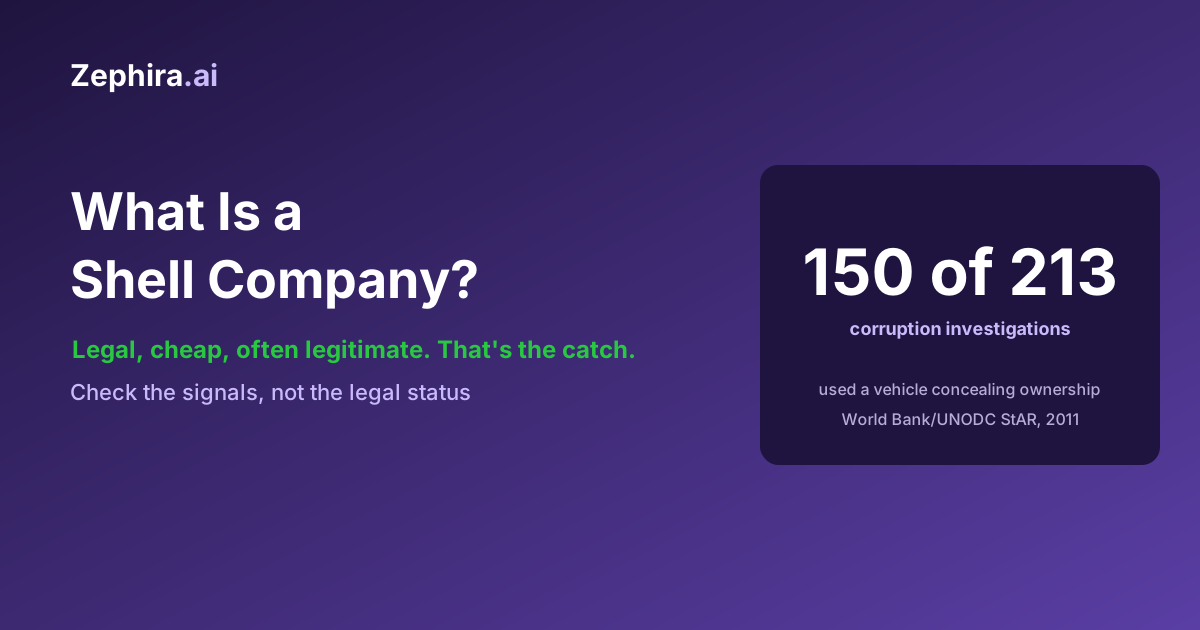
No, not by themselves. The offences are the underlying ones: corruption, fraud, sanctions evasion, laundering, false filings. In the Zambian state's civil recovery claim (AG of Zambia v Meer Care & Desai [2007] EWHC 952 (Ch)), the High Court said routing ownership through a BVI holding company with nominee directors and bearer shares, plus a Luxembourg company, "shows that the whole operation was to hide things." One defendant's dishonest-assistance liability was later overturned on appeal, per The Puppet Masters.
The denominator is the trap. The World Bank figure says corporate vehicles are common in grand corruption. It does not say corruption is common in shells. Its sample starts with investigated officials, so it gives no base rate for shells.
Shell, shelf, front, holding, SPV, SPAC: how they differ
These labels describe function, not legal form, and one entity can move between them.
| Type | What it is | Real operations? | Check first |
|---|---|---|---|
| Shell | No independent operations, assets or staff (FATF–Egmont) | No | Stated purpose against documents |
| Shelf | Inactive officers, left dormant (FATF–Egmont) | Not yet | Control changes against the incorporation date |
| Front | Functioning business that disguises illicit activity (FATF–Egmont) | Yes | Turnover against premises, staff and sector |
| Holding | Holds control of subsidiaries (Companies Act 2006 s.1159 test) | Through subsidiaries | Subsidiaries exist and file |
| SPV | Descriptive term for a ring-fenced asset or liability vehicle | Limited by design | The asset and the financing documents |
| SPAC | Shell sponsored to merge with an unidentified target (SEC 33-11265) | No, until de-SPAC | SEC filings and sponsor |
A front company is the harder problem: it has real revenue, so a shell checklist clears it. Over a quarter of FATF–Egmont's case studies involved one.
What is a nominee director?
A nominee director is a person who holds a board seat and appears on the record while acting for someone else, the nominator. FATF–Egmont calls nominees "lawful (or at least not unlawful) in most jurisdictions." FATF added definitions of "nominee shareholder or director" and "nominator" when it revised Recommendation 24 in March 2022, and its March 2023 guidance says a nominee director is never the real owner because of the role. The person to identify is the one on whose behalf the nominee acts.
In FATF–Egmont Case Study 81, a Vanuatu-based provider supplied nominee directors for over 1,000 New Zealand companies, and authorities suspected at least 73 of facilitating crimes abroad. In Case Study 77, the director of record told journalists he was unaware of the company or its accounts; he had sold his passport details. For the property-title version, see tracing real-estate LLCs and shell chains behind property.
Nominee director versus shadow director
UK law has no separate "nominee director" office. Companies Act 2006 s.155 requires at least one director who is a natural person. Section 251 defines a shadow director as someone whose directions the board is accustomed to follow, with exclusions for professional advice. So the nominee is on the register, and the person instructing them may be a shadow director who is not.
How a nominee director shows up on the register
| Jurisdiction | Public view | Nominee flagged? |
|---|---|---|
| UK | Free Companies House officer page with "Total number of appointments" | No public field. Identity verification has applied since 18 November 2025 |
| Cayman | Names of directors and alternates open to inspection at the General Registry under the 2019 amendment law | Names only |
| BVI | Registrar makes a list of directors available on request (2022 amendment to s.118B) | Licensed providers must be indicated, and the name and address of the individual they act for filed with the Registrar (2024 amendment to ss.118, 118A) |
Here is the pivot: the UK publishes more, while the BVI text collects the nominator. Filing is not publication, and the BVI text does not say that detail reaches the public list. UK identity verification proves a person exists. It does not prove that person decides anything.
How to identify a shell company
You identify a shell company by testing observable signals against its stated business, then reading the combinations. No single signal proves anything: a registered agent address is a legal requirement in many states. The sources in brackets are the official typologies each signal draws on; the wording and grouping are our own reading of them, not a list any regulator publishes.
| Signal | Where to check | Innocent explanation |
|---|---|---|
| Mass-registered address (FATF–Egmont; FinCEN 2006) | Address search; company count at that address | Accountant or formation agent as registered office |
| Officers on many companies (FATF–Egmont) | Officer appointment history, including other registers | Corporate services or fund director |
| No or dormant accounts against activity claimed | Filing history; accounts type against bank flows | Genuinely pre-trading, or small-company filing |
| Dormant, then suddenly active (SEC; shelf typology) | Gap in filings, then new officers or owners | Bought off the shelf for speed; restart |
| Recent incorporation, large flows (FinCEN 2006; FATF–Egmont "transit transactions") | Incorporation date against expected volumes in the KYB file | Funded joint venture or acquisition vehicle |
| Looping or purposeless ownership (FATF–Egmont "complex structures") | Draw the chain; does it end in a person? | Regulated fund or tax-driven group, with documents |
A looping chain is our reading of the FATF indicator on complexity without commercial sense, not the report's phrase. FATF–Egmont also lists no personnel, no physical presence and no tax or social-benefit payments. Access varies, so check the global registry index for which tests a jurisdiction allows. Across borders, officer names from different registers have to resolve to one person. Officer search across 640M companies in 220 countries and territories, with corporate linkages on top exposes the pattern a single-register lookup cannot show.
What US and UK rules now give you
The two systems moved in opposite directions. In the US, GAO found in April 2006 that most states did not require ownership information at formation and that none verified the identity of company officials. The Corporate Transparency Act aimed to fix that federally. Then FinCEN's interim final rule of March 2025, made permanent by a final rule effective August 14, 2026, exempted US companies and US persons. Only foreign entities registered to do business in a US state or tribal jurisdiction still report. GAO says the exemption covers over 99 percent of entities previously required to report, and warns it may perpetuate shell-company risk.
Banks keep their own duty. A beneficial owner is the natural person who ultimately owns or controls a company, as distinct from the legal owner on the share register; owners, PSCs and shareholders explained covers the distinctions. FinCEN's customer due diligence (CDD) rule (31 CFR 1010.230) requires covered institutions to identify anyone with 25 percent or more of the equity and one individual with significant control. Since FIN-2026-R001 of February 13, 2026, institutions can do that at first account opening, on facts that undermine prior data, or as risk-based monitoring requires, rather than at every new account.
In the UK, identity verification became mandatory on 18 November 2025 with a 12-month transition. The government's outline plan, updated 23 October 2026, says the transition completes no earlier than the end of 2026, with compliance action to follow. Companies House entered 920 companies on the expedited strike-off pathway in 2025 to 2026 as registered on a false basis.
Read those removals as a warning about old snapshots: last year's record may carry an address the registrar has since replaced with its own.
Worked example: a registry walkthrough
Example Trading Ltd is fictional and illustrative, and so is every fact below. It applies to a US payments firm as a commodity broker, expecting £4 million a year from suppliers abroad.
- Status and age. Active, incorporated 16 months ago. No finding.
- Address. An advanced company search on the partial address returns about 2,300 companies. Signal one, consistent with a formation agent.
- Officer. The sole director's page shows 187 appointments across unrelated sectors. Signal two: lawful, but it weakens "this person runs the business."
- Control statement. The person with significant control (PSC) filing names a BVI company. Under UK PSC guidance, a legal entity that is not a relevant legal entity cannot be the registrable person, and the company must look through it. Signal three, and a filing defect to raise directly.
- Accounts. The company filed dormant accounts for its first year. GOV.UK treats a company as dormant only if it had no significant transactions, so claimed trading in that period needs explaining. This is the strongest signal, because it contradicts the applicant's own story.
- Chain. The BVI company's directors come back as a list on request. They are a licensed provider's staff, so ask for the nominee agreement and the register of members.
The result is not "reject." It is enhanced due diligence: signed supplier contracts, the look-through to a natural person, an explanation for the dormant filing. A broker with those documents is a thin company with a business plan. Without them, it is what FinCEN's guidance contemplates: a US institution's SAR narrative should use the word "shell" where suspicion stands. Ownership due diligence at this stage closes the gap between filed record and stated purpose.
Frequently Asked Questions
What are shell companies?
Shell companies are formally registered entities with no independent operations, significant assets, business activity or staff, per the FATF–Egmont definition of July 2018. Most exist for ordinary reasons, so the label alone settles nothing.
How does a shell company work?
It works as a separate legal person that can hold assets, sign contracts and open accounts without running a business. Purpose, control and funding sit in private documents you have to request.
Is a shell company the same as a shell corporation?
In everyday use, yes. A shell corporation is organised specifically as a corporation; the wider term also covers LLCs, and FinCEN's 2006 definition adds trusts.
Is a SPAC a shell company?
Yes. SEC Release 33-11265 of January 24, 2024 states that SPACs are shell companies organised by a sponsor to merge with an unidentified private operating company.
Is a nominee director legal?
Generally yes. FATF–Egmont describes nominees as lawful or at least not unlawful in most jurisdictions, and the BVI licenses the service. FATF's revised Recommendation 24 asks countries to mitigate misuse through disclosure or licensing, or to prohibit nominees and enforce the ban.
How can you tell if someone is a nominee director?
The UK and Cayman public records do not say so. Look for appointments across many unrelated companies, a shared service address, no apparent role in the business, and a residence far from operations. Those are indicators, not proof, so ask for the services agreement.
Does a registered agent address make a company a shell?
No. Registered agents are a normal statutory feature. FinCEN's 2006 guidance flags companies providing only a registered agent's address as one indicator among several.
What is a shelf company?
A shelf company has inactive shareholders, directors and secretary and sits dormant for a longer period, per FATF–Egmont.
Do US companies still report their owners to FinCEN?
No. FinCEN's final rule, effective August 14, 2026, made permanent the March 2025 exemption for US companies. Registered foreign entities still file unless exempt. Bank CDD obligations continue separately.
Should a compliance team refuse every shell company?
No. FinCEN said its 2006 guidance was not intended to encourage institutions to end shell relationships. Refuse when the stated purpose stays unsupported after you have asked, not because the company has no staff.
Bottom line: legal status answers whether the file is in order. Filings, officers, addresses and flows answer whether the story holds. Run the second test every time.