An Indiana business entity search starts with the Secretary of State’s public Business Search, reached through INBiz. Find the business, open its Business ID and compare the registered entity with the party on your contract. Then review its status, relevant filings and next Business Entity Report date. A matching name is the beginning of the check, not the approval decision.
Indiana’s two-year reporting cycle creates a specific problem for enterprise teams: a record can have no new Business Entity Report this year without being overdue. Equally, an old report does not tell you whether a supplier’s address, management or commercial circumstances have changed since it was filed. Filing compliance and evidence freshness need separate treatment.
This guide explains how to use an Indiana business lookup for supplier onboarding, resolve ambiguous records and maintain a review trail. Registry guidance and published charges were checked on 27 September 2026. Worked examples are fictional and are labelled separately from official figures.

How to run an Indiana Secretary of State business search
Start at the official INBiz website and choose “Search for a Record”, then “Business Entities”. This separates entity research from business-name availability, trademarks and UCC searches. Those services answer different questions. A name-availability result, for example, is not evidence identifying a supplier already in your accounts-payable system.
- Collect the counterparty’s legal name and jurisdiction. Use the signed contract or supplier submission. Keep its trading name and website in separate fields so a familiar brand does not silently replace the legal party.
- Search for candidates. Begin with the supplied name. If the result is inconclusive, try a distinctive part of the name and review the alternatives. Record the search terms you used.
- Open the Business ID. Indiana’s official guidance directs users to the Business Details page, where the report due date is displayed. Compare the entity with the counterparty’s supplied identifier rather than approving the closest-looking name.
- Read the available details and filing evidence. Look for discrepancies that affect your decision: different legal names, different jurisdictions, a changed address or a status requiring further review.
- Document the conclusion. Save the identifier, source, observation time, material evidence and reviewer’s decision. Keep unresolved questions visible instead of marking the whole supplier verified.
Suppose a purchase order names a manufacturing subsidiary but the onboarding form uses its parent’s brand. Ask which entity will sign, invoice and receive payment. An exact registry match for the parent does not resolve the subsidiary’s identity. If the parties genuinely differ, document the relationship and obtain the approvals your process requires.
Keep a search failure separate from a negative result. A page that cannot load has not established that the company is absent. Retry through the normal service later or request suitable evidence from the counterparty, with the limitation recorded. Avoid converting unavailable information into a confident adverse conclusion.
Read identifiers and roles without merging them
Your internal company record should preserve each identifier’s issuing authority. A state Business ID belongs in the Indiana registry field. An EIN belongs in a federal-tax identifier field: Indiana’s Business Roadmap identifies the IRS as the issuing authority. Do not put either value into an unlabelled “company number” column that downstream users may interpret differently.
| Evidence | Question it helps answer | Question still open |
|---|---|---|
| Name and Business ID | Which Indiana record are we reviewing? | Is this the entity accepting our contract? |
| Registered agent | Who is designated to receive service of process? | Who owns, controls or can bind the business? |
| Governing person, where filed | Which management role appears in the filing? | What is the complete ownership chain? |
| Status and report history | What does the registry currently record? | Can the supplier perform and meet its liabilities? |
| Certificate of Existence | What formal facts has the state certified? | Are the remaining commercial checks satisfactory? |
Indiana describes a registered agent as the recipient of legal notices and service of process. An agent relationship is therefore not an ownership relationship. If several suppliers share an agent or service address, preserve that observation without automatically drawing a corporate group around them.
The same caution applies to governing-person information. A manager’s appearance in a filing can help explain a role, but it should not be stretched into proof of every shareholder or ultimate beneficial owner. Request ownership evidence appropriate to the transaction, and distinguish a missing field from a confirmed absence of an owner.
Why the Indiana Business Entity Report comes every two years
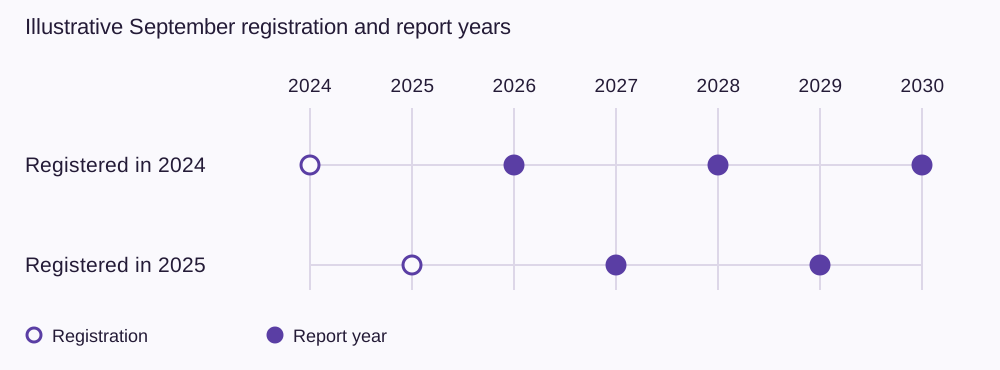
INBiz states that Business Entity Reports follow a biennial cycle for registered for-profit and nonprofit businesses. The relevant anniversary is formation in Indiana or registration to do business in the state. For a company formed elsewhere, its original home-state formation date can therefore be the wrong anchor for the Indiana calendar.
Use the due date displayed on the actual record. The state’s report guidance describes the first report as due two years after formation or registration and allows until the end of the anniversary month before treating it as past due. A newly formed entity and an older registered entity should not inherit the same assumed next deadline.
Chart 1. Two registration years, different report years
For a group managing its own entities, assign a filing owner and a backup contact. For procurement monitoring an external supplier, assign a review owner. These are different responsibilities: procurement needs evidence of the supplier’s position; it is not automatically responsible for filing the supplier’s report.
Do not estimate that half your portfolio has a report due each year merely because the cycle is biennial. Acquisition history, registration dates and portfolio composition can concentrate deadlines. Count actual due dates from resolved records, and leave unknown dates in an explicit exception queue.
Separate search costs from filing fees
Indiana’s official material distinguishes free access to public search data from paid filings and bulk services. The current Business Entity Report page lists for-profit filing at $32 through INBiz or $50 on paper, and nonprofit filing at $22 through INBiz or $20 on paper. These are report-filing charges, not prices for looking up another company.
Chart 2. Business Entity Report fees by filing route
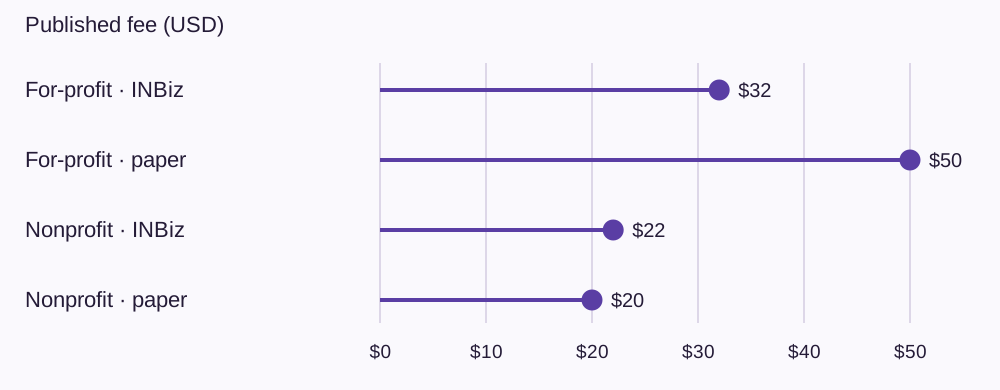
The nonprofit comparison is a useful reason to avoid copying a generic claim that online filing is always cheaper. Also keep service-provider charges separate from government charges. A third party may offer filing assistance, but its invoice should not be mistaken for the state’s mandatory fee.
For an enterprise budget, record the service purchased, entity type, filing method and payment date. If a team orders formal evidence, keep that cost distinct from both search access and the entity’s maintenance filings. Otherwise a per-company verification budget can become inflated by unrelated compliance spending.
What an overdue report means for supplier review
INBiz says there are no late fees for an overdue Business Entity Report, but failure to file can lead to administrative dissolution or revocation. Its guidance distinguishes past-due notices, pending action and completed action. Follow the deadline on the actual notice; do not turn that process into an automatic “dissolved on day 120” rule.
Record the registry’s precise wording before choosing an internal response. A past-due filing, a pending notice and a completed dissolution are materially different observations. None, on its own, establishes insolvency or fraud. Your commercial response should reflect the evidence, contractual requirements and the consequence of continuing the relationship.
If a supplier says the issue has been corrected, obtain current evidence and recheck. Retain both observations: the original exception and the later resolution. Record who accepted the explanation and which restriction, if any, was lifted. Overwriting the earlier result makes the eventual decision harder to reconstruct.
Reinstatement is a separate process. Current INBiz guidance directs eligible businesses through Department of Revenue clearance before the reinstatement application. It also says businesses dissolved or revoked for more than five years may now apply on paper. Older statements that five years is an absolute cutoff should not be reused as a current decision rule.
A worked example: a report date is not a monitoring policy
Consider a fictional supplier, Company A, registered in Indiana in September 2024. Its ordinary first-report cycle points to September 2026. Your analyst checks the displayed due date and filing history rather than assuming that today’s month proves either compliance or delinquency.
The contract is renewed in November. Even if the September report was filed, procurement still needs to evaluate any new evidence relevant to that renewal. A changed invoice entity, a newly supplied bank account or a discrepancy in signing authority warrants its own investigation. Completing a scheduled registry filing does not answer those questions.
This suggests two clocks in the operating process. The filing clock tracks the entity’s state obligation. The review clock tracks your need for current evidence. Store both dates, along with the time the source was checked. A system that stores only “last updated” cannot tell an auditor which event the date represents.
Chart 3. Evidence age grows between successful reviews
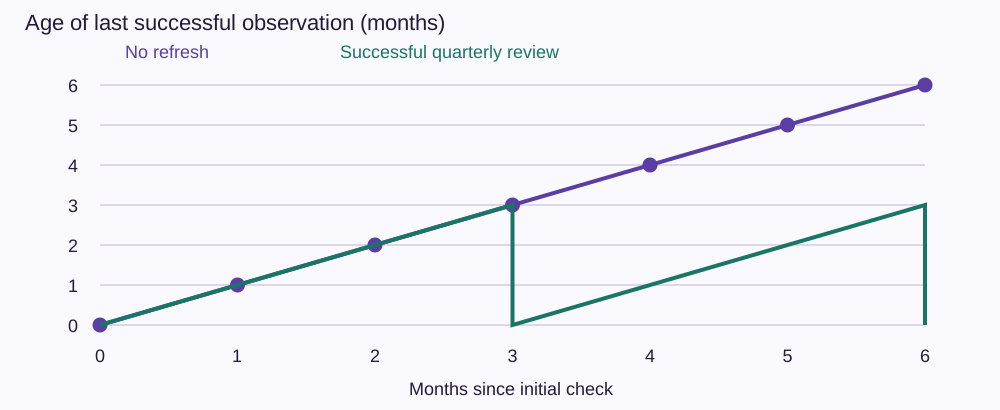
Choose the review interval from exposure and your ability to act on changes. A major supplier supporting a critical operation may justify different handling from an inactive record retained for historical accounting. The chart is not a prescribed review frequency. It shows why a two-year filing cycle should not automatically become a two-year evidence-refresh policy.
Build an exception queue that someone can close
Before automating INBiz business search results into a procurement platform, define the possible outcomes. A resolved identity with satisfactory registry evidence is different from a possible name match, a missing report date or an unresolved status. Keep the raw source value alongside your internal category so the mapping can be inspected.
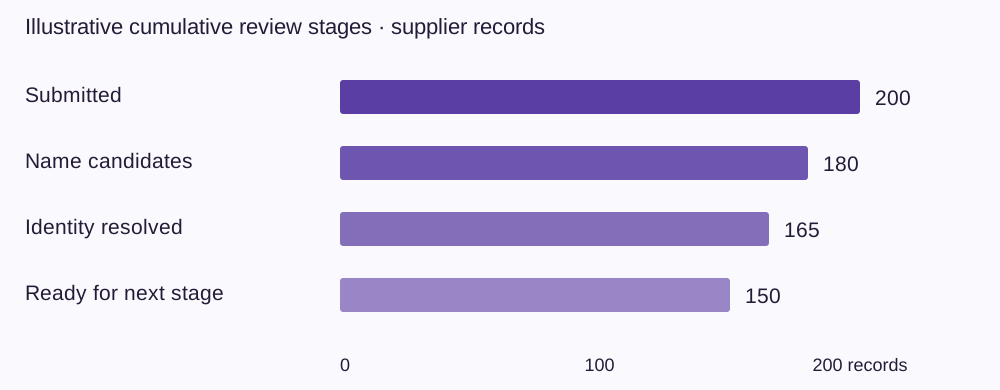
The example below starts with 200 fictional supplier submissions. Name review leaves 180 candidate records. Identifier and jurisdiction checks resolve 165 identities. Fifteen of those resolved records still require a standing or filing review, leaving 150 ready for the next stage. “Ready” means ready for further checks, not approved to transact.
Chart 4. A name match does not clear every check
Give each unresolved case an owner, a reason and the next evidence required. “Need exact registered name and Business ID” is actionable. “Needs verification” is not. Where the supplier has several registrations, link the relevant records while preserving their separate jurisdictional statuses.
Measure how many cases are resolved correctly and how long exceptions remain open. A high match rate can conceal incorrect matches if the system always returns its best guess. Include uncertain and rejected examples when reviewing a data integration, and make it possible for an analyst to reopen a decision.
Certificates, source records and API evaluation
Indiana’s information-request guidance explains what a Certificate of Existence certifies, including identifying information and whether the latest report has been filed. A long-form certificate additionally lists filed documents. The same service offers certificate validation. Check that a supplied certificate concerns the exact entity and relevant date; the presence of a seal does not resolve a different contracting name.
If a normal database search fails, the state also describes a due and diligent search of historic records. Use an appropriate escalation route where historical evidence matters. A single unsuccessful online query is a weak basis for concluding that an older entity never existed.
For API or bulk access, ask a provider to demonstrate the specific Indiana fields your workflow needs. Request a sample showing source identifiers, retrieval times, missing values and status changes. Ask what happens when the upstream source is unavailable and whether a previous observation is labelled as such. Do not assume a global field list means every field exists for every Indiana company.
Use Zephira’s data dictionary and field-availability guidance when defining acceptance criteria. For the wider process, review supplier and vendor onboarding. For counterparties with registrations elsewhere, the Secretary of State search guide provides a starting point for keeping jurisdictions separate.
The deliverable from a good Indiana search is a defensible entity record: the right company, the evidence checked, the remaining gaps and the person responsible for resolving them. That gives procurement and compliance teams something they can use in a decision and revisit when circumstances change.
Frequently asked questions
1. Where should I start an Indiana business entity search?
Use the official INBiz site, choose Search for a Record and then Business Entities. Review the candidates and open the Business ID. Match the registered party to your contract before interpreting the record as evidence about your supplier.
2. Is an Indiana business lookup free?
Official Indiana material describes free public search access. Filing a report, buying a bulk service and obtaining particular certificates are separate activities. Check which service you are selecting before authorising a payment.
3. Is the Business ID the same as an EIN?
No. Keep the Indiana registry identifier separate from the IRS-issued federal tax identifier. Label both with their issuing authority so a downstream system does not substitute one for the other.
4. When should I check the next Business Entity Report date?
Check it when you resolve the entity and again when your review process requires current evidence. Use the due date shown on the Business Details page rather than relying only on a date copied from an old supplier form.
5. Does no new report this year mean a report was missed?
Not necessarily. Indiana uses a two-year report cycle. Review the entity’s actual filing history and next due date before creating an exception. Absence of an annual filing is not enough to establish non-compliance.
6. Does the registered agent own the company?
Not necessarily. The agent is designated to receive legal notices and service of process. Ownership needs separate evidence. A shared agent or address should not, by itself, be treated as proof that businesses belong to the same group.
7. Does Active status prove the supplier is solvent?
No. Registry status does not establish available cash, ability to perform or capacity to repay debt. Record which question the status check answers and assess financial and other risks separately where your transaction requires them.
8. Is dissolution automatic 120 days after a missed report?
Do not apply a universal fixed countdown. INBiz distinguishes overdue reports, pending action and completed dissolution or revocation. Check the actual notice, its deadline and the current record before drawing a conclusion.
9. What if the supplier says a registry problem has been fixed?
Obtain current evidence, recheck and document the resolution. Keep the original exception and identify who accepted the correction. A supplier’s assurance should not silently overwrite an unresolved status in your system.
10. Can an API result replace the whole supplier review?
No. Define the checks your workflow requires and assess which of them the returned data supports. Preserve unresolved identity, ownership, standing and payment questions separately. A successful API response means data was returned, not that the supplier is approved.
Need Indiana evidence within a wider supplier portfolio?
Talk to Zephira about your jurisdictions, required fields, source evidence and delivery method. Define the pilot’s acceptance criteria before treating returned records as successful verifications.