Published in:
Blog
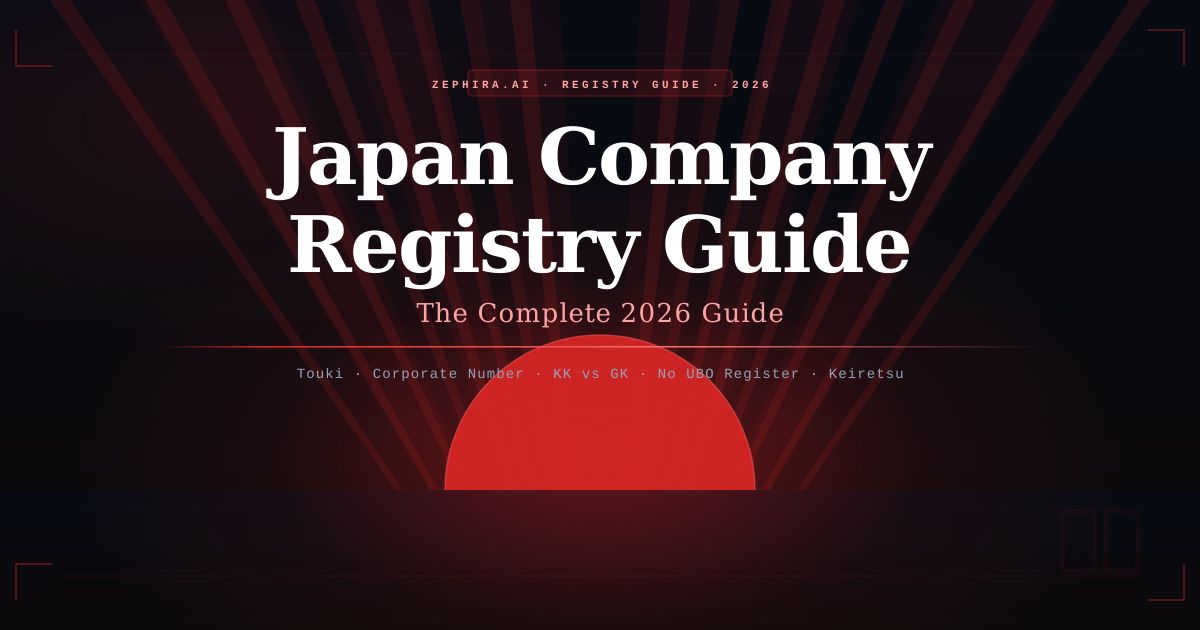
Japan Company Registry: The Complete Guide to KK, GK and Corporate Number
Japan is the world’s fourth-largest economy and home to over 3 million active companies. Every commercial entity must register with the Touki system, Japan’s Ministry of Justice commercial registry. The registry is public, accessible online, and contains confirmed legal details including company name, address, representative directors, and registered capital.
In practice, Japanese KYB is significantly harder than the registry suggests. Three structural features create real obstacles. First, no shareholder data is in the public registry — for any entity type. Second, Godo Kaisha (GK) companies have no public financial disclosure obligation, making private company financials largely invisible. Third, Japan has no public beneficial ownership register, with reforms still ongoing following FATF criticism in 2021. Add Japanese-only documentation and the complexity of keiretsu cross-shareholding structures, and Japan consistently requires more specialist input per entity than any major EU registry.
This guide covers everything compliance, data, and product teams need to work with Japanese company data in 2026 — from the Touki extract to the Corporate Number, from KK vs GK transparency differences to the keiretsu ownership problem.
| 3M+ Active companies | No UBO No public UBO register | No API No official free REST API | Japanese All documents Japanese-only |
Japan’s Registry Landscape in 2026
Japan’s corporate data is distributed across two primary systems that serve different purposes. Both are necessary for comprehensive company verification.
| System | Operator | What it holds | Access |
|---|---|---|---|
| Touki system (商業・法人登記) | Ministry of Justice / Legal Affairs Bureaus | Official commercial registry: company name, address, representative directors, capital, articles of incorporation, registration history. No shareholders. | Paid — ~¥330 online |
| Corporate Number (法人番号) | National Tax Agency (NTA) | 13-digit identifier for all corporations. Name, address, registration date, corporate type. Free API. | Free API |
| EDINET | Financial Services Agency (FSA) | Securities filings for listed companies only: annual reports, shareholder disclosures (5%+ threshold), quarterly reports. | Free — listed only |
| Beneficial Ownership List | Ministry of Justice | UBO declarations filed since Jan 2022. Not publicly searchable — available to financial institutions during CDD. | Not public |
Key identifiers
Corporate Number (法人番号) — 13-digit identifier from the NTA. Searchable free at houjin-bangou.nta.go.jp. Use this for bulk lookup and system integration. · Commercial Registration Number — 12-digit number used in the Touki system for certified document requests. Different from the Corporate Number. · Company seal (印鉛) — Japan’s registered company seal (hanko) acts as the official signature for corporate documents. The Seal Certificate (Inkan Shomeisho) certifies who holds the registered seal authority. Both are required for many formal transactions.
Entity Types: KK, GK and the Transparency Gap
Japan’s Companies Act defines four entity types. For KYB purposes, the most important distinction is between KK (which must publish financial statements) and GK (which does not).
| Entity | Japanese | Min. capital | Shareholders public? | Financials public? |
|---|---|---|---|---|
| KK — Kabushiki Kaisha (Joint-stock) | 株式会社 | ¥1 | No | Summary required (enforcement weak) |
| GK — Godo Kaisha (LLC) | 合同会社 | ¥1 | No | Not required |
| Gomei Kaisha (General partnership) | 合名会社 | None | Partners disclosed in registry | Not required |
| Goshi Kaisha (Limited partnership) | 合資会社 | None | General partners disclosed | Not required |
| YK — Yugen Kaisha (legacy) | 有限会社 | — | No | Not required |
| Foreign branch | 支店 | None | Parent entity disclosed | Parent obligations apply |
Chart
Japanese companies by entity type (est. 2024)
| KK | ~65% | |||
| Required to publish financial statements. No shareholders in registry. Can list on TSE. | ||||
| GK | ~26% | |||
| No financial disclosure obligation. Increasingly used by foreign investors and PE structures. | ||||
| YK (legacy) | ~6% | |||
| Frozen pre-2006. Cannot be newly registered. Convert to KK or GK to change structure. | ||||
| Other | ~3% | |||
| Gomei, Goshi, branches, investment partnerships. | ||||
91% of all Japanese companies (KK + GK) have no shareholders in the public registry. The GK segment — 26% of all companies — has no financial disclosure obligation whatsoever.
Why GK is the hardest entity type for KYB
Apple Japan, Amazon Japan, Goldman Sachs Japan, and many other large foreign subsidiaries operate as Godo Kaisha precisely because GK requires no public financial disclosure. For a KYB team onboarding a supplier or counterparty that is a GK, the only financial data available from official sources is: none. Directors and capital are in the registry. Financials require direct request or third-party credit bureau data.
What the Registry Contains
| Data type | Available? | Source & cost |
|---|---|---|
| Company name, legal form, status | Yes — free | Corporate Number search / Touki |
| Registered address | Yes | Corporate Number site (free) / Touki (~¥330) |
| Representative director(s) | Yes | Touki extract (~¥330–600) |
| Board of directors | Yes (KK only) | Touki extract |
| Registered capital | Yes | Touki extract |
| Articles of incorporation | Yes — certified copy | Legal Affairs Bureau — ~¥1,200+ |
| Shareholders | Not public | Shareholder registry held internally by company |
| Financial statements (KK) | Summary required, inconsistently filed | Gazette, EDINET (listed only) |
| Financial statements (GK) | Not required | Only via credit bureaus or direct request |
| Beneficial owners (UBO) | Not public | Ministry of Justice BO List — financial institutions only |
| Insolvency / dissolution | Yes | Registry status + Official Gazette (Kanpo) |
| Major shareholders (listed KK) | Yes — 5%+ threshold | EDINET — free — annual securities report |
Documents and Costs
Japan’s registry documents are all in Japanese. There is no official English-language version of any commercial registry document. All costs are in yen.
| Document | Japanese name | Cost | Use case |
|---|---|---|---|
| Corporate Number search | 法人番号検索 | Free | Basic identification, SIREN equivalent |
| Touki registry information (online view) | 砯記情報提供サービス | ~¥330 | Online view — name, address, directors, capital |
| Certified registry extract | 砯記事项#pped;明書 | ¥480–600 | KYB, bank account opening, visa, contracts |
| Seal certificate | 印鉛証明書 | ¥450 | Confirms representative director’s seal authority |
| Articles of incorporation | 定款 | ¥1,200+ | Corporate structure, share transfer restrictions |
| EDINET filing (listed only) | 有併識报告書 | Free | Full financials, major shareholders for listed KK |
| Teikoku Databank report | 御国データバンク | ¥3,000–30,000+ | Credit, financial data for private KK and GK |
April 2025 fee revision
The Ministry of Justice revised registry document fees in April 2025. The online Touki information service (砯記情報提供サービス) is now approximately ¥330 per company for online access — a non-certified view. Certified extracts (砯記事项諝明書) remain ¥480–600 depending on the method of application. These are among the lowest document fees of any G7 registry.
The No-Shareholder Problem
In every major EU jurisdiction, some version of shareholder data is in the public registry. In Japan, no shareholder information is disclosed in the commercial registry for any entity type. The shareholder registry (株假名簿, kabunushi meibo) is an internally maintained document that companies are required to keep but not required to make public.
For a listed KK, major shareholders holding 5% or more are disclosed in the annual securities report filed with EDINET — and the top 10 shareholders are also disclosed. Below 5%, nothing is public. For a private KK or GK, no shareholder information is accessible from any official public source.
What this means for KYB in practice
A private Japanese KK with ¥10 million in capital, 3 directors in the registry, and 10 years of operational history could be 100% owned by a single anonymous individual — and there is no official public source that would reveal this. The only options: (1) request the shareholder registry directly from the company; (2) obtain a credit bureau report that may include beneficial ownership data collected during banking relationships; (3) access the Ministry of Justice Beneficial Ownership List through a qualifying financial institution. There is no self-serve public route.
Japan and Beneficial Ownership — the Missing Register
Japan does not have a public beneficial ownership register. This is one of the most significant gaps in Japan’s AML/CFT framework and was explicitly criticised in FATF’s Fourth Round Mutual Evaluation Report (August 2021), which rated Japan as «Partially Compliant» on Recommendation 24 (beneficial ownership of legal persons).
In response, the Ministry of Justice introduced the Beneficial Ownership of Legal Persons List System in January 2022. Companies must include beneficial ownership declarations — natural persons holding more than 25% directly or indirectly — as part of their commercial registration procedures. This data is available to financial institutions conducting customer due diligence. It is not publicly searchable.
| Who | Access | Method |
|---|---|---|
| Competent authorities (NPA, FSA, prosecutors) | Full | Direct government system access |
| Financial institutions conducting CDD | During customer onboarding only | Ministry of Justice BO List — per-transaction |
| AML-obliged businesses (notaries, tax advisors) | Limited — CDD context only | Request to company directly |
| General public / foreign institutions | No access | No public route |
FATF reform status — FY2024–26 Action Plan
Japan’s Inter-Ministerial Council for AML/CFT Policy published the National AML/CFT/CPF Action Plan (FY2024–26) in April 2024. Reforms include strengthening beneficial ownership verification requirements, improving the corporate transparency framework under the Commercial Registration Act, and working toward meeting updated FATF Recommendation 24 standards ahead of the fifth round mutual evaluation. A central publicly searchable UBO register is not yet established and no firm timeline has been announced.
Cross-border ownership via Zavia.ai
For Japanese companies owned through holding structures — a GK owned by a Cayman LP, a KK owned through a Singapore HoldCo — tracing beneficial ownership requires connecting registry data from multiple jurisdictions. Zavia.ai maps ownership chains across 100+ registries worldwide, connecting the Japanese registry layer to upstream holding entities regardless of jurisdiction.
Japan Standard Industrial Classification (JSIC)
Japan uses the Japan Standard Industrial Classification (日本標準産業分類, JSIC) — a 4-digit industry code assigned by the government and recorded in tax and statistical systems. JSIC aligns broadly with ISIC Rev. 4 but has Japan-specific subdivisions. It is not recorded in the Touki commercial registry itself, but appears in the Corporate Number database (NTA) and statistical filings. For data pipelines doing sector classification on Japanese entities, JSIC is the primary code system — not NACE or SIC. The NTA Corporate Number API returns the JSIC-equivalent industry description for most entities.
Japan’s March Fiscal Year
Japan’s standard corporate fiscal year runs April to March. The majority of listed Japanese KK companies — including most large industrials, banks, and insurers — follow this April–March cycle. Annual securities reports (Yukashoken Hokokusho) are therefore due by late June each year. AGMs cluster in June. EDINET filing volumes peak in June–July. For compliance teams building monitoring schedules or account refresh cycles on Japanese entities, this means financial data is typically 3–4 months staler in Q1 (January–March) than at any other time of year. Not all companies follow the April–March cycle — companies can choose any month-end — but the majority do.
EDINET API and XBRL — Japan’s open data for listed companies
EDINET provides a free machine-readable API at api.edinet-fsa.go.jp. Listed company filings are available in structured XBRL format — meaning balance sheets, P&L statements, and segment data can be pulled programmatically without PDF parsing. The API is in Japanese but the data schema is well-documented. This is Japan’s closest equivalent to France’s Sirene API — but limited entirely to listed companies. Key endpoints: document list by date range, document metadata by EDINET code, and full XBRL filing download. Rate limits apply but are generous for research use. For private KK and all GK companies, the EDINET API returns nothing.
Why the Touki extract can be stale — the Shiho Shoshi role
Every change to a company’s Touki registration — a director appointment, address change, capital increase, representative director change — must be formally filed with the Legal Affairs Bureau within 2 weeks of the event. In practice, most companies use a Shiho Shoshi (司法書士士士士, judicial scrivener) — a licensed professional who handles registry filings. The Shiho Shoshi prepares documents, applies the company seal, and submits to the Bureau. Processing at the Bureau typically takes 3–7 business days. The result: a director change that occurred on 1 April may not appear in the Touki extract until 20 April or later. For time-sensitive KYB decisions — particularly director screening — always ask the company to confirm current directors directly and treat the Touki extract as a recent-history document rather than a real-time record.
The Keiretsu Ownership Problem
Even for listed Japanese companies — where major shareholders above 5% are publicly disclosed — identifying the ultimate beneficial owner is complicated by Japan’s legacy of keiretsu cross-shareholding. A keiretsu is a network of companies with mutual equity stakes and interlocking business relationships, typically centred around a major bank.
At their peak in 1988, cross-shareholdings represented more than half the value of the Japanese stock market. Following corporate governance reforms — particularly the Corporate Governance Code (2015) and Tokyo Stock Exchange pressure on companies to justify or unwind strategic holdings — the keiretsu has been unwinding. But it has not disappeared.
What keiretsu means for ownership analysis today
A listed KK with disclosed shareholders may show its top 10 holders as: Mitsubishi UFJ Financial Group (8.2%), Nippon Life Insurance (5.1%), Meiji Yasuda Life (4.8%), Toyota Motor (3.2%). These are all corporate entities in a cross-shareholding network. None of them is a natural person. Tracing through to an ultimate individual owner requires going through multiple layers of corporate registration — and for each Japanese corporate entity in the chain, the same shareholder opacity problem applies.
The keiretsu unwind is accelerating. Major Japanese insurers were ordered by the FSA in 2024 to accelerate the dissolution of strategic holdings following price-fixing allegations linked to cross-shareholding relationships. The four largest insurers alone held approximately ¥6.5 trillion (US$43 billion) in strategic shareholdings as of early 2024.
TSE reform — what it means for ownership transparency
In March 2023, the Tokyo Stock Exchange launched a reform campaign requiring companies — particularly those trading below book value (P/B ratio below 1.0) — to disclose concrete plans to improve capital efficiency. A key lever: unwinding strategic cross-shareholdings that generate poor returns and obscure ownership structures. By 2025, hundreds of listed companies had published cross-shareholding reduction plans. The practical effect for KYB: listed Japanese company ownership structures are becoming cleaner and more traceable year by year. A shareholder disclosure that showed three corporate cross-holders in 2020 may now show institutional and retail investors instead. Always pull the most recent EDINET annual report rather than relying on cached or older data.
Financial Data — Listed vs Private
Japan has a binary financial disclosure regime. The gap between listed and private companies is starker than any major EU registry.
| Company type | Financial disclosure | Source | Language |
|---|---|---|---|
| Listed KK (TSE) | Full — quarterly + annual | EDINET — free | Japanese (+ voluntary English) |
| Large unlisted KK (capital >¥500M or 500+ employees) | Summary balance sheet — gazette publication required | Kanpo (Official Gazette) or directly | Japanese only |
| Small/medium unlisted KK | Summary required but enforcement weak | Credit bureau or direct | Japanese only |
| GK (any size) | None required | Credit bureau or direct only | N/A |
| YK (legacy) | None required | Credit bureau or direct only | N/A |
Teikoku Databank and Tokyo Shoko Research
Japan’s two major credit bureaus — Teikoku Databank (TDB) and Tokyo Shoko Research (TSR) — are the primary sources for private company financial data. Both collect financial information from banking relationships and direct company submissions. TDB and TSR reports typically include: estimated turnover, employee headcount, credit scores, payment history, key executives, and in some cases partial ownership data. Reports cost ¥3,000–30,000+ depending on depth. All reports are in Japanese.
Japan’s Insolvency Framework
Japan has three primary insolvency procedures, governed by separate statutes. Unlike France (BODACC) or Spain (BORME), there is no structured free machine-readable gazette for insolvency events. The Official Gazette (官园, Kanpo) at kanpou.npb.go.jp is the only official publication source — free, but Japanese-only, unstructured, and not designed for bulk monitoring.
| Procedure | Japanese | What it means | Signal source |
|---|---|---|---|
| Civil Rehabilitation | 民事再生手続 | Primary rescue procedure — debtor remains in control, proposes repayment plan to creditors. Most common for SMEs. | Kanpo + Touki status change |
| Corporate Reorganisation | 会社更生手続 | Court-supervised restructuring for large companies. Management replaced by trustee. Used for major corporate failures. | Kanpo + EDINET (listed) |
| Bankruptcy | 硲獓手続 | Liquidation. Assets sold, company dissolved. Filed by company or creditor. | Kanpo + Touki dissolution notice |
| Special Liquidation | 特別清算 | Simplified court-supervised liquidation for companies already in voluntary dissolution. | Touki status |
| Out-of-court workout | 稿外整理 | Private creditor negotiation — no public filing. Completely invisible from any official source. | None |
The Kanpo problem — no structured insolvency feed
The Official Gazette at kanpou.npb.go.jp publishes insolvency openings, dissolution notices, and liquidation orders. It is free and updated daily. However: it is entirely in Japanese, published as PDF pages rather than structured data, and requires knowing which company to search for in advance. There is no bulk download, no API, and no machine-readable feed. For portfolio monitoring of Japanese entities, a third-party provider that parses and structures Kanpo data is required. This is the single biggest operational gap in Japanese KYB compared to EU registries.
The KYB Workflow for a Japanese Company
Chart
Effort required by data source
Bar length = effort · colour = difficulty
| Corporate Number (NTA) | Free · instant | |||
| Touki extract (online) | ¥330 · 10 min | |||
| EDINET (listed only) | Free · listed only | |||
| Credit bureau (TDB/TSR) | ¥3k–30k+ | |||
| Shareholders (private) | Specialist | |||
| UBO / beneficial owner | No public route | |||
|
|
|
Step-by-step
1 |
Corporate Number lookup — free, instant houjin-bangou.nta.go.jp or the English version. Search by company name. Returns the 13-digit Corporate Number, registered name, address, entity type, and registration date. Use this as your primary identifier. The API allows bulk lookup. |
2 |
Touki extract — ~¥330 online www1.touki.or.jp — online view. Returns representative directors, registered capital, articles of incorporation summary, and registration history. All in Japanese. This is the primary KYB document — the equivalent of the Kbis in France or the Nota Informativa in Spain. |
3 |
For listed KK: EDINET review — free edinet.fsa.go.jp — search by company name or securities code. Retrieve the latest Yukashoken Hokokusho (annual securities report). Contains full audited financials, top 10 shareholders, and major shareholder disclosures (5%+). In Japanese, with some English voluntary reports available for large companies. |
4 |
For private KK/GK: credit bureau report Teikoku Databank (tdb.co.jp) or Tokyo Shoko Research (tsrdata.co.jp). Order a company report — ¥3,000–30,000 depending on depth. Contains estimated financials, employee count, credit score, and in many cases partial shareholder data collected through banking relationships. Japanese only. |
5 |
Shareholder / UBO identification For private companies: direct request to the company, financial institution channels, or specialist provider. For listed companies: EDINET 5%+ disclosures. There is no self-serve public route for UBO data on any private Japanese entity. |
6 |
Translation and screening All registry documents are in Japanese. Translation is required before names can be screened against sanctions lists — Japanese-to-English transliteration can introduce variations (e.g. Tanaka Takeshi vs Takeishi Tanaka). Use a provider with built-in Japanese name normalisation. Screen all identified directors and shareholders against relevant sanctions lists and PEP databases. |
Branch Office vs Subsidiary in Japan
Foreign companies operating in Japan can choose between three structures, each with different registry implications. The Touki system records all three, but the data available and the KYB approach differs significantly.
| Structure | Legal personality | Registry record | Financial disclosure | KYB approach |
|---|---|---|---|---|
| KK / GK subsidiary | Separate Japanese entity | Full Touki record — directors, capital | KK: required. GK: none. | Treat as standalone Japanese company |
| Branch office (据点) | Extension of foreign parent | Touki record links to foreign parent registration number | Parent obligations apply | Look up parent entity in its home registry |
| Representative office | No legal personality | Not registered in Touki | None | Verify parent entity only; rep office cannot contract |
Branch KYB — the key step most teams miss
A Japanese branch of a foreign company appears in the Touki system with a registration record showing the branch address and representative in Japan. But the legal entity behind it is the foreign parent — not a Japanese company. The Touki record for the branch will show the parent’s country of incorporation and registration number. Always pull the parent’s registry record from the home jurisdiction. A UK parent will have a Companies House record; a US parent will have a state-level incorporation record. The Japanese branch record alone is insufficient for KYB.
Common Mistakes
1. Treating the Touki extract as a complete KYB document
The Touki extract confirms that a company exists and who its representative director is. It does not identify shareholders, financial condition, or ultimate beneficial owner. Using the Touki extract alone as the basis for a KYB decision is comparable to using only an address confirmation — it verifies existence, nothing more.
2. Confusing Corporate Number and commercial registration number
These are two different identifiers. The 13-digit Corporate Number is from the NTA and is searchable free. The 12-digit commercial registration number is used in the Touki system for document requests. Both are needed. Systems that store only one create gaps.
3. Assuming GK means small company
Apple Japan GK, Amazon Japan GK, Goldman Sachs Japan GK, Costco Japan GK — major multinationals use GK precisely because it has no financial disclosure obligation. A GK counterparty with no public financial data is not necessarily a risk — it may be a significant foreign subsidiary. Always identify the parent company and review at group level.
4. Ignoring Japanese name transliteration variants
Japanese names have multiple romanisation systems (Hepburn, Nihon-shiki, Kunrei-shiki) and the romanisation of the same name can vary between documents. Yamada Taro may appear as Yamada Taro, Yamada Taroh, or Yamada Tarou. Screening without fuzzy matching for Japanese name variants produces false negatives.
5. Not checking for dissolved YK entities
Yugen Kaisha (YK) entities cannot be newly registered since 2006 but existing YKs continue to operate. Some YKs have not updated their registry since the Companies Act revision and may show outdated director information. YKs that wish to change their corporate structure must convert to KK or GK — conversion triggers a fresh registration and provides a more current record.
6. Underestimating the keiretsu layer
For listed Japanese companies, the disclosed major shareholders are often themselves Japanese corporations in a cross-shareholding network. A shareholder ownership graph of a major listed KK may require resolving 4–6 additional layers of Japanese corporate entities before reaching a natural person. Each layer requires its own registry lookup and potentially its own credit bureau check.
Regulatory Timeline
| 2006 | New Companies Act — GK introducedGodo Kaisha created as Japan’s LLC equivalent. YK registration frozen. GK has no financial disclosure obligation from inception. |
| 2015 | Corporate Number system launchedNTA assigns 13-digit Corporate Numbers to all corporations. Free public API at houjin-bangou.nta.go.jp. |
| Aug 2021 | FATF Mutual Evaluation — Japan criticised on UBOFATF rates Japan «Partially Compliant» on Recommendation 24. Criticises lack of central BO register and weak enforcement. Inter-Ministerial Council for AML/CFT established. |
| Jan 2022 | Beneficial Ownership List System — not publicMinistry of Justice introduces BO declarations via commercial registration. Available to financial institutions during CDD only. Not publicly searchable. |
| Apr 2024 | National AML/CFT Action Plan FY2024–26Commits to strengthening beneficial ownership framework ahead of FATF fifth round evaluation. No firm timeline for public UBO register. |
| 2025–26 | FATF fifth round — Japan under reviewJapan’s fifth round FATF mutual evaluation expected. Pressure to establish more accessible beneficial ownership infrastructure. Outcome will determine pace of further reform. |
Japan vs Global Registries
Chart
Registry transparency — global comparison
Composite: API · shareholder access · UBO access · financial data · language
| 🇬🇧 UK | 9.0 / 10 | |||
| Free API · all shareholders public · PSC register · English | ||||
| 🇫🇷 France | 7.0 / 10 | |||
| Free Sirene + INPI API · SARL shareholders public · UBO restricted | ||||
| 🇩🇪 Germany | 5.5 / 10 | |||
| Free access · no API · GmbH shareholders partially public · UBO restricted | ||||
| 🇸🇬 Singapore | 5.0 / 10 | |||
| Paid ACRA API · RORC UBO internally held · English | ||||
| 🇯🇵 Japan | 2.5 / 10 | |||
| No API · no shareholders public · no UBO register · Japanese only · GK financial opacity | ||||
| Country | Free API | Shareholders public? | UBO register | Financials (private) | Language |
|---|---|---|---|---|---|
| 🇯🇵 Japan | NTA only (basic) | None | None (public) | GK: none. KK: weak | Japanese only |
| 🇬🇧 UK | Yes — full REST | Yes — all changes | PSC — public | All companies file | English |
| 🇫🇷 France | Yes — Sirene+INPI | SARL yes / SAS no | Restricted Jul 2024 | Partial (confidentiality opt) | French |
| 🇩🇪 Germany | No | GmbH first layer | Restricted (ECJ) | Required, not always filed | German |
| 🇸🇬 Singapore | Paid ACRA | Via ACRA search | RORC — internal | Partial | English |
How Zephira Solves the Japanese Data Problem
Zephira connects directly to the Touki system, NTA Corporate Number database, and EDINET, normalises Japanese-language output into a unified English-language entity model, and delivers via REST API or bulk file. For the ownership and financial gaps that official sources cannot fill, Zephira supplements with structured data from Japanese credit bureau partnerships and corporate linkage analysis across the full ownership chain.
|
🇯🇵
Japanese translation
All registry documents translated to English. Japanese name normalisation to handle romanisation variants for screening.
|
📊
GK financial coverage
Where GK accounts are unavailable, Zephira appends revenue estimates, employee bands, and credit signals from bureau partnerships.
|
🔗
Keiretsu chain resolution
Corporate linkage analysis across Japanese cross-shareholding networks. Connected to 150+ jurisdictions for upstream parent resolution.
|
|
⚡
API or bulk
REST API · 99.9% SLA · no rate limits. Or bulk via S3 or SFTP. Same unified data model.
|
🏛
Government-sourced
Direct from Touki, NTA, and EDINET. No third-party resale chain. Updated as filings occur at source.
|
🔦
Dissolution monitoring
Automated monitoring of registration changes — dissolution notices, director changes, capital amendments — with real-time alerts.
|
ZEPHIRA.AI · GLOBAL INTELLIGENCE LAYER
Beyond Japan: Global Registries, Corporate Linkage & Enrichment
The Touki extract tells you a company exists and who represents it. It does not tell you who owns it, what it earns, or whether the parent entity in Singapore or Cayman is clean. Zephira connects directly to 150+ government registries worldwide and traces ownership chains at each layer — through the Japanese entity and all the way up the structure.
All Japanese-language registry output is normalised and delivered in English. GK financial gaps are supplemented with bureau-sourced estimates. Available via REST API or bulk delivery via S3 or SFTP.
See the full data model →
Related Country Guides
|
🇬🇧
United Kingdom
Companies House: The Complete Guide
Free API, all shareholders public, PSC register, English.
|
🇫🇷
France
RCS, INPI & Sirene: The Complete Guide
Best-in-EU open data, free APIs, SAS transparency gap.
|
🇪🇸
Spain
Registro Mercantil: The Complete Guide
No API, S.L. share transfer gap, burdensome UBO access.
|
Frequently Asked Questions
What is the Touki system in Japan?
▼
Japan’s commercial and corporate registry, operated by the Ministry of Justice through its Legal Affairs Bureaus. Every company under the Companies Act must register. The registry is public and accessible online at www1.touki.or.jp. Confirms legal name, address, representative directors, capital, and registration history. No shareholders. All documents in Japanese.
What is the Corporate Number (Houjin Bangou)?
▼
A 13-digit identifier assigned by the National Tax Agency (NTA) to every corporation in Japan. Introduced in 2015. Searchable free at houjin-bangou.nta.go.jp. Distinct from the 12-digit commercial registration number used in the Touki system. Use the Corporate Number as the primary entity identifier for system integration.
What is a Kabushiki Kaisha (KK)?
▼
Japan’s most common and prestigious company form — a joint-stock company, equivalent to a corporation. Minimum capital ¥1. Required to publish financial statements annually. Directors appointed for 2-year terms (up to 10 years for non-public companies). The only entity type that can pursue a public listing on the Tokyo Stock Exchange.
What is a Godo Kaisha (GK) and why does it matter for KYB?
▼
Japan’s LLC equivalent, introduced in 2006. Minimum capital ¥1. GK companies are not required to publish financial statements — their accounts are private. GK is increasingly used by foreign investors and PE structures precisely because of this reduced disclosure. Apple Japan, Amazon Japan, and Goldman Sachs Japan are all GKs.
Are shareholders publicly available for Japanese companies?
▼
No. The commercial registry does not disclose shareholders for any entity type. The shareholder registry (kabunushi meibo) is internally maintained. For listed KK companies, major shareholders holding 5%+ are disclosed via EDINET. For private KK and GK, no shareholder data is accessible from any official public source.
Does Japan have a public UBO register?
▼
No. Japan does not have a publicly searchable beneficial ownership register. The Ministry of Justice introduced a Beneficial Ownership List System in January 2022, but this is accessible only by financial institutions during customer due diligence — not the public. Japan was criticised by FATF in 2021 for this gap. The FY2024–26 AML Action Plan commits to further reform, but no public register has been established.
What is the difference between the Touki system and the Corporate Number?
▼
The Touki system (Ministry of Justice) is the legal commercial registry holding official registration records. The Corporate Number system (NTA) is the tax identifier overlay. They use different numbers — 12-digit Touki registration number vs 13-digit NTA Corporate Number. Both are needed: Corporate Number for bulk identification, Touki for certified legal documents.
What financial data is publicly available for Japanese companies?
▼
Listed KK: full financials via EDINET (free). Large unlisted KK: summary balance sheet publication required but enforcement is inconsistent. Small/medium unlisted KK: minimal, credit bureau only. GK (any size): no public financial disclosure obligation. For private company financials, Teikoku Databank (TDB) or Tokyo Shoko Research (TSR) credit reports are the primary source — cost ¥3,000–30,000+, Japanese only.
What is EDINET?
▼
Japan’s FSA-operated disclosure system for listed companies, at edinet.fsa.go.jp. Free. Contains Yukashoken Hokokusho (annual securities reports) with full audited financials, quarterly reports, major shareholder disclosures (5%+), and shareholder meeting notices. In Japanese, with voluntary English versions available for major international companies.
What is the full KYB workflow for a Japanese company?
▼
(1) Corporate Number lookup at houjin-bangou.nta.go.jp — free; (2) Touki online registry extract — ~¥330; (3) For listed KK: EDINET review — free; (4) Credit bureau report (TDB/TSR) for private company financials; (5) Direct company request or financial institution channels for shareholder/UBO data — no public route; (6) Japanese name normalisation and sanctions/PEP screening for all identified directors.
Get structured Japanese company data via API
Touki, Corporate Number, EDINET — normalised, translated, English output.
|
⚡
REST API
Real-time · 99.9% SLA · No rate limits · JSON
|
📦
Bulk Delivery
S3 or SFTP · Scheduled · Data warehouse ready
|