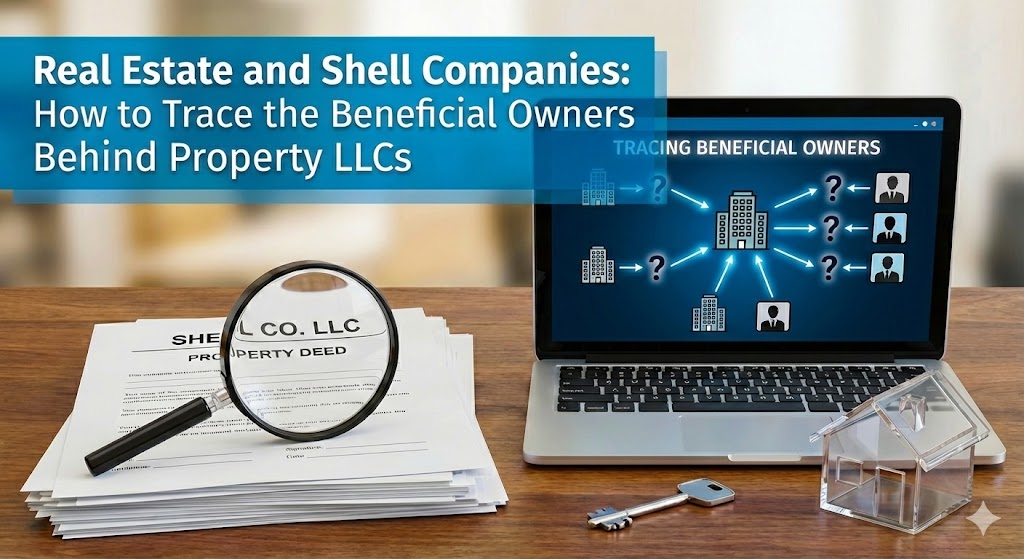
Who Really Owns That Property? How to Trace Real Estate LLC Ownership in 2026
Who Really Owns That Property?
How to trace real estate LLC ownership in 2026 — using public registries, APIs, and the workarounds nobody talks about.
A three-bedroom house in Miami sells for $4.2 million. All cash. The buyer on the deed: "Oceanview Capital Holdings LLC."
Who's behind it?
Whether you're a compliance analyst screening counterparties, a lender underwriting a CRE loan, an investor doing due diligence, or a journalist following the money — the question is the same. And in 2026, answering it requires a specific set of tools that most people don't know about.
At Zephira, we cover the data infrastructure behind corporate transparency — the registries, the APIs, and the gaps between them. This is the guide we wished existed when we started.
We'll walk through the exact process. Start with a property address. End with a natural person. And we'll be honest about where the trail goes cold.
What Changed in 2025
And why most guides on this topic are now wrong
March 2025 — FinCEN gutted the Corporate Transparency Act. An interim final rule exempted all U.S.-formed entities from beneficial ownership reporting. Only foreign-formed entities registered in the U.S. must file. A Delaware LLC that owns a $50 million tower? No filing required.
March 1, 2026 — FinCEN's Residential Real Estate Rule went live. Settlement agents must report all-cash residential transfers to entities or trusts. But it only covers residential, only non-financed deals, and reports aren't publicly searchable.
January 2026 — New York's LLC Transparency Act took effect, barely. Governor Hochul vetoed the expansion bill. It only covers foreign-formed LLCs registered in New York.
The bottom line: For domestic LLCs holding U.S. real estate — the vast majority of entity-owned property — no database will hand you the beneficial owner. You build the chain yourself.
Find the Entity on the Deed
Every property has an owner of record at the county assessor. That's your starting point. Search by address on the county website, or use aggregated property APIs (ATTOM, CoreLogic, First American) for bulk lookups.
You're pulling four things: the entity name, the mailing address, the transfer date and price, and the grantor — who sold or transferred the property into this entity.
The clue most people miss: the owner mailing address. "1209 Orange Street, Wilmington, DE" is the Corporation Trust Company — registered agent for 285,000+ entities. That address tells you the LLC is Delaware-formed. It won't tell you who owns it. But it tells you which state registry to search next.
Look Up the Entity Where It Was Formed
Every LLC in the U.S. is registered with a state government. These registries are free and public. What they reveal depends entirely on which state.
Florida — sunbiz.org
Officers, managers, members by name and address. You can search by officer name to find every entity a person is connected to.
CA · NV · NY
California lists CEO/CFO/Secretary and LLC managers. Nevada shows officers and directors. New York lists agents and managers in formation docs.
Delaware
The most popular state for real estate LLCs. Discloses only: name, formation date, status, registered agent. No members. No managers. Dead end.
Wyoming · New Mexico
Registered agent and formation date only. No ownership or management information disclosed.
Querying Registries with Code
Most states lack APIs. The OpenCorporates API aggregates 140+ registries. Free tier: basic entity data. Paid: officers and filings.
import requests

def search_entity(name, jurisdiction):
    # jurisdiction: 'us_fl' for Florida, 'us_de' for Delaware
    resp = requests.get(
        "https://api.opencorporates.com/v0.4/companies/search",
        params={"q": name, "jurisdiction_code": jurisdiction}
    )
    companies = resp.json()["results"]["companies"]
    if not companies:
        return None
    co = companies[0]["company"]
    return {
        "name": co["name"],
        "status": co.get("current_status"),
        "agent": co.get("agent_name"),
        "url": co.get("opencorporates_url")
    }
For UK entities, the Companies House API is free and far more powerful (Step 4). For broader international coverage, commercial providers like Bureau van Dijk, Global Database, and Moody's offer ownership data across hundreds of jurisdictions.
Walk the Ownership Chain
The registry shows the manager is another LLC — not a person. So you look up that LLC. And repeat. Until you reach a name or hit a wall.
Here's what a successful trace looks like:
Four layers. Three jurisdictions. Two countries. One person.
Now here's the more common outcome:
This is the most common result. The chain hits Delaware and stops. But there are side doors — that's Step 5.
First: what happens when the chain crosses international borders.
Foreign Registries That Give You More
If the chain leads to a foreign entity, you might be in luck. Several countries publish far more than any U.S. state.
UK Companies House — The Gold Standard
The UK requires every company to disclose Persons with Significant Control — anyone with 25%+ ownership. Free API. Full name, nationality, country of residence, nature of control.
def get_uk_owners(company_number, api_key):
    # Free key: developer.company-information.service.gov.uk
    resp = requests.get(
        f"https://api.company-information.service.gov.uk"
        f"/company/{company_number}"
        f"/persons-with-significant-control",
        auth=(api_key, "")
    )
    return [
        {"name": p["name"],
         "nationality": p.get("nationality"),
         "control": p.get("natures_of_control", [])}
        for p in resp.json().get("items", [])
    ]
No U.S. state gives you name, nationality, and ownership percentage for free. The UK does.
Other Countries with UBO Data
France — via the INPI. Luxembourg, Netherlands, Austria — UBO registers for entities with "legitimate interest." Canada — federal beneficial ownership registry since 2024.
Opaque Jurisdictions
BVI, Cayman, Panama — ownership data held by authorities only. Public data won't get you there.
Workarounds That Actually Work
This is what most guides skip. Here are five side doors when the state registry gives you nothing.
The Delaware Dead End — Five Ways Around It
Check other state registrations
If the Delaware LLC operates in Florida, it registers as a foreign entity. Florida's foreign registration often requires a manager name.
Search UCC filings
Any entity with secured financing has a public UCC-1 filing that names the debtor with more detail than the corporate registry.
Pull litigation records
Lawsuits name real principals. Operating agreements get attached as exhibits. Search PACER for federal cases.
Review deed history
Who transferred the property into the LLC? The grantor may be a natural person. Mortgage docs may name personal guarantors.
Cross-reference annual reports
Some Delaware LLCs file reports in disclosure-friendly states. California and Florida filings often reveal names invisible through Delaware.
Nominee Directors
You traced the chain to a name — but it appears on 300+ unrelated entities. That's a professional nominee. Search their name across registries. If they show up on dozens of unrelated companies across multiple countries, they're paid to be the legal front. The actual controller's name is in the operating agreement — a private document.
Series LLCs
Deed says "XYZ Holdings LLC - Series 14" but only the parent is registered. Strip the series designation. Look up the parent. Its officers control all sub-series.
Land Trusts
Not business entities. Don't appear in registries. Trustee may be on the deed. Property tax records sometimes list a contact. But trust agreements are private — you usually need cooperation or legal process.
The Honest Summary
What's actually achievable — scenario by scenario
The question isn't whether your method is perfect. It's whether you know where it fails.
The Decision Tree
The full process, as a series of questions
Doing This at Scale
The manual process works for one investigation. For a portfolio, a lending pipeline, or a CRE analytics platform — you need three data layers:
Property data at scale — aggregated county records via ATTOM, CoreLogic, or First American. Multi-jurisdiction registry data — officer and shareholder information across U.S. and international registries. Ownership graph traversal — walking chains programmatically until you reach a natural person or a documented dead end.
No single provider covers everything. The right approach combines public data, commercial data, and investigative techniques — and stays honest about where each one runs out.
Frequently Asked Questions
How do I find out who owns a property held in an LLC?
Start at the county assessor to get the entity name. Search the state registry where it was formed. If the manager is another entity, trace that one. For Delaware and Wyoming, use UCC filings, litigation records, and other-state registrations.
Does the Corporate Transparency Act require LLCs to disclose owners?
Not for domestic entities. FinCEN's March 2025 rule exempted all U.S.-formed companies. Only foreign entities registered in the U.S. must file.
What is FinCEN's Residential Real Estate Rule?
Effective March 1, 2026, it requires reporting of all-cash residential transfers to entities or trusts. Covers 1-4 family homes nationwide. Reports aren't publicly searchable.
Why is it so hard to find the owner of a Delaware LLC?
Delaware doesn't require public disclosure of members, managers, or officers. You only get entity name, formation date, and registered agent. Workarounds: foreign state registrations, UCC filings, litigation, deed history.
Which U.S. states disclose LLC ownership publicly?
Florida is the best — full officer disclosure via Sunbiz. California, New York, and Nevada also disclose varying data. Delaware, Wyoming, and New Mexico reveal very little.
Can the UK Companies House API help with U.S. property tracing?
Yes, if the chain includes a UK entity. The free API provides name, nationality, residence, and control percentage for 25%+ owners.
How do I spot a nominee director?
Search their name across registries. If they appear on dozens of unrelated entities in multiple jurisdictions, they're a nominee. Their address usually matches a registered agent firm.
What's a Series LLC and how do I trace through it?
A Series LLC creates sub-series holding individual properties. They may not be separately registered. Strip the series designation from the deed name and look up the parent entity.
Can I trace ownership through a land trust?
Rarely. Land trusts aren't business entities. The trustee may appear on the deed. Trust agreements are private. You usually need cooperation or a legal process.
What tools trace LLC ownership programmatically?
OpenCorporates API (140+ registries). UK Companies House API (free PSC data). Commercial: Bureau van Dijk, Global Database, Moody's. Property data: ATTOM, CoreLogic, First American.
Zephira gives you real-time access to verified company records, ownership structures, and UBO data from official registries in 150+ countries — through a single API.
REQUEST A DEMO