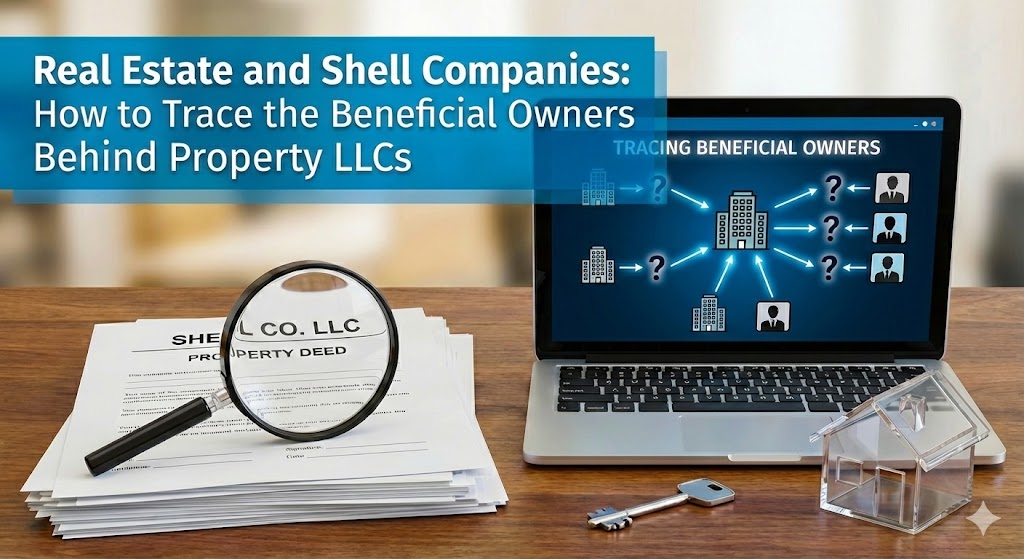
Real Estate and Shell Companies: How to Trace the Beneficial Owners Behind Property LLCs
The $2.3 Billion Blind Spot
More than $2.3 billion was laundered through US real estate over a five-year period, according to Global Financial Integrity. That figure only counts cases that were detected, investigated, and reported.
The real number is significantly higher.
Real estate has always been attractive to money launderers. The transactions are large. The assets are stable. And until very recently, the rules around disclosure were almost nonexistent.
The mechanism is straightforward. A buyer forms an LLC — in Delaware, Wyoming, Nevada, or any state where beneficial ownership disclosure is not required. The LLC purchases the property with cash. No mortgage means no bank conducting anti-money laundering checks. No beneficial ownership registry means no public record of who is behind the entity. The property sits in the name of the LLC, and the actual owner is invisible.
This is not a theoretical risk. When FinCEN began requiring title insurance companies to report all-cash purchases by shell companies through Geographic Targeting Orders (GTOs), they found that up to 30% of the flagged transactions involved a beneficial owner or representative who had previously been the subject of a suspicious activity report. Nearly half of all residential real estate purchases above $5 million in the US were made by shell companies, according to data from First American Data Tree cited by the New York Times.
Manhattan alone tells the story. Reinvent Albany found that 37% of all properties in Manhattan are owned by LLCs — five times the state average. Behind those entities: foreign government officials suspected of corruption, businesspeople accused of fraud, and individuals whose source of funds would not survive basic scrutiny.
The regulatory response has arrived. FinCEN’s Residential Real Estate Rule takes effect March 1, 2026. The UK’s Register of Overseas Entities has been live since 2022. New York’s LLC Transparency Act became effective January 1, 2026. The EU’s Anti-Money Laundering Directives keep expanding coverage.
For compliance teams, title companies, settlement agents, and anyone involved in real estate transactions with legal entities, the question is no longer whether to identify beneficial owners — it’s how.
This article walks through the regulatory landscape, the practical challenges of tracing ownership through layered LLC structures, and the tools that make it possible at scale.
Why Real Estate Is the World’s Favorite Laundromat
Money laundering follows a simple three-stage process: placement (getting dirty money into the financial system), layering (moving it through transactions to obscure its origin), and integration (making it look clean). Real estate can accomplish all three stages in a single transaction.
Here’s why the sector is uniquely vulnerable:
- Large value, low scrutiny. A single property purchase can move millions without triggering the same transaction monitoring that banks apply to wire transfers. Until the RRE Rule, all-cash real estate transactions to LLCs had no federal reporting requirement at all.
- Asset stability. Real estate holds value. It can be rented to generate income. It can be sold later through legitimate channels. It doesn’t depreciate the way a luxury car does. For someone trying to park illicit funds, a $4 million condo in Miami is a better store of value than a $4 million wire transfer sitting in a bank account drawing attention.
- LLC opacity. In most US states, an LLC can be formed without disclosing who owns it. The cost is minimal — often under $500. The process takes days. And the resulting entity can hold property indefinitely without any public record of the individuals behind it.
- Layered ownership. A single property can be held by an LLC that is owned by another LLC, that is managed by a trust, that was formed in a jurisdiction with strict secrecy laws. Each layer adds distance between the property and the person who controls it. FinCEN’s own advisory describes these structures as “matryoshka dolls” — nested entities where the smallest doll is empty.
- Professional enablers. Global Financial Integrity found that in 82% of US real estate money laundering cases, the buyer used a legal entity to mask ownership. But the structures don’t build themselves. Attorneys, real estate agents, and company formation agents all play roles — sometimes knowingly, sometimes through willful blindness.
The 1MDB scandal showed this at scale. Billions of dollars were diverted from Malaysia’s sovereign wealth fund and funneled through shell companies into luxury real estate in New York and Los Angeles — properties worth over $150 million. The Danske Bank scandal involved $230 billion laundered through networks of shell companies. The Panama Papers and Pandora Papers exposed how the practice was endemic among global elites.
These are the headline cases. The routine cases — the ones that don’t make the front page of the New York Times — happen every day.
The Regulatory Stack: What’s Changed and What’s Coming
The regulatory environment for real estate beneficial ownership has shifted dramatically in the past 24 months. Here’s the current landscape.
FinCEN Residential Real Estate Rule (US)
| Detail | Requirement |
|---|---|
| Effective date | March 1, 2026 |
| Scope | All non-financed (all-cash) transfers of residential real estate to legal entities or trusts — nationwide |
| Who reports | Settlement agents, title insurance agents, escrow agents, closing attorneys (determined by a reporting cascade) |
| What’s reported | Transferor, transferee entity/trust, beneficial owners of the transferee, property details, transaction details, payment method |
| Beneficial owner definition | Any individual who directly or indirectly exercises “substantial control” over the entity OR owns/controls at least 25% of ownership interests (consistent with CTA definitions) |
| Filing deadline | By the last day of the month following the month in which closing occurred, or 30 calendar days after closing — whichever is later |
| Penalties | Civil: up to $1,394 per negligent violation; up to $108,489 for pattern of negligence. Criminal: up to 5 years imprisonment and/or $250,000 fine for willful violations |
| Key exemptions | Transfers to individuals (not entities), financed transactions (with bank mortgage), transfers incident to divorce, court-supervised transfers, transfers to bankruptcy estates |
This is a fundamental shift. Before the RRE Rule, FinCEN’s approach to real estate transparency was limited to Geographic Targeting Orders — temporary reporting requirements covering specific high-value markets (originally Manhattan and Miami-Dade County, later expanded to 13 metropolitan areas). The GTOs had price thresholds and geographic limits.
The RRE Rule eliminates those limits. It applies nationwide. It covers all price points. And it applies to every non-financed transaction where the buyer is a legal entity or trust — not just the luxury market.
Litigation challenging the rule is pending, but a federal magistrate judge has recommended summary judgment in FinCEN’s favor, finding the rule legitimate under the Bank Secrecy Act.
UK Register of Overseas Entities (ROE)
| Detail | Requirement |
|---|---|
| Effective since | August 1, 2022 |
| Scope | Any overseas entity (non-UK company, partnership, or legal person) that owns or wants to acquire UK real estate |
| Registration requirement | Must register with Companies House and disclose beneficial owners before buying, selling, or transferring property |
| Beneficial owner threshold | >25% shares, >25% voting rights, right to appoint/remove majority of directors, or significant influence/control |
| Update frequency | Annual update statements required |
| 2024 expansion | Nominee loophole closed — if overseas entity holds property as nominee, the person on whose behalf property is held must now be disclosed |
| Trust disclosure | All corporate trustees must now register as beneficial owners, regardless of whether they are regulated. Trust information made available on request from August 31, 2025 |
| Non-compliance | Criminal offence: fine and/or imprisonment. Land Registry places restrictions on property titles of non-compliant entities — they cannot sell, transfer, or create charges |
The ROE was the UK’s direct response to revelations that London’s property market was being used as a safe deposit box by kleptocrats. Secretary Yellen’s famous 2021 quote captured the sentiment: “The best place to hide and launder ill-gotten gains is actually the United States… Many corrupt actors can hide their money in Central Park skyscrapers.”
The UK acted first. The US is catching up.
A key 2024 development: the nominee loophole. Previously, if an overseas entity held property as nominee for another party, only the entity needed to register — not the actual beneficial owner of the property. This effectively let wealthy individuals hide behind corporate nominees. Since March 2024, the person on whose behalf the entity holds property must be disclosed as a beneficial owner.
New York LLC Transparency Act
| Detail | Requirement |
|---|---|
| Effective date | January 1, 2026 |
| Original scope | All LLCs formed or authorized to do business in New York |
| Current scope (post-IFR) | Only non-US LLCs authorized to do business in New York |
| What happened | The Act incorporated CTA definitions by reference. When FinCEN’s March 2025 Interim Final Rule gutted the CTA to exclude domestic entities, the NY Act’s scope collapsed with it |
| Governor Hochul’s veto | December 19, 2025 — vetoed legislation (S.8432) that would have restored the broader scope and decoupled definitions from FinCEN rules |
| Filing requirement | Beneficial ownership disclosure to NY Department of State; $25 filing fee; annual updates |
| Penalty | Suspension from conducting business in New York. Past-due status after 30 days; delinquent status after 2 years |
The New York story is a cautionary tale in regulatory design. The state passed a law intended to make LLC beneficial ownership public — directly addressing the problem of shell company property ownership in Manhattan. Then the federal government changed the definitions the state law depended on, and the governor vetoed the fix.
As of February 2026, New York’s LLC Transparency Act only applies to foreign-formed LLCs. Domestically formed LLCs — which represent the vast majority of real estate shell companies in New York — are not covered.
EU Anti-Money Laundering Framework
The EU approach is more mature but varies by member state. Under AMLD5 and AMLD6:
| Element | Status |
|---|---|
| Beneficial ownership registers | Mandatory in all EU member states. Most are publicly accessible |
| Real estate coverage | Estate agents are “obligated entities” under EU AML directives — required to conduct CDD on clients |
| Threshold | 25% ownership or control (similar to US and UK) |
| Trust registers | Required in all member states; accessible to persons with “legitimate interest” |
| AMLA | EU Anti-Money Laundering Authority established — direct supervision of highest-risk obligated entities begins 2026-2027 |
How Shell Structures Hide Property Owners: A Practical Anatomy
Understanding why tracing is hard requires understanding how these structures work. Below are the most common patterns compliance teams encounter.
Pattern 1: The Single-Layer LLC
The simplest structure. An individual forms an LLC in a state with no beneficial ownership disclosure (Delaware, Nevada, Wyoming). The LLC buys the property. Public records show the LLC as the owner. The individual’s name appears nowhere.
- Tracing difficulty: Low — if you have access to the state registry and the state collects member/manager information. But most states don’t.
- Where Zephira.ai helps: Cross-referencing the LLC’s registered agent, formation date, and any available filing data against government registries. In the UK, Companies House provides director and PSC (Persons with Significant Control) data. In the EU, UBO registers provide direct ownership chains.
Pattern 2: The Nested LLC Stack
An LLC owns another LLC, which owns another LLC, which owns the property. Each layer can be in a different state — or a different country.
Example: Property is held by ABC Holdings LLC (Delaware), which is owned by XYZ Capital LLC (Wyoming), which is managed by a trust established in South Dakota with a corporate trustee in the Cayman Islands.
- Tracing difficulty: High. Each layer requires a separate lookup. No single US registry connects them. No federal registry exists for domestic entities (post-CTA Interim Final Rule).
- Where Zephira.ai helps: For entities with a presence outside the US — particularly in the UK, EU, or other jurisdictions with mandatory UBO registers — Zephira.ai can resolve ownership chains by querying the government registry in each jurisdiction. The platform normalizes data across 150+ registries, so a Cayman Islands entity and a UK company return structured, comparable ownership data.
Pattern 3: The Offshore Trust + Nominee
A trust is established in a jurisdiction with strong secrecy laws. The trust holds shares in an offshore company. The offshore company acts as nominee for the purchase. The property is registered in the nominee company’s name.
- Tracing difficulty: Very high. Trust information is not publicly available in many jurisdictions. Nominee arrangements are specifically designed to break the ownership chain.
- Where Zephira.ai helps: The UK’s ROE now requires disclosure of trust information and nominee arrangements for overseas entities holding UK property. Zephira.ai pulls this data from Companies House. For EU jurisdictions, trust registers are accessible to obligated entities. The platform surfaces whatever is available in the government registry — which, in well-regulated jurisdictions, is increasingly comprehensive.
Pattern 4: The Mixed-Jurisdiction Chain
A common pattern in cross-border money laundering. A Luxembourg holding company owns a UK subsidiary, which owns a BVI entity, which holds property in the US through a Delaware LLC.
- Tracing difficulty: Extreme. Four jurisdictions. Four different registry systems. Four different data formats. Four different access methods. And the BVI entity may have minimal public information.
- Where Zephira.ai helps: This is the use case that API-based registry data was built for. Instead of manually checking four registries — each with different search interfaces, data fields, and access requirements — Zephira.ai queries each registry and returns normalized entity data: legal name, status, directors, shareholders, and whatever ownership structure information is available in the jurisdiction.
The Verification Workflow: From Property Record to Beneficial Owner
For compliance teams, title companies, and settlement agents who will be responsible for filing Real Estate Reports under the RRE Rule, the workflow looks like this:
Step 1: Identify the Transferee Entity
When a property transaction involves a legal entity (LLC, corporation, trust), capture the entity’s full legal name, jurisdiction of formation, and registration number.
For trusts, identify the trustee, beneficiaries with rights to demand distributions, and any grantor/settlor of a revocable trust. The RRE Rule definition of beneficial owner for trusts is broad — it covers anyone who can dispose of trust assets, receive distributions, or who settled a revocable trust.
Step 2: Verify Entity Status
Check the entity against the government registry in its jurisdiction of formation. Confirm:
- The entity is currently active (not dissolved, suspended, or struck off)
- The registered address and agent match what the buyer provided
- The entity was not recently formed (a company formed days before a property purchase is a red flag)
- The entity type matches the claimed structure
Zephira.ai’s API returns this data in real time from the primary government source — not a cached copy, not a screenshot, not a third-party aggregation.
Step 3: Identify Beneficial Owners
Under the RRE Rule, the beneficial owner definition mirrors the Corporate Transparency Act: any individual who directly or indirectly exercises substantial control over the entity, or who owns or controls at least 25% of its ownership interests.
For simple LLCs, this may be a single individual. For nested structures, this requires tracing through each layer of ownership until you reach a natural person.
In jurisdictions with UBO registers (UK, EU), this information is available directly from the government registry. In the US, the compliance burden falls on the reporting person to collect and verify beneficial ownership certifications from the transferee.
Step 4: Screen Beneficial Owners
Once identified, beneficial owners should be screened against:
- Sanctions lists (OFAC SDN, EU Consolidated, UN Security Council)
- PEP (Politically Exposed Persons) databases
- Adverse media sources
- Prior suspicious activity reports (where accessible to the institution)
Step 5: File the Real Estate Report
Under the RRE Rule, the reporting person files electronically through FinCEN’s BSA E-Filing System. The report includes detailed information about the property, the transaction, the transferee entity, and the beneficial owners.
Records must be retained for at least five years.
Step 6: Ongoing Monitoring
The property doesn’t become compliant and stay compliant forever. Entities change. Directors resign. Ownership transfers. Beneficial owners acquire new risk indicators.
For portfolios of entity-owned properties, ongoing monitoring against the source registry catches changes before they become problems. Zephira.ai provides registry-sourced monitoring that surfaces entity changes — dissolution, director appointments, ownership transfers — as they are recorded in the official registry.
What the CTA Collapse Means for Real Estate Transparency
The Corporate Transparency Act was supposed to solve the shell company problem in the US. Signed into law in January 2021, it required most domestic companies (including LLCs) to report their beneficial owners to FinCEN.
Then, in March 2025, FinCEN issued an Interim Final Rule that eliminated the reporting requirement for all domestic entities. Only companies formed under foreign law and registered in the US are still required to report.
The practical effect for real estate: the vast majority of shell company LLCs used to hold US property are domestic entities. They are no longer required to report beneficial ownership to FinCEN under the CTA.
This makes the RRE Rule even more important. Where the CTA would have created a national registry of beneficial owners that compliance teams could query, the RRE Rule instead puts the burden on individual reporting persons — title companies, settlement agents, closing attorneys — to collect, verify, and report beneficial ownership for each transaction.
It also makes tools like Zephira.ai more critical. Without a functioning domestic beneficial ownership registry, compliance teams need to verify entity status and ownership through the registries that do exist — state-level registries in the US, and government registries in every other jurisdiction where entities in the ownership chain are incorporated.
Where Does Verified Registry Data Still Exist?
| Jurisdiction | Registry | Beneficial Ownership Available? |
|---|---|---|
| UK | Companies House + ROE | Yes — PSC register (domestic), ROE (overseas entities owning property) |
| EU (most states) | National BO registers | Yes — AMLD-mandated registers. Access varies by member state |
| US (federal) | FinCEN BOI | Only for foreign-formed entities (post-IFR) |
| US (New York) | NY Dept of State | Only for non-US LLCs (post-Hochul veto) |
| US (other states) | Secretary of State | No beneficial ownership data. Entity status only — name, address, agent, formation date |
| BVI, Cayman, etc. | Varies | Limited. Some jurisdictions maintain BO registers but do not make them publicly searchable |
| Singapore | ACRA | Directors and shareholders available. Nominee arrangements harder to trace |
| Australia | ASIC + proposed BO register | Directors and shareholders available. BO register under development |
The takeaway: beneficial ownership data is available, but it’s scattered across hundreds of registries with different data models, different access methods, and different levels of depth. No single government source covers every entity in a cross-border ownership chain.
Zephira.ai connects to 150+ government registries and returns whatever ownership data each registry provides — standardized into a single format. For compliance teams facing the RRE Rule, this means one API call per entity, regardless of where it was formed.
Red Flags in Real Estate Entity Verification
Compliance professionals should watch for these indicators when verifying transferee entities:
| Red Flag | Why It Matters |
|---|---|
| Entity formed within 90 days of transaction | Shell companies are often created specifically for a single property purchase |
| Registered agent is a formation service (no physical office) | Common in structures designed for opacity, not operations |
| No employees, no website, no operating history | The entity exists solely to hold the property |
| Beneficial owner is a PEP or associate of a PEP | Politically exposed persons present elevated corruption risk |
| Ownership chain passes through a known secrecy jurisdiction (BVI, Panama, Seychelles) | Additional layers suggest intentional obfuscation |
| Entity recently changed directors or members | Ownership transfer immediately before a property transaction is suspicious |
| Multiple properties held by entities sharing the same registered agent or address | Pattern suggests a single individual or network behind multiple shell companies |
| Cash payment with no clear source of funds documentation | All-cash purchases to entities bypass bank AML scrutiny |
| Entity dissolved or suspended in its jurisdiction of formation | Transaction with a legally non-existent entity |
| Beneficial owner has adverse media hits or sanctions matches | Direct risk indicator requiring enhanced due diligence |
The Business Case for Registry-Sourced Verification
The RRE Rule creates a compliance obligation. But the cost of non-compliance is not just regulatory.
- Regulatory penalties. FinCEN can impose civil penalties up to $108,489 for a pattern of negligent violations. Willful violations carry criminal penalties — up to five years imprisonment and $250,000 in fines.
- Reputational risk. A title company or law firm that facilitates a transaction later revealed to involve money laundering faces reputational damage that no fine can capture. The Global Witness investigations into Miami and Manhattan real estate named specific professionals and institutions.
- Transaction risk. A property purchased by a dissolved entity, a sanctioned individual, or a shell company linked to fraud creates legal complications for everyone in the chain — buyer, seller, lender, title insurer.
- Portfolio risk. For institutional investors, REITs, and property management companies, a single entity-owned property with an unverified beneficial owner introduces risk across the entire portfolio.
The cost of verification is negligible by comparison. Zephira.ai offers API access to verified company data from 150+ government registries. Plans start at $49/month for 100 company profiles, with enterprise pricing for high-volume compliance operations. For a title company processing dozens of entity transactions per month, the cost per verification is under $1.
What Comes Next
The RRE Rule is the beginning, not the end. FinCEN has signaled that commercial real estate reporting may follow — the residential rule was always described as a first step. The Investment Advisors Rule, delayed to January 2028, will bring AML obligations to advisors managing private real estate funds.
At the state level, New York’s LLC Transparency Act may yet be expanded. Other states are watching. The pressure from Transparency International, Global Witness, and international bodies like the FATF has not diminished — if anything, the CTA’s partial collapse has intensified the push for alternative transparency mechanisms.
In the UK, the ROE continues to expand. Trust data is becoming accessible. Nominee loopholes are closing. The Economic Crime and Corporate Transparency Act 2023 introduced further requirements for historical disclosure of beneficial ownership changes.
In the EU, the new Anti-Money Laundering Authority (AMLA) begins direct supervision of the highest-risk obligated entities in 2026-2027. Convergence of national UBO registers into a cross-border system is underway.
The direction is clear: more disclosure, more jurisdictions, more enforcement.
Compliance teams that build the infrastructure now — API-based entity verification, cross-jurisdictional UBO tracing, continuous monitoring — will be positioned for every rule that follows. Those that wait will be scrambling to retrofit processes under enforcement pressure.
Verify property-owning entities across 150+ registries — try the Zephira API free →
Frequently Asked Questions
1. What is the FinCEN Residential Real Estate Rule?
The Residential Real Estate Rule, effective March 1, 2026, requires certain professionals involved in real estate closings to file reports with FinCEN on non-financed (all-cash) transfers of residential real estate to legal entities or trusts. The rule applies nationwide and covers all price points. Reporting persons must identify the transferee entity, its beneficial owners, the property, and the transaction details. The rule is designed to combat money laundering through anonymous shell company real estate purchases.
2. Who is responsible for filing Real Estate Reports under the RRE Rule?
The “reporting person” is determined by a cascading hierarchy of professional roles in the transaction. Settlement agents, title insurance agents, escrow agents, and closing attorneys are among the professionals who may be responsible. There is only one reporting person per transaction. Professionals can use written designation agreements to assign reporting duties to another party in the cascade.
3. What is the beneficial ownership threshold for real estate transactions?
Under the RRE Rule, a beneficial owner is any individual who directly or indirectly exercises “substantial control” over the transferee entity, or who owns or controls at least 25% of the entity’s ownership interests. For trusts, the definition includes trustees with authority to dispose of trust assets, sole beneficiaries, and grantors or settlors of revocable trusts.
4. How does the UK’s Register of Overseas Entities affect property transactions?
Since August 2022, any overseas entity (non-UK company, partnership, or legal person) must register with Companies House and disclose its beneficial owners before buying, selling, or transferring property in the UK. Failure to register is a criminal offence. The Land Registry places restrictions on the titles of non-compliant entities, preventing them from transacting. Since March 2024, nominee arrangements must also be disclosed — the actual beneficial owner of the property, not just the registered entity, must be identified.
5. Why do shell companies use LLCs for real estate purchases?
LLCs offer limited liability (protecting the owner’s personal assets from claims related to the property), pass-through taxation (avoiding corporate-level taxes), and — in most US states — the ability to hold property without disclosing the individuals behind the entity. This combination makes LLCs the most common vehicle for anonymous property ownership. Unlike corporations, LLCs in many states do not require public disclosure of members or managers.
6. What happened to the Corporate Transparency Act’s beneficial ownership registry?
The CTA was signed into law in 2021 and was intended to create a national beneficial ownership registry. However, in March 2025, FinCEN issued an Interim Final Rule that eliminated reporting requirements for all domestic entities. Only companies formed under foreign law and registered in the US are still required to report. This means the vast majority of US-formed LLCs used for real estate are no longer required to disclose beneficial ownership at the federal level.
7. How do you trace the beneficial owner of a nested LLC structure?
Tracing through nested structures requires identifying each entity in the ownership chain and checking it against the government registry in its jurisdiction of formation. For US entities, this means state-level Secretary of State registries — most of which provide only basic entity information (name, agent, status) without beneficial ownership data. For entities incorporated outside the US, government registries in the UK, EU, and other jurisdictions often provide director, shareholder, and UBO information. An API-based service like Zephira.ai automates this by querying 150+ government registries and returning standardized ownership data for each entity in the chain.
8. What are the penalties for non-compliance with the RRE Rule?
Negligent violations can result in civil penalties of up to $1,394 per violation, with an additional penalty of up to $108,489 for a pattern of negligent activity. Willful violations carry criminal penalties: up to five years imprisonment and/or a fine of up to $250,000. FinCEN has indicated that enforcement will be a priority.
9. Does New York’s LLC Transparency Act require beneficial ownership disclosure for real estate LLCs?
As of January 2026, the NY LLC Transparency Act only applies to non-US LLCs authorized to do business in New York — not to domestically formed LLCs. Governor Hochul vetoed legislation in December 2025 that would have expanded the scope to include domestic entities. This means the vast majority of New York LLCs used for real estate ownership are not covered by the state’s transparency law.
10. How does Zephira.ai help with real estate entity verification?
Zephira.ai provides API access to verified company data from 150+ government registries worldwide. For real estate compliance teams, this means the ability to verify entity status, identify directors and shareholders, and trace ownership chains — all from a single API, regardless of where the entity was incorporated. The platform returns real-time data from the source registry, not cached copies, enabling compliance with the RRE Rule’s requirement to verify beneficial ownership information. Plans start at $49/month, with enterprise pricing for high-volume operations.