Corporate Data Freshness: How Often Do Government Registries Actually Update?
1. Why Corporate Data Freshness Is a Compliance Problem (Not Just a Data Problem)
Every year, poor data quality costs businesses an estimated $3.1 trillion in the United States alone. That number comes from Gartner, and it counts everything from wasted sales hours to failed compliance checks. But most of that research focuses on contact data — wrong emails, old phone numbers, job title changes.
Corporate data freshness is a different problem. It’s not about whether a sales rep can reach someone. It’s about whether the company record your compliance team relies on is still true. Is the director who was listed six months ago still in charge? Has the ownership structure changed? Has the company been dissolved, sanctioned, or flagged?
When corporate data goes stale, the consequences are regulatory — not just operational.
The Audit Trail Test
Regulators don’t ask “do you have data on this company?” They ask “when was this data last verified, and from what source?” If your answer is a third-party aggregator that pulled from a registry eight months ago, you have a problem. That’s not a verified record. That’s a cached guess.
Under the EU’s 6th Anti-Money Laundering Directive (6AMLD), member states must transpose new rules by July 2026. Under the UK’s Money Laundering Regulations, firms must apply ongoing monitoring — not point-in-time checks. Under FinCEN’s evolving Corporate Transparency Act framework in the US, companies are expected to report beneficial ownership changes within 30 days. If your data provider can’t match that cadence, you’re exposed.
The Real Cost of Stale Company Data
Stale corporate data creates three downstream failures:
- False negatives in KYB screening. A director gets sanctioned. Your data still shows the old director. You onboard the entity. That’s a compliance breach — and regulators won’t accept “our provider was behind” as a defence.
- Onboarding delays. Your system flags a discrepancy between the customer’s self-declaration and your data. But the discrepancy exists because your data is three months old. The customer’s information is correct. You’ve just created friction for no reason.
- False positives that waste analyst time. Stale records trigger alerts on entities that have already resolved their issues — dissolved shell companies still showing as active, former PEPs still linked to current roles. Your compliance team spends hours investigating ghosts.
The point is simple: data freshness is not a nice-to-have for compliance teams. It’s the foundation that everything else — screening, monitoring, due diligence — depends on.
2. How Government Company Registries Work (And Why Update Speeds Vary)
Before you can evaluate your data provider’s freshness, you need to understand how the source data works. Government registries are the authoritative record of company existence. But they don’t all work the same way.
What Triggers a Registry Update
A registry record changes when a company files something. The most common triggers:
- Incorporation or dissolution. New entity appears or existing entity is struck off.
- Annual returns or confirmation statements. Periodic filings that confirm or update directors, shareholders, registered address, and share capital.
- Change-of-officer filings. Director appointments, resignations, or changes in company secretary.
- Ownership or share transfer filings. New shareholders, changes in beneficial ownership, or restructuring of share classes.
- Financial statement filings. Annual accounts, audited financials, or abbreviated filings depending on company size.
The speed at which these filings become visible in the registry’s public data depends on the registry’s processing model.
Real-Time Filing vs Batch Processing
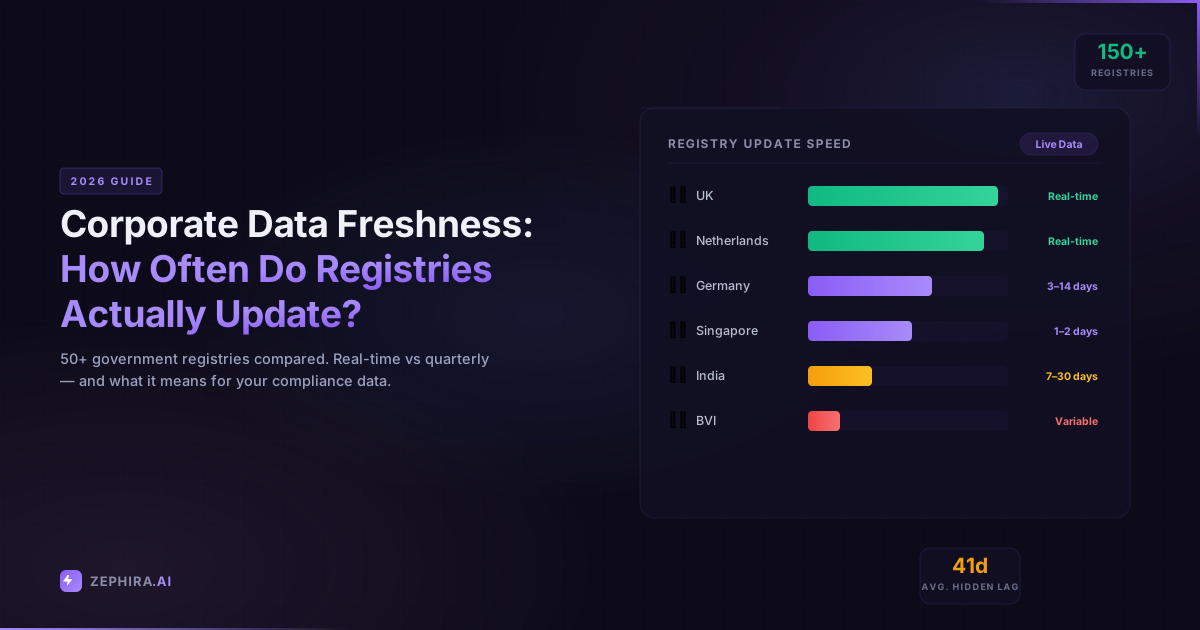
Some registries process filings in real time. UK Companies House is the standard bearer here — submit a filing electronically and it’s visible in the public data within hours. The Netherlands’ KVK, Luxembourg’s RBE, and Estonia’s e-Business Register work similarly.
Other registries operate on batch cycles. Germany’s Handelsregister, for example, processes through local courts (Amtsgerichte), which means a filing submitted in Munich may take days to appear depending on the court’s backlog. France’s RCS (Registre du Commerce et des Sociétés) has similar court-mediated delays.
Then there are registries in emerging markets where the bottleneck isn’t digital processing — it’s physical. Paper filings, manual entry, and limited IT infrastructure mean updates can take weeks or months. If you’re sourcing data from a registry that only digitises records quarterly, no amount of AI or API sophistication on your end will make that data fresh.
The Three-Layer Lag Problem
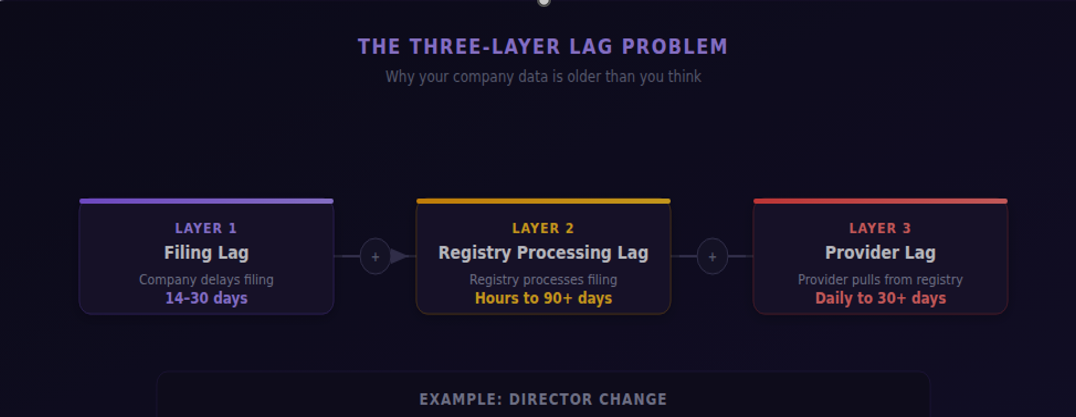
When you receive a company record from any data provider, the age of that record is the sum of three delays:
- Layer 1: Filing lag. How long after the change occurred did the company file with the registry? Many jurisdictions give companies 14–30 days to report changes. Some give longer. Some companies file late.
- Layer 2: Registry processing lag. How long after the filing did the registry make it available in its public data? This ranges from hours (UK, Netherlands) to weeks (some APAC and African registries).
- Layer 3: Provider lag. How long after the registry published the data did your provider pull it into their system? If they connect directly and poll daily, the lag is minimal. If they buy bulk extracts monthly from an intermediary, add another 30–60 days.
Most data providers only talk about Layer 3. But the total freshness of your data is Layer 1 + Layer 2 + Layer 3. Understanding all three is the only way to evaluate what you’re actually working with.
3. Registry Update Frequency: 50+ Countries Compared
This is the comparison nobody else has published. We’ve compiled update frequency data across 50+ government registries, drawing on our direct connections to official sources in 150+ countries worldwide. The table below covers update speed, available data fields, and whether each registry provides API or bulk data access.
| Country | Registry | Update Speed | Key Data Fields | API / Bulk Access |
| UK | Companies House | Real-time | Directors, shareholders, PSC/UBO, financials, charges | Yes — free API |
| Netherlands | KVK | Real-time | Directors, shareholders, UBO, financials, SBI codes | Yes — paid API |
| Estonia | e-Business Register | Real-time | Directors, shareholders, UBO, financials | Yes — free API |
| Luxembourg | RBE / RCSL | Same-day | Directors, shareholders, UBO, financials | Partial — bulk download |
| Denmark | CVR | Same-day | Directors, owners, UBO, financials, employees | Yes — free API |
| Norway | Brønnøysund | Same-day | Directors, owners, UBO, financials, roles | Yes — free API |
| Singapore | ACRA / BizFile | 1–2 days | Directors, shareholders, financials, charges | Paid API |
| Hong Kong | CR / ICRIS | 1–3 days | Directors, shareholders, charges, annual returns | Partial — bulk & search |
| Australia | ASIC | 1–3 days | Directors, shareholders, financials, charges | Paid API |
| Ireland | CRO | 1–3 days | Directors, shareholders, financials, charges | Bulk download |
| Germany | Handelsregister | 3–14 days | Directors, share capital, legal form, filings | Paid — via court portals |
| France | RCS / INSEE | 5–14 days | Directors, financials (via BODACC), legal form | API via data.gouv.fr |
| Spain | Registro Mercantil | 7–14 days | Directors, shareholders, financials | No public API |
| Italy | Registro Imprese | 7–14 days | Directors, shareholders, financials, PEC | Paid — via InfoCamere |
| Japan | MOJ Registry | 7–21 days | Directors, share capital, address | No public API |
| South Korea | DART / SupremeCourt | 7–14 days | Directors, financials, major shareholders | DART API (listed companies) |
| India | MCA21 | 7–30 days | Directors, shareholders, financials, charges | Paid API (limited) |
| UAE | DED / DIFC / ADGM | 7–30 days | License, shareholders, activities | No unified API |
| Brazil | Junta Comercial / Receita | 14–30 days | Directors, partners, CNAE, tax status | Partial — Receita Federal API |
| Mexico | SAT / SIGER | 14–30 days | Legal form, tax status, activities | Limited |
| Nigeria | CAC | 30–90 days | Directors, shareholders, status | Limited API |
| Kenya | BRS / eCitizen | 30–60 days | Directors, shareholders, status | Portal only |
| South Africa | CIPC | 14–60 days | Directors, shareholders, status, financials | Partial API |
| Indonesia | AHU Online | 30–90 days | Directors, commissioners, status | No public API |
| Pakistan | SECP | 30–90 days | Directors, shareholders, status | Portal only |
| BVI | FSC Registry | Variable | Limited — name, status, reg date | No public access |
| Cayman Islands | CIMA / Gen Registry | Variable | Limited — name, status | No public API |
| Panama | Public Registry | 30–90+ days | Directors (sometimes), status | Portal only |
A note on this table: “Update speed” reflects how quickly a filed change becomes visible in the registry’s public-facing data. Actual freshness in your system depends on how your provider accesses this data (see Section 5). Offshore jurisdictions (BVI, Cayman, Panama) are intentionally opaque — limited public data is a feature of their regulatory design, not a technical limitation.
4. The 5 Data Points That Go Stale Fastest (and the Ones That Don’t)
Not all corporate data decays at the same rate. Understanding which fields change frequently — and which are relatively stable — helps you focus your monitoring and set intelligent refresh thresholds.
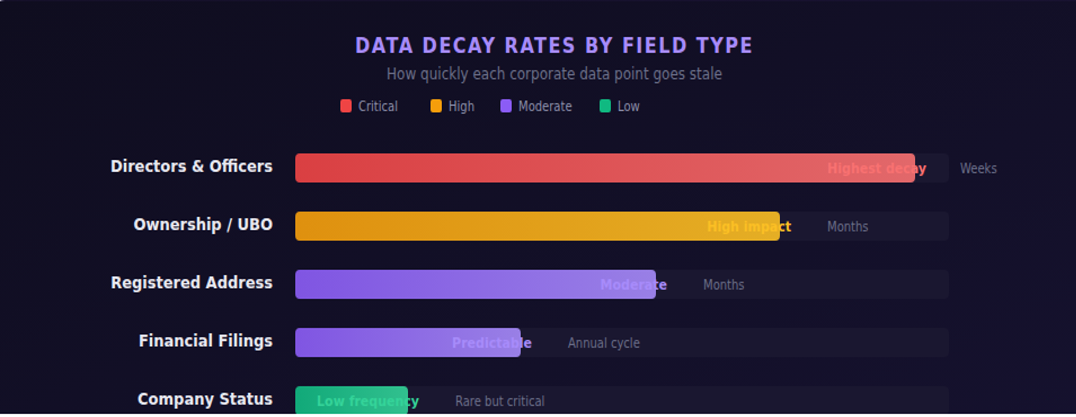
- Director and Officer Data — Highest Decay
Directors change roles constantly. Appointments, resignations, retirements, and removals happen throughout the year. In the UK alone, Companies House processes over 3 million director change filings annually. If you’re working with a provider that refreshes director data quarterly, you’re guaranteed to have stale records for a significant portion of your portfolio.
Compliance impact: A former director who’s been sanctioned or flagged as a PEP may still appear as active in your system. Or a newly appointed director with adverse media may not appear at all. - Registered Address — Moderate Decay
Registered addresses change less frequently than directors, but they carry jurisdictional implications. A company that moves its registered office from London to Limassol has changed its regulatory exposure. If your data still shows the old address, your risk scoring is wrong. - Ownership and Shareholder Data — Variable Decay, Highest Impact
Ownership changes happen less frequently for most companies, but when they do happen, the compliance implications are massive. A change in beneficial ownership can shift a company from low-risk to prohibited overnight — especially if the new owner is connected to a sanctioned entity, a PEP, or a high-risk jurisdiction.
The problem: ownership data is the hardest to keep fresh. Many registries only require annual confirmation of shareholder details. Intermediate changes may not appear until the next filing cycle. And in jurisdictions with nominee shareholder structures, the true ownership may never appear in the registry at all. - Financial Filings — Predictable but Slow
Financial data follows an annual cycle. Companies file their accounts after year-end, typically with a 6–9 month lag. This is predictable but means you’re always working with historical financials. For credit risk and financial health assessments, this is normal and expected. The problem arises when providers present 18-month-old financials as “current” without disclosing the reporting period. - Company Status — Stable Until It’s Not
Active, dissolved, in liquidation, struck off — company status rarely changes for most entities. But when it does, the compliance impact is immediate. Transacting with a dissolved company is a red flag. Onboarding a company in liquidation exposes you to credit risk. Status changes need to be reflected in your data within days, not months. Some registries are good at this (UK, Netherlands). Others are not (many emerging markets delay dissolution records by weeks).
5. How Data Providers Handle (or Hide) Registry Lag
This is where the conversation shifts from registry infrastructure to what you — the enterprise buyer — can control. Not all data providers access registries the same way, and the sourcing method directly determines the freshness of what you receive.
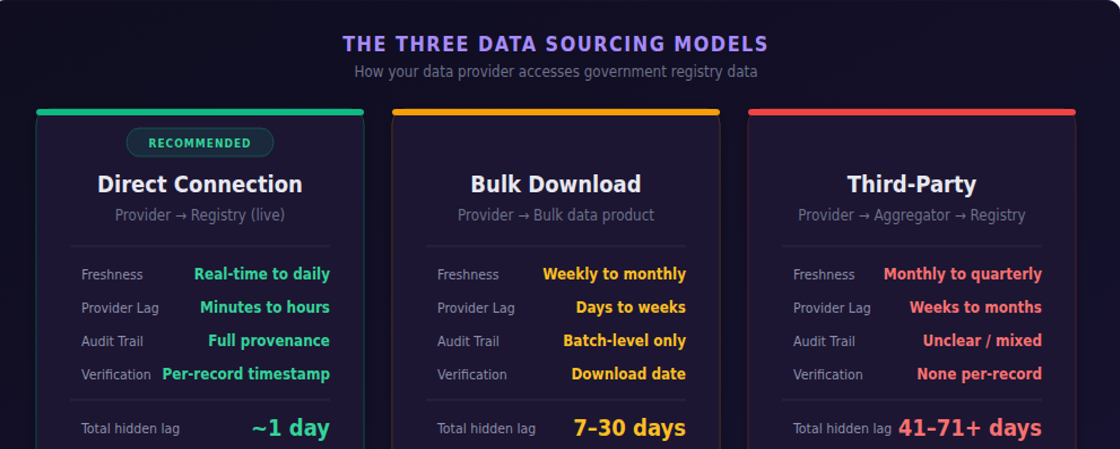
The Three Sourcing Models
Model 1: Direct registry connection. The provider maintains a live integration with the government registry. When you request a company record, the provider either pulls it from the source in real time or synchronises from the source on a defined schedule (daily, in most cases). This is the freshest model. It’s also the most expensive and complex to build, because every registry has different formats, access protocols, and rate limits.
Model 2: Bulk download and indexing. The provider downloads registry data in bulk — either through official bulk data products (like Companies House’s free monthly data dump) or through scheduled extractions. The data is indexed and searchable, but its freshness depends on the download frequency. Monthly bulk downloads mean your data is, on average, 15 days old at the time you receive it — and up to 30 days old at the end of the cycle.
Model 3: Third-party aggregation. The provider buys data from one or more intermediaries who themselves pull from registries. This adds another layer of lag. The intermediary downloaded the data, processed it, sold it to your provider, and your provider loaded it. By the time you see the record, it may be 60–90 days removed from the registry source. This is the most common model for legacy data providers — and the hardest for buyers to detect.
Why “Registry-First” Claims Need Scrutiny
The term “registry-first” or “registry-sourced” has become a marketing claim. Several providers — from legacy players like Dun & Bradstreet and Moody’s (via their kompany acquisition) to newer entrants — now claim direct registry access. But the depth of that claim varies dramatically.
Key questions to pressure-test the claim:
- How many registries? A provider connected to 50 registries has a very different freshness profile than one connected to 400. Ask for the list.
- What data fields per registry? Some providers connect to the registry but only pull basic fields (name, status, incorporation date). Others pull the full record including directors, shareholders, UBO declarations, financials, and charges. The depth matters.
- What’s the sync frequency? A “direct connection” that syncs monthly is functionally no different from a bulk download. Ask for the actual polling interval per registry.
- What happens when the registry is down? Registries go offline. They restructure their APIs. They change formats. How does your provider handle downtime? Do they serve cached data (and disclose it), or do they silently serve stale records?
The Compounding Lag Problem
Here’s what most providers won’t tell you: lag compounds across the chain.
A company changes its director on January 1. The company files the change on January 15 (14-day filing lag). The registry processes it on January 20 (5-day processing lag). Your provider’s next sync runs on February 1 (12-day provider lag). You query the record on February 10.
Total lag: 41 days. The director changed 41 days ago, and your record still shows the old one. If that old director was sanctioned on January 25, you’ve been operating with a compliance gap for over two weeks.
Now run that same scenario through a third-party aggregation model where the intermediary adds another 30-day cycle. Total lag: 71 days. Nearly two and a half months of stale data on a single critical change.
6. How to Audit Your Own Company Data for Freshness
You don’t need to trust your data provider’s claims. You can test them. Here’s a practical framework your team can run this quarter.
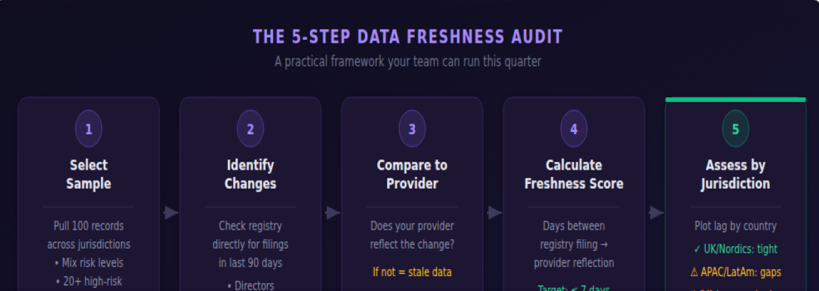
The 5-Step Data Freshness Audit
Step 1: Select a sample. Pull 100 company records from your system across a mix of jurisdictions and risk levels. Include at least 20 from high-risk jurisdictions (UAE, BVI, Hong Kong, Panama) and 20 from well-documented registries (UK, Netherlands, Germany).
Step 2: Identify known changes. For each company, check the official government registry directly. Look for changes filed in the last 90 days — new directors, ownership changes, address moves, status changes. Note the filing date on the registry.
Step 3: Compare to your provider’s data. For each change you found on the registry, check whether your provider’s record reflects it. If the registry shows a new director appointed on January 5 and your provider’s record still shows the previous director on February 14, that’s a freshness gap of 40+ days.
Step 4: Calculate the freshness score. For each record where a change was filed, measure the number of days between the registry filing date and when the change appeared in your provider’s system. If it hasn’t appeared yet, that’s an open gap. Compute the average lag across your sample.
Step 5: Assess by jurisdiction. Plot the lag by country. You’ll likely see tight freshness in well-documented markets (UK, Nordics) and significant gaps in emerging markets and offshore jurisdictions. This tells you where your provider is strong — and where they’re serving cached data.
Red Flags That Indicate Stale Data
- No “last verified” timestamp on records. If your provider doesn’t show when the record was last verified against the registry, they’re likely hiding lag.
- Dissolved companies still showing as active. This is the easiest test. Look up 10 companies you know were dissolved in the last 6 months. If more than 2 still show as active in your provider’s system, you have a freshness problem.
- Director data matching your last check exactly. If you pull the same company record 3 months apart and every field is identical — including directors, address, and financials — the record probably hasn’t been refreshed. Real companies change.
- Financial data with no period identifier. If your provider shows “revenue: $5M” without specifying the reporting period (FY2023? FY2024?), they’re presenting stale financials as current.
7. Building a Data Freshness Policy for Compliance Teams
Auditing your current data is step one. Step two is building a policy that prevents freshness from degrading going forward. Here’s how enterprise compliance teams should think about this.
Set Update Thresholds by Risk Tier
| Risk Tier | Entity Profile | Refresh Frequency | Monitoring Type |
| High Risk | Sanctioned jurisdictions, PEP-linked, complex multi-layered ownership, offshore structures | Daily or per-transaction | Event-driven + daily sync |
| Medium Risk | Standard corporates, known jurisdictions, moderate ownership complexity | Weekly to monthly | Scheduled + event-driven |
| Low Risk | Simple structures, transparent jurisdictions, long-standing relationships | Monthly to quarterly | Scheduled review |
Event-Driven Monitoring Triggers
The shift in compliance is from periodic reviews to event-driven monitoring — sometimes called perpetual KYB. Instead of checking a company record every 12 months, your system triggers a refresh when something happens. The most critical triggers:
- Ownership change filed at registry. Any change in shareholder structure, especially crossing the UBO threshold (25% in most jurisdictions, lower in some).
- Director appointment or resignation. New directors need screening. Departing directors may indicate instability or restructuring.
- Company status change. Active to dissolved, in liquidation, or struck off. This should trigger an immediate review of your exposure.
- Sanctions list update. When OFAC, EU, UN, or HMT update their lists, re-screen all entities in your portfolio against the new entries.
- Adverse media signal. News coverage mentioning the entity or its UBOs in connection with financial crime, fraud, or regulatory action.
Event-driven monitoring is only as good as the data freshness underneath it. If your provider’s data is 60 days behind the registry, your “real-time” monitoring is actually running on two-month-old information. The monitoring architecture is only as fast as its slowest data input.
What to Demand From Your Data Provider
Your data freshness policy should include SLA requirements for your provider. At minimum:
- Per-record verification timestamps. Every record should show when it was last verified against the registry source. Not when it was last “updated in our system” — when it was last compared to the official source.
- Jurisdiction-level freshness SLAs. Your provider should commit to specific refresh frequencies per jurisdiction. Daily for Tier 1 registries. Weekly for Tier 2. Defined schedules for Tier 3.
- Disclosure of sourcing method. Are they pulling directly from the registry, from a bulk download, or from a third party? This should be documented in your contract, not buried in marketing copy.
- Downtime and gap reporting. When a registry goes offline or your provider experiences a sync failure, you should be notified. Stale data served silently is worse than a disclosed gap.
8. How Zephira.ai Solves the Data Freshness Problem
Everything in this article points to the same conclusion: data freshness depends on how close you are to the source. The fewer layers between a government registry and your system, the fresher your data. That’s the principle Zephira.ai was built on.
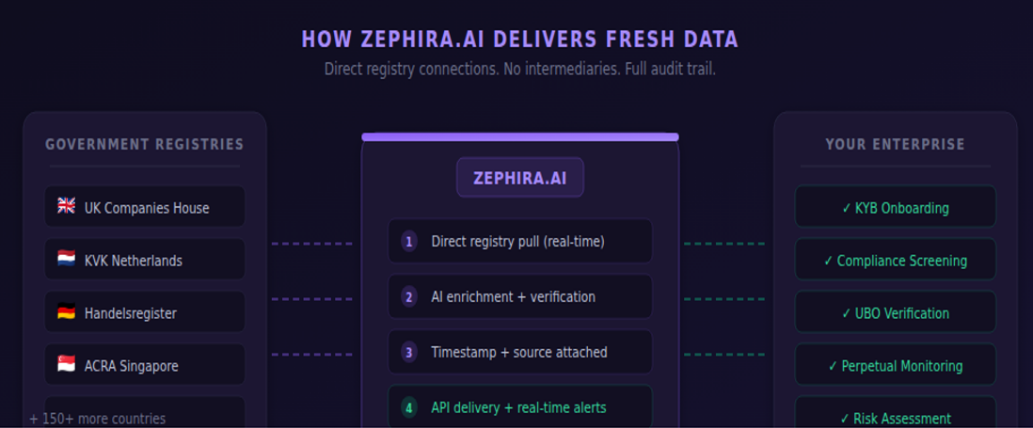
- Direct Registry Connections in 150+ Countries
Zephira.ai maintains direct integrations with official government company registries across 150+ countries. No intermediaries. No third-party aggregators adding lag to the chain. When a company files a change with its registry, Zephira pulls that update directly — eliminating the Layer 3 lag we described in Section 2.
This isn’t a “registry-first” marketing claim. Every record in Zephira includes the source registry, the filing date, and a verification timestamp so your compliance team can build an audit trail that regulators actually accept. - AI-Powered Enrichment on Top of Verified Data
Registry data is the foundation. But enterprise buyers also need UBO structures, financial filings, and cross-referenced ownership chains. Zephira’s AI layer enriches the verified registry core with data from hundreds of additional trusted sources — financial databases, public filings, and global directories — without compromising the provenance of the underlying record.
The enrichment is additive, not a replacement. The registry-verified company name, directors, status, and registered address remain anchored to the government source. AI adds the layers on top — ownership graphs, financial ratios, risk signals — that turn raw registry data into actionable intelligence. - Real-Time Monitoring, Not Periodic Refreshes
Section 7 outlined why compliance teams are shifting from periodic reviews to event-driven monitoring. Zephira supports this with real-time notifications when any tracked entity has a change filed at registry — director appointments, ownership transfers, status changes, address moves. Your team gets alerted when the change happens, not 41 days later. - API-First for Enterprise Integration
Zephira delivers all of this through a modern API designed for enterprise workflows. Plug registry-verified company data directly into your onboarding pipeline, your case management system, or your compliance platform. Every API response includes the verification timestamp and source registry — the freshness metadata your team needs to meet the SLA requirements we outlined in Section 7.
If the data freshness audit in Section 6 revealed gaps in your current provider, Zephira.ai is built to close them. Request a demo at zephira.ai to see how your specific jurisdictions and use cases are covered.
9. Conclusion: Fresh Data Isn’t a Feature — It’s the Baseline
Every company data provider will tell you their data is “fresh” and “regularly updated.” Those words mean nothing without specifics. How fresh? Updated from where? How regularly? Compared to what source?
The enterprise buyers who avoid compliance failures are the ones who ask harder questions. Not “do you have data on this company?” but “when was this record last verified at source, and can you prove it?”
Corporate data freshness is not a feature to list on a product page. It’s the baseline requirement for any compliance-grade data infrastructure. If your provider can’t show you the timestamp, the source, and the lag — you don’t have verified data. You have a cached assumption.
And assumptions don’t hold up in front of regulators.
10. Frequently Asked Questions
- What is corporate data freshness?
Corporate data freshness measures how recently a company record was verified against its official government registry source. It’s the gap between when a change happens — a new director, an ownership transfer, a status change — and when that change appears in the data you’re working with. Unlike contact data freshness (wrong emails, old phone numbers), corporate data freshness has direct compliance and regulatory implications. - How often do government company registries update?
It depends entirely on the country. UK Companies House updates within hours of an electronic filing. The Netherlands’ KVK operates similarly. Germany’s Handelsregister, which processes filings through local courts, typically takes 3–14 days. Singapore’s ACRA processes within 1–2 days. Many emerging market registries (Nigeria, Indonesia, Pakistan) may take 30–90 days to make filings publicly visible. Offshore jurisdictions like BVI and Cayman provide minimal public data regardless of timing. There is no global standard. - Why does company data go stale?
Company data goes stale at three levels. First, the company itself files late — or doesn’t file at all. Second, the registry takes time to process the filing and make it available in its public data. Third, your data provider introduces additional lag through their collection method — whether that’s a direct connection that syncs daily, a monthly bulk download, or a purchase from a third-party aggregator. Each layer adds delay, and the total lag is cumulative. - What is the difference between data freshness and data accuracy?
Accuracy means the data was correct when it was recorded. Freshness means it’s still correct right now. A company record can be 100% accurate as of six months ago and completely wrong today because the directors changed, the company relocated, or it was dissolved. In compliance, an accurate-but-stale record is often worse than a known gap — because it creates false confidence that the entity has been properly screened. - How does stale company data affect KYB compliance?
Stale data causes false negatives in your screening process. If a beneficial owner was sanctioned last week but your data is three months old, your system will clear an entity that should be blocked. Regulators do not accept “our data provider was behind” as a defence. Under 6AMLD, MLD requirements, and FinCEN’s evolving CTA framework, firms are expected to maintain ongoing monitoring — which is impossible if the underlying data isn’t fresh. - What’s the difference between registry-first data and aggregated data?Registry-first (or registry-sourced) means the data provider connects directly to the government registry and pulls records from the authoritative source. Aggregated means the provider buys data from intermediaries who may have pulled it from the registry weeks or months earlier — sometimes through multiple layers of resale. Registry-first data is more current and auditable. Aggregated data is often more convenient to access but carries additional lag and provenance risk. The key question is whether your provider can prove, per record, when it was last verified at source.
- How can I test if my company data provider has fresh data?
Run a spot-check. Pick 10 companies you know had recent changes — director appointments, address moves, dissolutions. Look them up in your provider’s system. Then verify the same companies directly on the government registry. If your provider’s record doesn’t reflect changes that are already visible on the registry, you have a freshness gap. Measure the lag in days. Repeat across jurisdictions. This takes a few hours and gives you a clear picture of your provider’s actual freshness — not their marketed freshness. - Which company data points go stale the fastest?
Director and officer data has the highest decay rate — executives change roles constantly. Ownership and shareholder data changes less frequently but carries the highest compliance impact when it does change. Registered addresses are moderately stable but carry jurisdictional implications. Financial data follows an annual reporting cycle and is predictably stale (6–9 months lag is normal). Company status (active vs. dissolved) is the most stable but the most critical when it changes. - How often should enterprise compliance teams refresh company data?
It depends on the risk tier. High-risk entities — those in sanctioned jurisdictions, with PEP-linked ownership, or with complex multi-layered structures — should be refreshed daily or on every transaction. Standard-risk entities should be refreshed weekly to monthly. Low-risk entities can follow a quarterly cycle. The industry is shifting toward event-driven monitoring (perpetual KYB), where refreshes are triggered by changes rather than by calendar. This approach is more efficient but requires a data provider whose freshness can keep pace. - What should I ask a company data provider about their update frequency?
Three questions will tell you everything you need to know. First: do you connect directly to the government registry, or do you source from a third party? Second: what is your average lag time between a registry filing and the data appearing in your system — broken down by jurisdiction? Third: can you show me, on any individual record, the timestamp of when it was last verified at the source? If the provider can’t answer all three with specifics, their freshness claims are marketing, not commitments.