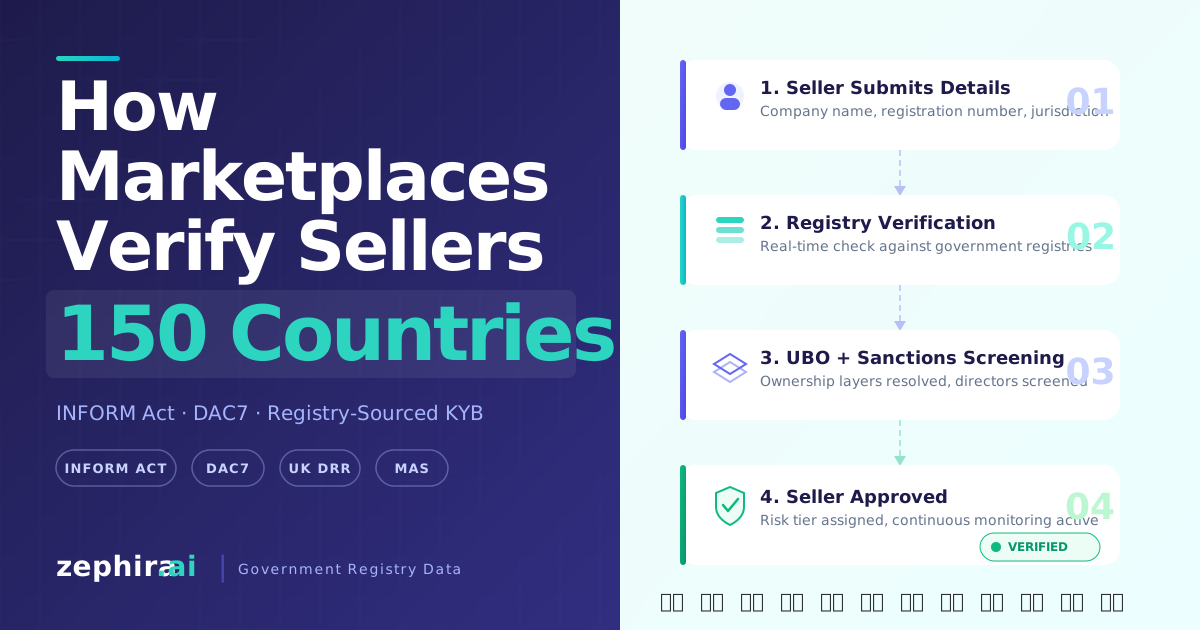
How Marketplaces Verify Sellers Across 150 Countries
The $3.8 Trillion Trust Problem
The top 100 online marketplaces moved $3.8 trillion in gross merchandise value in 2024. That number doubled in six years.
Behind every transaction is an assumption: the seller on the other side is a real, legally operating business.
That assumption is wrong more often than most marketplace operators want to admit.
Global e-commerce fraud losses hit $48 billion in 2025. First-party fraud — where the seller themselves is the problem — now accounts for 36% of all reported fraud, up from 15% the year before. And those numbers only capture the fraud that gets caught.
Here’s the thing most marketplace teams miss: the fraud starts at onboarding. If you don’t verify the business entity behind a seller account, every downstream control — payment monitoring, review systems, dispute resolution — is built on sand.
A seller uploads a business license photo. Maybe they provide a tax ID. The marketplace checks a box and moves on. Six months later, that entity was dissolved, or never existed in the first place, or is owned by someone on a sanctions list.
This is not a hypothetical. In September 2025, the FTC brought its first enforcement action under the INFORM Consumers Act against Temu — a $2 million penalty for failing to properly verify and disclose seller information. Senators Durbin and Cassidy sent letters to 46 marketplace operators requesting evidence of their compliance efforts. The message from Washington is clear: if you run a marketplace, you are responsible for knowing who your sellers are.
And that’s just the US. In Europe, DAC7 requires digital platforms to collect, verify, and report seller data to tax authorities annually — or face penalties and potential deregistration from operating in the EU entirely.
The era of “self-certification” is ending. What’s replacing it is actual entity verification — confirming that a business legally exists, is actively registered, and is operated by the people it claims.
Platforms like Zephira.ai exist precisely for this problem. By pulling verified data directly from government registries across 150+ countries, marketplace operators can automate the verification that used to take hours per seller — and do it at onboarding, not after something goes wrong.
This article breaks down what seller verification means in practice. Across 150 countries. At scale.
What “Verify a Seller” Actually Means When They’re in Lagos, Tallinn, and São Paulo
Most marketplace teams conflate two different processes: KYC (Know Your Customer) and KYB (Know Your Business).
KYC verifies the individual. It checks a passport, runs a selfie match, maybe screens the person against a sanctions list. Every fintech and marketplace knows how to do this. Tools are abundant. The process is well-understood.
KYB verifies the business entity. It answers different questions entirely:
| KYC (Individual Verification) | KYB (Business Entity Verification) |
|---|---|
| Is this person who they claim to be? | Does this company legally exist? |
| Valid government-issued ID? | Active registration with a government authority? |
| Face matches the document? | What is the official legal name and registration number? |
| Person on a sanctions list? | Company dissolved, struck off, or suspended? |
| Proof of address? | Who are the directors and shareholders on record? |
| — | Who is the ultimate beneficial owner (UBO)? |
These are not the same question as “is this person who they say they are.” A fraudulent seller can pass individual KYC with a real ID and still operate behind a shell company, a dissolved entity, or a business registered in a jurisdiction they’ve never set foot in.
A business license photo proves nothing. Licenses expire. Companies get struck off. Directors change. A static document from six months ago tells you what was true at the time — not what’s true today.
Real verification means checking the entity against the government registry where it was incorporated. In real time. Against the primary source. This is exactly what Zephira.ai’s API does — it queries the official registry and returns the entity’s current legal status, not a cached copy or a screenshot.
And this is where the problem gets hard. Because government registries are not standardized.
In the UK, Companies House is free, well-structured, and provides rich data — directors, shareholders, filing history, company status. In India, the MCA portal is paid, inconsistent, and requires workarounds to access reliably. In the US, there’s no federal company registry at all — there are 50 separate state-level Secretary of State offices, each with different data structures, different search interfaces, and different update frequencies.
A seller from Nigeria provides a CAC registration number. A seller from Estonia provides a registry code from the Centre of Registers. A seller from Brazil provides a CNPJ. These are three completely different formats, from three completely different systems, with three completely different data fields.
The marketplace that treats all of these the same — or worse, treats a screenshot of any of them as “verified” — is leaving the front door open.
The Regulatory Stack Marketplaces Can’t Ignore
Two pieces of legislation now define the baseline for seller verification on global marketplaces: the INFORM Consumers Act in the US and DAC7 in the EU.
INFORM Consumers Act vs. DAC7: Side-by-Side
| INFORM Consumers Act (US) | DAC7 (EU) | |
|---|---|---|
| Effective | June 27, 2023 | January 1, 2023 |
| Who it applies to | Online marketplaces with high-volume 3P sellers | Digital platforms facilitating sales, rentals, or services in the EU |
| Seller threshold | 200+ transactions AND $5,000+ revenue in 12 months | 30+ transactions OR €2,000+ income per year |
| Data required | Bank account, government ID/business record, tax ID, email, phone | Full legal name, address, DOB, TIN, VAT number, business registration |
| Verification deadline | Within 10 days of collection | By December 31 each year; reports due January 31 |
| Public disclosure | Required for sellers with $20,000+ annual revenue | Seller receives copy of report; data shared across EU tax authorities |
| Non-compliance penalty | $53,088 per violation (FTC + state AG enforcement) | Varies by EU member state; can include fines, seller suspension, platform deregistration |
| Extra-territorial reach | US marketplace operations | Applies to non-EU platforms with EU-resident sellers |
Beyond the US and EU
The regulatory trend is global:
| Jurisdiction | Regulation | Status |
|---|---|---|
| United Kingdom | UK Digital Reporting Rules (UK DRR) | Effective 2024; first reports due 2025 |
| Singapore | MAS marketplace obligations | Active; seller verification required for regulated platforms |
| Multiple jurisdictions | INFORM Act-style legislation | In development; modeled on the US framework |
The common thread: governments are done trusting marketplaces to self-police. They want verified entity data, not self-certifications. And they’re willing to fine, suspend, and deregister platforms that can’t provide it.
For marketplace compliance teams, this means you need infrastructure that can collect, verify, and maintain seller entity data across every jurisdiction your sellers operate in. Zephira.ai covers 150+ countries from a single API — which means your compliance team isn’t managing dozens of separate registry relationships. One integration. One data format. Every jurisdiction.
Why Manual Country-by-Country Registry Checks Don’t Scale
Let’s walk through what it actually takes to manually verify a single seller across five jurisdictions.
| Country | Registry | Cost | Data Quality | What You Get | What You Don’t Get |
|---|---|---|---|---|---|
| UK | Companies House | Free | Excellent | Status, directors, shareholders, filing history, registered address | UBO (requires PSC register lookup) |
| US (Delaware) | Division of Corporations | Paid | Limited | Entity name, file number, status, registered agent | Directors, shareholders, financials |
| India | MCA Portal | Paid | Inconsistent | Company name, CIN, status, some director data | Reliable shareholder data; transliteration issues |
| Brazil | Receita Federal (CNPJ) | Free | Moderate | Company name, status, tax registration, activities | Director names (requires Junta Comercial lookup) |
| Nigeria | Corporate Affairs Commission | Free | Poor | Company name, registration number, status | Unreliable; frequent downtime; limited director data |
Total time for one seller across five jurisdictions: hours. And you haven’t standardized the data, haven’t run it through any downstream compliance checks, haven’t stored it in a format your risk team can use.
Now multiply this by 10,000 sellers onboarding per month. It’s not a scalability problem — it’s a physical impossibility.
The data format problem alone kills any manual approach. Registration numbers follow different patterns per country. Company statuses use different terminology (“active,” “live,” “in good standing,” “registered,” “operational” all mean roughly the same thing — but not exactly). Director data might be first name/last name, or a single name field, or transliterated from a non-Latin script.
Without standardization, you can’t automate downstream workflows. Without automation, you can’t operate at marketplace scale.
This is the core problem Zephira.ai solves. The API normalizes data across all 150+ jurisdictions into a single, structured format. A company from Nigeria returns the same field structure as one from Germany. Your product team integrates once. Your compliance team works with one data schema. Your risk models don’t need per-country logic.
The Automated Approach: Registry-Sourced Verification via API
The fix isn’t hiring more compliance analysts. It’s pulling registry data directly into your onboarding flow through an API like Zephira.ai’s.
Here’s how it works in practice:
Step 1: Capture the entity identifier. During seller onboarding, collect the company name and country of registration. Ideally, also collect the registration number. Zephira’s API uses this to query the relevant government registry.
Step 2: Match and return the registry record. The API returns the official company profile: legal name, registration number, jurisdiction, date of incorporation, legal form, registered address, and current status (active, dissolved, suspended, struck off).
Step 3: Pull director and shareholder data. For jurisdictions where it’s available, Zephira returns the names of current directors and shareholders. This feeds directly into your sanctions screening and PEP checks.
Step 4: Identify the ultimate beneficial owner. By tracing shareholder data upward through corporate structures, you can map the ownership chain until you reach natural persons. This is the UBO — the individual who ultimately controls the business.
Step 5: Run downstream compliance checks. With verified entity data and identified UBOs, your existing compliance stack can do its job: sanctions screening, adverse media checks, PEP screening, risk scoring. The difference is that now these checks are running against verified data — not self-reported information from the seller.
Manual vs. API Verification: The Numbers
| Manual Registry Checks | Zephira.ai API | |
|---|---|---|
| Time per seller | 2–4 hours (multi-jurisdiction) | Seconds |
| Countries covered | Depends on analyst language skills and registry access | 150+ from a single endpoint |
| Data format | Different per registry; requires manual normalization | Standardized JSON across all jurisdictions |
| Director/UBO data | Requires separate lookups per country | Included in API response where available |
| Status monitoring | Periodic manual rechecks | Continuous; alert-based |
| Cost at scale | Scales linearly with headcount | Flat API pricing from $49/month |
| Audit trail | Manual documentation | Automatic; every query logged |
Handling edge cases:
Not every check returns a clean result. A robust verification integration needs to handle:
- Dormant companies — technically registered but not actively trading. These may indicate a shell entity or simply an inactive business that forgot to deregister.
- Recently dissolved entities — a seller whose company was struck off last month might still be trying to onboard. The registry data catches this immediately.
- Name mismatches — the seller provides “ABC Solutions” but the registry shows “ABC Solutions Private Limited.” Fuzzy matching logic handles this, but it needs to be built into the flow.
- Thin jurisdictions — some registries provide minimal data. When a registry only returns company name and status, the system should flag the seller for manual review or request additional documentation.
The point isn’t that API verification eliminates all ambiguity. It’s that it eliminates the 80% of onboarding that’s routine — freeing your compliance team to focus on the 20% that actually requires human judgment.
Case in Point: Upwork’s Approach to Business Client Verification
Upwork connects businesses with independent professionals across 150+ countries. When a business client signs up on Upwork, they’re entering a two-sided marketplace where trust is the product. If a client turns out to be a fraudulent entity, the freelancers working with them are the ones who get hurt.
Upwork’s challenge was the same one every global marketplace faces: how do you verify a business in São Paulo the same way you verify one in Stockholm?
The answer was to move from manual, document-based review to automated, registry-sourced verification using Zephira.ai’s government registry data. By integrating Zephira’s API directly into the onboarding flow, Upwork could:
- Confirm that a business legally exists at the point of registration
- Check the company’s active status against the official registry in real time
- Surface director and ownership information for compliance review
- Standardize entity data across 150+ jurisdictions into a single, queryable format
The shift from manual to automated verification changed three things: onboarding speed increased (no more waiting for compliance analysts to manually check five different registry websites), fraudulent account creation decreased (hard to fake a company that doesn’t exist in the registry), and compliance costs dropped (less manual labor, fewer false positives, cleaner data for auditors).
You can read the full case study on the Zephira.ai case studies page.
Building a Risk-Tiered Seller Onboarding Flow
Not every seller presents the same risk. A registered UK limited company with ten years of filing history is a different onboarding case than a recently formed entity in a high-risk jurisdiction with nominee directors.
Your verification flow should reflect this. Here’s a three-tier model:
| Risk Tier | Criteria | Verification Action | Zephira API Role | Timeframe |
|---|---|---|---|---|
| Tier 1: Low Risk | Active registration in regulated jurisdiction (UK, EU, US, CA, AU, SG). Directors match expected profiles. No sanctions or adverse media hits. | Auto-approve. No human review. | API confirms entity status, directors, and registration. Automated sanctions check clears. | Seconds |
| Tier 2: Medium Risk | Foreign entity in less-transparent jurisdiction. Thin registry data. Recently incorporated (<12 months). Minor data discrepancies (name variations, missing fields). | Supplement with document requests. Cross-reference documents against registry data. Route to analyst if discrepancies remain. | API returns partial data. System flags gaps. Analyst reviews Zephira’s registry output alongside submitted documents. | Minutes to hours |
| Tier 3: High Risk | Sanctioned or high-risk jurisdiction. Nominee directors. Registered agent address shared with dozens of entities. Opaque ownership chain. Director/UBO on sanctions or PEP list. | Full manual EDD. Certified corporate documents. Ownership chain traced to natural persons. Compliance officer go/no-go. | API provides starting point: entity data, director names, ownership structure. Analyst traces from there. | Days |
The economics of this model matter. If 70% of your sellers fall into Tier 1 and are auto-approved, your compliance team only needs to touch 30% of onboarding volume. Of that 30%, most are Tier 2 cases that resolve with one additional document. True Tier 3 cases — the ones that require real investigative effort — are typically under 5% of volume.
Without the tiering, your compliance team is spending the same time on a ten-year-old UK company as they are on a three-month-old BVI shell with nominee directors. That’s not compliance. That’s waste.
What Comes After Onboarding: Continuous Monitoring
Verifying a seller at onboarding is necessary. It’s also insufficient.
Companies change. Directors resign. Businesses get dissolved. Owners get sanctioned. A seller that was clean at onboarding can become a risk three months later — and your marketplace won’t know unless you’re watching.
Point-in-time verification creates a false sense of security. You checked the box once. The box is now stale.
Events That Should Trigger a Review
| Registry Event | Why It Matters | Risk Implication |
|---|---|---|
| Status change (active → dissolved/struck off) | Seller is operating behind a legally dead entity | Immediate: suspend seller pending review |
| Director change | New director may be sanctioned, a PEP, or a nominee | Re-screen directors against sanctions/PEP lists |
| Ownership/shareholder change | UBO may have changed; risk profile may have shifted entirely | Re-run UBO identification and screening |
| Registered address change | Shift to a less-transparent jurisdiction may indicate restructuring to avoid scrutiny | Flag for compliance review |
| Filing lapse | Company stops filing annual returns or financials | Often a precursor to dissolution; indicator of dormant entity |
Zephira.ai’s monitoring capabilities pull fresh data from the registry on a regular cadence and surface changes as they happen. Your compliance team doesn’t need to manually re-check thousands of sellers — they get notified when something changes that affects a seller’s risk profile.
For marketplaces handling DAC7 reporting, continuous monitoring also solves a compliance requirement: the directive requires platforms to keep seller data current, not just collect it once. The annual reporting cycle means that if a seller’s entity data changed mid-year, your report needs to reflect the current state — not the state at the time of onboarding.
The Bottom Line
Marketplace seller verification is no longer a “nice to have” compliance checkbox. It’s a regulatory requirement in the US (INFORM Act), a tax reporting obligation in the EU (DAC7), and increasingly a commercial necessity — because platforms that can’t verify their sellers will lose the trust of both buyers and payment processors.
The manual approach doesn’t work. Fifty different registry websites, fifty different data formats, fifty different login procedures — it collapses at any meaningful scale.
The solution is to source verification data directly from government registries through an API. Standardized. Real-time. Across every jurisdiction where your sellers operate.
Zephira.ai provides exactly this: verified company data from 150+ government registries, delivered through a single API, starting at $49/month. It’s how platforms like Upwork verify business clients at scale — and it’s accessible to any marketplace willing to build verification into the onboarding flow rather than bolting it on as an afterthought.
Verify your first seller in under 60 seconds — try the Zephira API free →
Frequently Asked Questions
1. What is marketplace seller verification?
Marketplace seller verification is the process of confirming that a third-party seller on an online marketplace is a legally registered, actively operating business. It involves checking the seller’s entity information — company name, registration number, legal status, directors, and ownership — against official government registry records. This is distinct from individual identity verification (KYC), which only confirms the identity of a person, not the legitimacy of their business.
2. What is the difference between KYC and KYB for marketplaces?
KYC (Know Your Customer) verifies the identity of an individual using documents like passports and selfie checks. KYB (Know Your Business) verifies the legal entity behind that individual — confirming that the business is registered, active, and operated by the claimed owners. For marketplaces, KYB is essential because a seller can pass KYC with a valid personal ID but still operate behind a dissolved, fraudulent, or sanctioned business entity.
3. What does the INFORM Consumers Act require from online marketplaces?
The INFORM Consumers Act, effective since June 2023, requires US online marketplaces to collect, verify, and disclose information about high-volume third-party sellers — those with 200+ transactions and $5,000+ in revenue over 12 months. Marketplaces must collect bank details, a government-issued ID or business record, tax ID, and contact information. Verification must happen within 10 days. Non-compliance carries penalties of up to $53,088 per violation, enforced by the FTC and state Attorneys General.
4. What is DAC7 and how does it affect marketplace sellers?
DAC7 is an EU directive that requires digital platforms — including online marketplaces — to collect, verify, and report seller data to EU tax authorities annually. It applies to any platform with EU-resident sellers, regardless of where the platform is headquartered. Sellers who exceed €2,000 in income or 30 transactions per year become “reportable.” Reports are due by January 31 each year. Non-compliance can result in fines, seller suspension, and even permanent revocation of the platform’s right to operate in the EU.
5. How do you verify a business seller in multiple countries?
Verifying a seller across multiple countries requires checking each entity against the government registry in its country of incorporation. Each country has a different registry (e.g., Companies House in the UK, Secretary of State offices in the US, MCA in India, CAC in Nigeria) with different data formats, fields, and access methods. An API-based solution like Zephira.ai normalizes this process by connecting to 150+ registries and returning standardized entity data — legal name, status, directors, shareholders — in a single format, regardless of the seller’s country.
6. Why is a business license not enough to verify a marketplace seller?
A business license is a static document that reflects a point in time. Licenses expire. Companies get dissolved. Directors change. A license photo uploaded during onboarding tells you nothing about the entity’s current legal status. True verification requires a live check against the government registry where the business is incorporated, confirming the entity is currently active and the information is up to date.
7. What data do government company registries provide?
The data varies by jurisdiction, but most government company registries provide: the company’s legal name, registration number, date of incorporation, legal form (e.g., Ltd, LLC, GmbH), registered address, current status (active, dissolved, suspended), and in many cases, director and shareholder information. Some registries also provide filing histories and financial statements. Zephira.ai aggregates data from 150+ registries and enriches it with firmographic data, ownership structures, and financial intelligence.
8. What is a risk-tiered seller onboarding flow?
A risk-tiered onboarding flow assigns different verification levels based on the risk profile of each seller. Low-risk sellers (established companies in well-regulated jurisdictions) can be auto-approved using API-based registry checks. Medium-risk sellers (recently formed entities, thin registry data) receive additional document requests. High-risk sellers (opaque ownership, sanctioned jurisdictions, nominee directors) undergo manual enhanced due diligence. This approach ensures compliance resources are focused where they’re needed most.
9. What is continuous seller monitoring and why does it matter?
Continuous monitoring means regularly checking a seller’s entity data against the government registry after onboarding — not just verifying them once. Companies change: they get dissolved, directors resign, ownership transfers, addresses shift. Without monitoring, a marketplace won’t know when a previously verified seller becomes a risk. Zephira.ai provides registry-sourced monitoring that surfaces these changes as they happen, so compliance teams can act on real events rather than conducting periodic manual rechecks.
10. How does Zephira.ai help marketplaces verify sellers globally?
Zephira.ai provides API access to verified company data from 150+ government registries worldwide. Marketplaces integrate the API into their seller onboarding flow to automatically verify entity status, directors, shareholders, and ownership structures — across every jurisdiction where their sellers operate. The API returns standardized data regardless of the source registry, eliminating the need for manual country-by-country checks. Plans start at $49/month for 100 company profiles, with enterprise pricing available for high-volume platforms. Upwork, Cognizant, and Adyen are among the companies using Zephira.ai’s registry data for verification and compliance.