8 OpenCorporates Alternatives for KYB & Company Registry Lookup
OpenCorporates is the world’s largest open database of company information. Launched in 2010, it aggregates data from corporate registries across 140+ jurisdictions and makes it freely searchable.
For journalists, researchers, and NGOs, OpenCorporates broke new ground. It democratized access to company records that were previously scattered across government portals or locked behind fees.
The platform delivers on basic company lookups — confirming a business exists, checking company registration numbers, finding registered office addresses.
But for compliance teams, risk analysts, and data teams, limitations surface quickly. Roughly half of OpenCorporates’ registry sources are no longer actively updated. There’s no data enrichment, no standardized financial statements, no beneficial ownership tracking. API access is capped at 500 calls per month, and even basic company searches consume credits.
For lightweight company research, OpenCorporates works. For KYB verification or due diligence workflows, teams typically need a more robust company data provider.
Best for: Journalists, academic researchers, and NGOs needing free access to basic company registry filings.
Key Features of OpenCorporates:
- 220M+ company profiles across 140+ jurisdictions
- Free company search access
- Open data API for developers
- Bulk company data licensing available
OpenCorporates Limitations:
- Approximately 50% of registry data sources no longer actively updated
- No data enrichment (company websites, descriptions, financials, tech stack)
- No beneficial ownership or UBO tracking
- API capped at 500 requests per month; company searches consume credits without retrieving full records
OpenCorporates Pricing: Free tier available | API access from £2,250/year | Bulk data licensing by quote
OpenCorporates FAQ
- Is OpenCorporates free to use?
Yes, basic company search on OpenCorporates is free. API access and bulk data downloads require paid plans starting at £2,250 per year. - How often is OpenCorporates company data updated?
Update frequency varies by registry. According to OpenCorporates’ own platform, roughly half of their data sources are currently labeled “offline” and no longer receive regular updates. - Does OpenCorporates provide beneficial ownership data?
No. OpenCorporates displays basic parent-subsidiary relationships when explicitly stated in registry filings, but does not track ultimate beneficial owners (UBOs). - Can I use OpenCorporates for KYB verification?
OpenCorporates supports basic company verification. However, full KYB compliance workflows typically require enriched data, standardized financials, and ownership chains that OpenCorporates does not provide. - What are OpenCorporates API limits?
Standard OpenCorporates API plans allow 500 calls per month with a maximum of 200 calls per day. Company searches consume credits whether or not you retrieve the full company record.
1. Zephira.ai: API-First Company Data for Developers and Fintechs

Introduction
Zephira.ai is an API-first company data platform built for developers, fintechs, and RegTech teams. It delivers real-time access to verified company records sourced directly from government registries across 100+ countries.
The platform is designed for programmatic consumption — structured outputs, fast response times, and scalable rate limits. Where OpenCorporates focuses on open access to raw filings, Zephira.ai is optimized for KYB workflows, onboarding automation, and data enrichment pipelines.
Zephira uses AI to normalize data across jurisdictions. Industry codes, legal forms, and company statuses are standardized automatically. When registries lack key fields like revenue or employee count, Zephira enriches records from validated third-party sources.
For teams building compliance products or integrating company verification into their platforms, Zephira offers a modern alternative to legacy providers — with transparent pricing and no vendor lock-in.
Zephira.ai vs OpenCorporates: Comparison Table
| Feature | Zephira.ai | OpenCorporates |
|---|---|---|
| Company records | 300M+ | 220M+ |
| Global coverage | 100+ countries | 140+ jurisdictions |
| Data sourcing | Direct from government registries | Aggregated from public registries |
| Data freshness | Real-time, actively updated | ~50% of sources offline |
| Data enrichment | Yes (revenue, employees, social, tech stack) | No |
| Beneficial ownership | Yes (where registries support) | No |
| Financial statements | Yes (structured) | PDF only (where available) |
| API rate limits | Up to 6,000 calls/min (Enterprise) | 500 calls/month standard |
| CRM integrations | Salesforce, HubSpot, Snowflake | Limited |
| Pricing | From $49/month | From £2,250/year |
| Best for | Developers, fintechs, KYB automation | Basic company lookups |
Best for: Developers, fintechs, and RegTech platforms needing real-time, API-accessible company data for KYB and compliance automation.
Key Features of Zephira.ai:
- Real-time API access to company records across 100+ countries
- Registry-sourced data including legal name, registration number, VAT, tax ID, and company status
- Ownership and UBO data with parent-subsidiary mapping
- AI-powered data normalization across jurisdictions
- Enrichment for missing fields (revenue, employee bands, website, social profiles)
- Integrations with Salesforce, HubSpot, Snowflake, and PostgreSQL
- Monitoring alerts for changes in company structure, ownership, or financials
Zephira.ai Limitations:
- Not a sales prospecting tool — no contact emails or phone numbers for outbound
- Developer-centric platform — less suited for users who prefer UI-based research
- Smaller track record compared to legacy providers like D&B or Moody’s
- Coverage depth varies by region
Zephira.ai Pricing:
| Plan | Price | Profiles/Month | API Rate Limit |
|---|---|---|---|
| Starter | $49/month | 100 | 30 calls/min |
| Pro | $99/month | 400 | 100 calls/min |
| Business | $199/month | 1,300 | 300 calls/min |
| Enterprise | Custom | Unlimited | 6,000 calls/min |
Zephira.ai FAQ
- What is Zephira.ai used for?
Zephira.ai is used for KYB verification, company onboarding automation, compliance workflows, and real-time data enrichment. It’s built for developers and product teams integrating company data into their platforms. - Does Zephira.ai provide beneficial ownership data?
Yes. Zephira.ai provides shareholder information and maps parent-subsidiary relationships with normalized structures. UBO data is available where registries support it. - How does Zephira.ai pricing compare to OpenCorporates?
Zephira.ai offers tiered subscription plans starting at $49/month with transparent API limits. OpenCorporates charges £2,250/year for API access with stricter call limits (500/month). - Does Zephira.ai offer a free trial?
Contact Zephira.ai directly to inquire about trial access or demo options. - Can Zephira.ai integrate with my CRM or data platform?
Yes. Zephira.ai integrates with Salesforce, HubSpot, Snowflake, Redshift, and PostgreSQL for real-time enrichment and sync.
2. Global Database: First-Party Registry Data for Compliance Teams
Introduction
Global Database is a B2B intelligence platform that sources company records directly from 200+ official government registries worldwide.
The platform covers 600M+ company profiles across 195 countries. Each record is enriched with firmographics, digitized financials, ownership structures, and executive contacts. Data is actively refreshed through direct registry connections, not periodic bulk imports.
For compliance teams, Global Database delivers KYB-ready profiles with beneficial ownership tracking, standardized financials, and company monitoring.
Best for: Compliance teams, risk analysts, and B2B teams needing verified, enriched company data with executive contacts.
Global Database vs OpenCorporates: Comparison Table
| Feature | Global Database | OpenCorporates |
|---|---|---|
| Company records | 600M+ | 220M+ |
| Global coverage | 195 countries | 140+ jurisdictions |
| Data sourcing | Direct from 200+ government registries | Aggregated from public registries |
| Data freshness | Actively updated via direct connections | ~50% of sources offline |
| Data enrichment | Yes (firmographics, tech stack, social profiles) | No |
| Beneficial ownership | Yes (UBO tracking across complex structures) | No |
| Financial statements | Yes (digitized, standardized, up to 20 years) | PDF only (where available) |
| Executive contacts | Yes (direct phone, verified email) | No |
| API rate limits | Up to 6,000 requests/min | 500 calls/month standard |
| Browser extension | Yes | No |
| CRM integrations | Salesforce, HubSpot, and major platforms | Limited |
| Pricing | Flexible per-call; enterprise plans available | From £2,250/year |
| Best for | Compliance, risk, KYB, B2B sales | Basic company lookups |
Best for: Compliance teams, risk analysts, and B2B sales teams needing verified, enriched company data with executive contacts.
Key Features of Global Database:
- 600M+ company profiles across 195 countries
- Direct connections to 200+ official government registries
- Digitized and standardized financial statements (up to 20 years)
- Beneficial ownership and UBO tracking across complex structures
- Company monitoring with real-time alerts on ownership, status, or financial changes
- Browser extension for instant company verification while browsing
- API capacity up to 6,000 requests per minute
- CRM integrations with Salesforce, HubSpot, and major platforms
Global Database Limitations:
- Premium positioning — not built for users seeking free or low-cost access
- Executive contact data availability varies by region
- Full feature access requires paid plans
Global Database Pricing:
Global Database offers flexible pricing based on usage — per-call API access with no mandatory monthly subscriptions. Enterprise plans available for high-volume workflows. Contact sales for custom quotes.
Global Database FAQ
- What is Global Database used for?
Global Database is used for KYB verification, due diligence, compliance screening, B2B sales prospecting, and company data enrichment. It serves compliance teams, risk analysts, sales teams, and data teams. - Does Global Database provide beneficial ownership data?
Yes. Global Database tracks ownership chains and identifies ultimate beneficial owners (UBOs) across complex, cross-border corporate structures. - How does Global Database compare to OpenCorporates?
Global Database offers actively updated, first-party registry data with enrichment, digitized financials, UBO tracking, and executive contacts. OpenCorporates provides raw registry filings with limited enrichment and roughly half of its sources no longer actively updated. - Does Global Database offer an API?
Yes. The API supports up to 6,000 requests per minute with flexible per-call pricing. Free company searches — you only pay when accessing full profiles or enriched data. - Does Global Database have a browser extension?
Yes. The Global Database web extension provides instant company verification, 20 years of financial data, shareholder details, and parent company information directly in your browser.
3. Dun & Bradstreet: The Legacy Standard for Business Credit and Risk Data

Introduction
Dun & Bradstreet (D&B) is one of the oldest and most recognized names in commercial data. Founded in 1841, it provides business intelligence, credit reports, and risk analytics to enterprises worldwide.
D&B is best known for the D-U-N-S Number — a unique nine-digit identifier assigned to businesses globally. This identifier has become a standard for credit decisions, supplier verification, and regulatory compliance. Many government agencies and large enterprises require D-U-N-S Numbers for vendor onboarding.
The platform covers 500M+ business records across 190+ countries. Products include D&B Hoovers for sales prospecting, D&B Connect for data enrichment, and credit reports for risk assessment. D&B serves regulated industries like banking, insurance, and government contracting where established data standards matter.
One thing to note: D&B is a first-party data owner primarily in the US, UK, and Nordics — markets strengthened by its acquisition of Bisnode. For most other countries, D&B licenses data from third-party vendors rather than sourcing directly from registries. This means data freshness, depth, and traceability can vary significantly by region.
D&B’s legacy architecture also comes with trade-offs. Pricing is opaque and often expensive. Not all data fields are traceable to official registry sources, which can complicate audit requirements for compliance teams.
For enterprises already embedded in D&B’s ecosystem, it remains a default choice. For teams seeking modern APIs, transparent sourcing, or flexible pricing, alternatives may deliver better value.
Dun & Bradstreet vs OpenCorporates: Comparison Table
| Feature | Dun & Bradstreet | OpenCorporates |
|---|---|---|
| Company records | 500M+ | 220M+ |
| Global coverage | 190+ countries | 140+ jurisdictions |
| Data sourcing | First-party (US, UK, Nordics); licensed elsewhere | Aggregated from public registries |
| Data freshness | Varies by region | ~50% of sources offline |
| Credit reports | Yes | No |
| Risk scores | Yes | No |
| Beneficial ownership | Limited | No |
| Financial statements | Yes (digitized) | PDF only (where available) |
| Executive contacts | Yes (D&B Hoovers) | No |
| API access | Enterprise contracts | 500 calls/month standard |
| Pricing | $25,000+/year (enterprise) | From £2,250/year |
| Best for | Enterprise credit, risk, compliance | Basic company lookups |
Best for: Large enterprises, banks, insurers, and government contractors needing established credit data standards and D-U-N-S Number integration.
Key Features of Dun & Bradstreet:
- 500M+ business records across 190+ countries
- D-U-N-S Number — globally recognized business identifier
- Commercial credit reports and risk scores
- D&B Hoovers for sales prospecting and lead generation
- D&B Connect for CRM data enrichment
- Supplier risk management and compliance monitoring
- KYC/KYB solutions for regulated industries
Dun & Bradstreet Limitations:
- First-party data limited to US, UK, and Nordics — other regions rely on licensed third-party data
- Opaque, enterprise-level pricing — costs difficult to predict
- Data freshness and traceability varies by region
- Complex product suite — can overwhelm smaller teams
- API access requires enterprise contracts
Dun & Bradstreet Pricing:
- Enterprise plans: Custom quotes, typically starting $25,000+/year
- Individual credit reports: $30–$200+ depending on depth and region
- API and bulk access: Contact sales
Dun & Bradstreet FAQ
- What is Dun & Bradstreet used for?
Dun & Bradstreet is used for business credit reporting, risk assessment, KYC/KYB compliance, sales prospecting, supplier verification, and data enrichment. It serves finance, compliance, sales, and procurement teams. - What is a D-U-N-S Number?
A D-U-N-S Number is a unique nine-digit identifier assigned by Dun & Bradstreet to individual business entities. It is widely used for credit decisions, government contracting, and global business verification. - How does Dun & Bradstreet compare to OpenCorporates?
D&B offers broader data enrichment, credit scoring, and risk analytics. OpenCorporates provides raw registry data with limited enrichment. D&B is significantly more expensive but includes proprietary insights not available in open registry platforms. - Does Dun & Bradstreet own all its data?
No. D&B is a first-party data owner in the US, UK, and Nordics (via its Bisnode acquisition). For most other regions, D&B licenses company data from third-party vendors, which can affect data freshness and source traceability. - Does Dun & Bradstreet offer an API?
Yes. D&B offers API access for credit data, company enrichment, and risk scoring. API plans require enterprise contracts with custom pricing.
4. Moody’s (Bureau van Dijk): The Enterprise Standard for Ownership and Financial Data
Introduction
Moody’s Bureau van Dijk (BvD) is the enterprise-grade standard for global company data, corporate ownership, and financial intelligence. Its flagship product, Orbis, covers 600M+ entities worldwide and is widely used by banks, auditors, regulators, and multinational corporations.
Acquired by Moody’s Analytics in 2017 for €3 billion, BvD specializes in private company data — an area where public sources fall short. Orbis aggregates and standardizes information from 170+ providers, creating comparable datasets across jurisdictions. This makes it a go-to platform for M&A research, transfer pricing, compliance, and third-party due diligence.
Where BvD excels is ownership mapping. Orbis provides detailed corporate hierarchies, ultimate beneficial ownership (UBO) structures, and cross-border linkages that are critical for AML compliance and risk assessment. For regulated industries with complex due diligence requirements, Orbis remains unmatched in depth.
However, this comes at a cost. Orbis is expensive — enterprise licenses typically start at $20,000/year and can exceed $100,000 for full global access. The platform is also known for rigid delivery models and limited API flexibility, which can frustrate teams looking for modern, developer-friendly integrations.
For large enterprises with deep pockets and complex compliance needs, BvD delivers. For mid-market teams or those needing agile API access, alternatives may offer better value.
Moody’s (BvD) vs OpenCorporates: Comparison Table
| Feature | Moody’s (BvD) Orbis | OpenCorporates |
|---|---|---|
| Company records | 600M+ | 220M+ |
| Global coverage | 200+ jurisdictions | 140+ jurisdictions |
| Data sourcing | 170+ providers, standardized | Aggregated from public registries |
| Data freshness | Regularly updated | ~50% of sources offline |
| Beneficial ownership | Yes (detailed UBO structures) | No |
| Financial statements | Yes (digitized, standardized) | PDF only (where available) |
| Corporate hierarchies | Yes (extensive ownership mapping) | Limited parent-subsidiary only |
| Executive contacts | Limited | No |
| API access | Available (enterprise contracts) | 500 calls/month standard |
| Pricing | $20,000–$100,000+/year | From £2,250/year |
| Best for | Banks, auditors, M&A, compliance | Basic company lookups |
Best for: Banks, auditors, multinational corporations, and compliance teams needing detailed ownership structures, standardized financials, and enterprise-grade due diligence tools.
Key Features of Moody’s (BvD) Orbis:
- 600M+ company and entity records worldwide
- Data aggregated and standardized from 170+ providers
- Detailed ultimate beneficial ownership (UBO) mapping
- Corporate hierarchies and cross-border linkages
- Standardized financial statements for 48M+ companies
- M&A database (Orbis M&A) integrated into the platform
- Risk scoring and compliance screening tools
- Regional products: Amadeus (Europe), Orbis IP (patents), BankFocus (banks)
- Salesforce integration available
Moody’s (BvD) Limitations:
- High cost — enterprise licenses start at $20,000/year, full access can exceed $100,000/year
- Rigid delivery models — limited API flexibility compared to modern platforms
- Complex interface — can overwhelm smaller teams
- Licensing restrictions — data reuse and redistribution often limited
- Not designed for sales prospecting — limited executive contact data
Moody’s (BvD) Pricing:
- Enterprise licenses: Typically $20,000–$100,000+/year depending on modules and data access
- Regional products (Amadeus, AIDA, etc.): Priced separately
- API and bulk data: Custom quotes
- Free trials available (excluding export functionality)
Moody’s (BvD) FAQ
- What is Moody’s Bureau van Dijk used for?
Moody’s BvD is used for compliance and due diligence, M&A research, transfer pricing, risk assessment, and corporate ownership analysis. It serves banks, auditors, regulators, and large enterprises. - What is Orbis?
Orbis is BvD’s flagship database covering 600M+ entities worldwide. It provides standardized company financials, ownership structures, and corporate hierarchies — primarily focused on private company data. - Does Moody’s BvD provide beneficial ownership data?
Yes. Orbis is known for detailed UBO mapping, corporate hierarchies, and cross-border ownership linkages. It’s widely used for AML compliance and third-party risk assessment. - How does Moody’s BvD compare to OpenCorporates?
BvD offers far deeper ownership data, standardized financials, and compliance tools. OpenCorporates provides raw registry data with no enrichment or UBO tracking. BvD costs significantly more but delivers enterprise-grade intelligence. - Is Moody’s BvD suitable for startups or small businesses?
Generally no. BvD’s pricing and complexity are designed for large enterprises, banks, and regulated institutions. Smaller teams may find more flexible and affordable alternatives.
5. Monetaiq: Financial Intelligence Beyond Basic Company Data

Introduction
Monetaiq is a financial data platform that blends traditional company information with deep financial intelligence. Where most company data providers stop at registration details and basic firmographics, Monetaiq focuses on what compliance, credit, and investment teams actually need: historical financials, credit indicators, and business activity signals.
The platform sources financial statements directly from government registries and official filings, then standardizes them using AI and OCR technology. This means structured, comparable data across jurisdictions — not raw PDFs that require manual extraction.
Monetaiq provides over 20 years of historical balance sheets, profit and loss statements, and cash flow data. It also layers in credit scores, payment behavior indicators, and digital signals like web traffic and hiring trends. This combination makes it useful for teams assessing not just whether a company exists, but whether it’s financially healthy.
For fintechs building underwriting workflows, investment firms screening targets, or procurement teams evaluating suppliers, Monetaiq fills the gap between basic registry lookups and full enterprise platforms like Moody’s Orbis.
Monetaiq vs OpenCorporates: Comparison Table
| Feature | Monetaiq | OpenCorporates |
|---|---|---|
| Company records | Global coverage (public & private) | 220M+ |
| Data sourcing | Registry-sourced, verified filings | Aggregated from public registries |
| Data freshness | Quarterly (public), as-filed (private) | ~50% of sources offline |
| Financial statements | Yes (digitized, standardized, 20+ years) | PDF only (where available) |
| Credit scoring | Yes | No |
| Payment behavior indicators | Yes | No |
| Digital signals (traffic, hiring) | Yes | No |
| Beneficial ownership | Limited | No |
| API access | Yes (up to 6,000 calls/min) | 500 calls/month standard |
| Pricing | From $49/month | From £2,250/year |
| Best for | Credit risk, investment screening, underwriting | Basic company lookups |
Best for: Investment firms, fintechs, credit teams, and procurement professionals needing deep financial intelligence beyond basic company verification.
Key Features of Monetaiq:
- 20+ years of historical financial statements (balance sheets, P&L, cash flow)
- Registry-sourced data standardized using AI and OCR
- Credit scores and payment behavior indicators
- Digital signals including web traffic, audience geography, and hiring trends
- Bulk data feeds in CSV, JSON, or custom formats
Monetaiq Limitations:
- Less focus on basic company verification compared to registry-first platforms
- Beneficial ownership data is limited compared to specialized KYB providers
- No executive contact data for sales prospecting
- Smaller brand recognition compared to legacy providers
Monetaiq Pricing:
| Plan | Price | Profiles/Month | API Rate Limit |
|---|---|---|---|
| Starter | $49/month | 50 | 30 calls/min |
| Pro | $99/month | 150 | 100 calls/min |
| Business | $199/month | 400 | 300 calls/min |
| Enterprise | Custom | Unlimited | 6,000 calls/min |
Monetaiq FAQ
- What is Monetaiq used for?
Monetaiq is used for credit risk assessment, investment screening, supplier evaluation, and financial due diligence. It serves fintechs, investment firms, banks, and procurement teams needing deep financial intelligence. - Does Monetaiq provide historical financial data?
Yes. Monetaiq offers over 20 years of historical balance sheets, income statements, and cash flow data — digitized and standardized for easy analysis across jurisdictions. - How does Monetaiq compare to OpenCorporates?
Monetaiq focuses on financial depth — standardized financials, credit scores, and business signals. OpenCorporates provides basic registry data with no financial enrichment. Monetaiq is better for credit and investment use cases; OpenCorporates is better for simple company lookups. - Does Monetaiq offer an API?
Yes. Monetaiq provides REST API access with rate limits up to 6,000 calls per minute on Enterprise plans. Data can also be delivered via bulk feeds in CSV, JSON, or custom formats. - Is Monetaiq suitable for KYB compliance?
Monetaiq supports KYB workflows that require financial health assessment and credit risk evaluation. For basic entity verification and UBO mapping, teams may need to combine Monetaiq with a registry-first provider.
6. Zavia.ai: AI-Powered UBO Discovery and Ownership Intelligence
Introduction
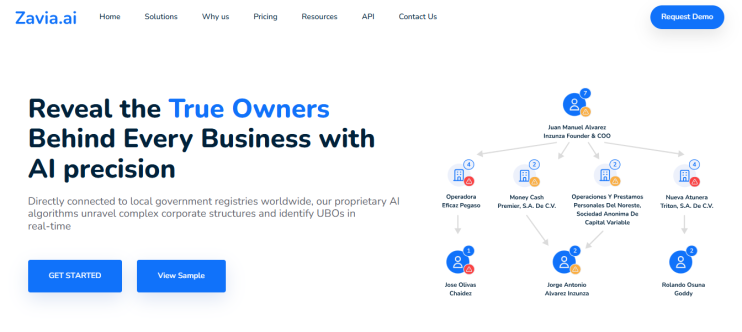
Zavia.ai is an AI-powered platform built specifically for ultimate beneficial ownership (UBO) discovery and corporate ownership intelligence. Where most company data providers treat ownership as a secondary feature, Zavia.ai makes it the core focus.
The platform connects directly to government registries in 100+ countries and uses proprietary AI algorithms to map complex ownership structures — including parent companies, subsidiaries, nominee arrangements, and offshore linkages. It goes beyond simple shareholder lists to uncover hidden relationships that traditional methods miss.
Zavia.ai is designed for compliance teams, risk analysts, and financial institutions managing AML, KYC, and KYB workflows. The platform automatically flags PEPs (politically exposed persons) and sanctions matches, and allows users to customize UBO thresholds based on regulatory requirements — whether 25%, 10%, or another percentage.
For teams that need to trace ownership through multiple jurisdictions and corporate layers, Zavia.ai offers a modern, AI-driven alternative to legacy providers like Moody’s Orbis — at a fraction of the cost.
Zavia.ai vs OpenCorporates: Comparison Table
| Feature | Zavia.ai | OpenCorporates |
|---|---|---|
| Company records | 100+ countries | 220M+ (140+ jurisdictions) |
| Data sourcing | Direct from government registries | Aggregated from public registries |
| Data freshness | Real-time updates | ~50% of sources offline |
| Beneficial ownership | Yes (AI-powered UBO mapping) | No |
| Ownership visualization | Yes (interactive corporate maps) | No |
| PEP & sanctions screening | Yes | No |
| Customizable UBO thresholds | Yes | No |
| Monitoring & alerts | Yes | No |
| API access | Yes (up to 1,000 calls/min) | 500 calls/month standard |
| Pricing | From $49/month | From £2,250/year |
| Best for | AML compliance, UBO discovery, due diligence | Basic company lookups |
Best for: Compliance teams, risk analysts, and financial institutions needing AI-powered UBO discovery, sanctions screening, and ownership visualization.
Key Features of Zavia.ai:
- AI-powered UBO mapping across complex, multi-jurisdictional structures
- Direct connections to government registries in 100+ countries
- Interactive ownership visualization with parent-subsidiary mapping
- Real-time monitoring and alerts on ownership changes
- Audit-ready evidence trails for AML/KYC compliance
- API access for integration into existing compliance systems
Zavia.ai Limitations:
- Focused on UBO and ownership — less suited for general company lookups or sales prospecting
- No executive contact data
- Smaller brand recognition compared to legacy providers like Moody’s or D&B
- Financial statement depth limited compared to specialized financial data platforms
Zavia.ai Pricing:
| Plan | Price | UBO Checks/Month | API Rate Limit | Monitoring |
|---|---|---|---|---|
| Starter | $49/month | 50 | 30 calls/min | ✓ |
| Growth | $99/month | 150 | 100 calls/min | ✓ |
| Corporate | $199/month | 400 | 1,000 calls/min | ✓ |
Enterprise plans available on request.
Zavia.ai FAQ
- What is Zavia.ai used for?
Zavia.ai is used for UBO discovery, corporate ownership mapping, AML/KYC compliance, sanctions screening, and due diligence. It serves compliance teams, risk analysts, financial institutions, and legal professionals. - Does Zavia.ai provide beneficial ownership data?
Yes. Zavia.ai specializes in AI-powered UBO identification, mapping complex ownership structures across 100+ countries and flagging PEPs and sanctioned entities automatically. - How does Zavia.ai compare to OpenCorporates?
Zavia.ai focuses on ownership intelligence — UBO mapping, sanctions screening, and compliance workflows. OpenCorporates provides basic registry data with no ownership analysis or AI-driven insights. Zavia.ai is purpose-built for compliance; OpenCorporates is better for simple company lookups. - Can I customize UBO thresholds in Zavia.ai?
Yes. Zavia.ai allows users to set custom UBO thresholds (25%, 10%, or other percentages) to align with specific regulatory requirements across jurisdictions. - Does Zavia.ai offer an API?
Yes. Zavia.ai provides API access with rate limits up to 1,000 calls per minute on Corporate plans. It can be integrated into existing compliance and onboarding workflows.
7. LexisNexis: Enterprise-Grade Compliance and Risk Intelligence
Introduction
LexisNexis Risk Solutions is one of the most established names in compliance, risk intelligence, and legal data. Part of RELX Group, it provides a comprehensive suite of tools for KYC, KYB, AML, fraud prevention, and due diligence — trusted by major banks, insurers, and government agencies worldwide.
The platform aggregates data from proprietary databases, public records, sanctions lists, PEP databases, adverse media sources, and legal filings across 200+ countries. LexisNexis is known for the depth of its risk intelligence — not just company data, but contextual signals that help compliance teams assess entities holistically.
For KYB specifically, LexisNexis RiskNarrative automates business due diligence by mapping beneficial ownership structures, screening against global watchlists, and flagging adverse media. The platform is designed for high-volume, regulated environments where audit trails and regulatory acceptance matter.
However, LexisNexis is an enterprise solution with enterprise pricing. Smaller teams or startups may find it complex and cost-prohibitive. For organizations with significant compliance burdens and global exposure, it remains a heavyweight choice.
LexisNexis vs OpenCorporates: Comparison Table
| Feature | LexisNexis | OpenCorporates |
|---|---|---|
| Company records | 200+ countries | 220M+ (140+ jurisdictions) |
| Data sourcing | Proprietary + public records + watchlists | Aggregated from public registries |
| Data freshness | Continuously updated | ~50% of sources offline |
| Beneficial ownership | Yes (multi-layer ownership mapping) | No |
| Sanctions & PEP screening | Yes (comprehensive) | No |
| Adverse media monitoring | Yes | No |
| Risk scoring | Yes (AI-driven) | No |
| Financial statements | Limited | PDF only (where available) |
| API access | Yes (enterprise contracts) | 500 calls/month standard |
| Pricing | Custom enterprise pricing | From £2,250/year |
| Best for | Banks, insurers, regulated institutions | Basic company lookups |
Best for: Large financial institutions, banks, insurers, and regulated enterprises needing comprehensive KYC/KYB, sanctions screening, and risk intelligence at scale.
Key Features of LexisNexis:
- Access to proprietary sanctions, watchlists, and PEP databases globally
- Beneficial ownership mapping across complex corporate structures
- Adverse media monitoring and risk scoring
- KYC, KYB, and AML tools integrated in a single suite
- Transaction monitoring and fraud prevention capabilities
LexisNexis Limitations:
- Enterprise-level pricing — prohibitive for smaller organizations
- Complex implementation — can require significant configuration
- Data overload — may require sophisticated filtering to avoid irrelevant information
- Less focus on raw company registry data compared to registry-first providers
- Not designed for sales prospecting or general company lookups
LexisNexis Pricing:
- Custom enterprise pricing based on modules, volume, and jurisdictions
- Contact LexisNexis for a custom quote
- Typically suited for mid-market to large enterprises with significant compliance needs
LexisNexis FAQ
- What is LexisNexis Risk Solutions used for?
LexisNexis Risk Solutions is used for KYC/KYB compliance, AML screening, sanctions and PEP checks, fraud prevention, adverse media monitoring, and due diligence. It serves banks, insurers, financial institutions, and government agencies. - Does LexisNexis provide beneficial ownership data?
Yes. LexisNexis maps beneficial ownership structures across multiple corporate layers and jurisdictions, helping compliance teams trace UBOs for regulatory requirements. - How does LexisNexis compare to OpenCorporates?
LexisNexis is a comprehensive risk intelligence platform with sanctions screening, PEP databases, adverse media, and ownership mapping. OpenCorporates provides basic registry data with no risk intelligence or compliance tools. LexisNexis is built for regulated institutions; OpenCorporates is better for simple company lookups. - Is LexisNexis suitable for startups or small businesses?
Generally no. LexisNexis is an enterprise solution with enterprise pricing and complexity. Smaller teams may find more accessible and affordable alternatives for basic KYB and company verification. - Does LexisNexis offer an API?
Yes. LexisNexis offers API access for integration into compliance systems and workflows. API plans are part of custom enterprise contracts.
8. Creditsafe: Accessible Business Credit Reports for SMBs and Enterprises
Introduction
Creditsafe is the world’s most-used provider of business credit reports, serving over 200,000 customers globally. Founded in Norway in 1997, it has grown into a comprehensive credit intelligence platform covering 365+ million companies across 160+ countries.
The platform focuses on speed and accessibility. Unlike legacy providers that cater primarily to large enterprises, Creditsafe is designed to be SMB-friendly — with straightforward pricing, instant report delivery, and an intuitive interface. Users can pull a business credit report and get a credit decision in under 60 seconds.
Creditsafe’s core strength is credit risk assessment. The platform provides credit scores, recommended credit limits, payment behavior data (Days Beyond Terms), insolvency predictions, and financial stability indicators. It also bundles KYB/AML compliance features, including corporate linkage, UBO insights, and sanctions screening.
For finance teams, credit controllers, and procurement professionals who need to quickly assess whether a customer or supplier is creditworthy, Creditsafe offers a practical, cost-effective solution. It lacks the depth of ownership mapping found in specialized UBO platforms, but delivers solid credit intelligence at accessible price points.
Creditsafe vs OpenCorporates: Comparison Table
| Feature | Creditsafe | OpenCorporates |
|---|---|---|
| Company records | 365M+ | 220M+ |
| Global coverage | 160+ countries | 140+ jurisdictions |
| Data sourcing | Public records, financials, trade payment data | Aggregated from public registries |
| Data freshness | Continuously updated | ~50% of sources offline |
| Credit scores | Yes (predictive insolvency model) | No |
| Credit limits | Yes (recommended limits) | No |
| Payment behavior data | Yes (Days Beyond Terms) | No |
| Beneficial ownership | Yes (corporate linkage, UBO insights) | No |
| AML/sanctions screening | Yes | No |
| API access | Yes | 500 calls/month standard |
| Pricing | From ~$3,500/year (avg. ~$49,000/year) | From £2,250/year |
| Best for | Credit risk, supplier vetting, onboarding | Basic company lookups |
Best for: Finance teams, credit controllers, procurement professionals, and SMBs needing fast, affordable business credit reports and risk assessment.
Key Features of Creditsafe:
- 365M+ company profiles across 160+ countries
- Credit scores with 12-month insolvency prediction
- Recommended credit limits based on financial analysis
- Payment behavior data (Days Beyond Terms)
- KYB/AML compliance bundling with sanctions screening
Creditsafe Limitations:
- Credit scoring models vary by country — less consistent for international operations
- Smaller businesses without trade payment data may receive benchmark scores with limited value
- Data quality issues reported — occasional outdated addresses, SIC codes, or DBAs
- UBO and ownership mapping less comprehensive than specialized compliance platforms
- Not designed for deep investigative due diligence or complex ownership analysis
Creditsafe Pricing:
- Plans range from ~$3,500/year to $238,000/year depending on usage and modules
- Average annual cost: ~$49,000 (based on Vendr data)
- SMB-friendly options available
- Contact Creditsafe for custom quotes
Creditsafe FAQ
- What is Creditsafe used for?
Creditsafe is used for business credit reporting, credit risk assessment, supplier vetting, customer onboarding, and KYB/AML compliance. It serves finance teams, credit controllers, procurement professionals, and sales operations. - Does Creditsafe provide credit scores?
Yes. Creditsafe provides proprietary credit scores that predict the likelihood of a company failing within 12 months, along with recommended credit limits and payment behavior data. - How does Creditsafe compare to OpenCorporates?
Creditsafe focuses on credit intelligence — credit scores, payment behavior, and insolvency prediction. OpenCorporates provides basic registry data with no credit or financial analysis. Creditsafe is better for credit decisions; OpenCorporates is better for simple company lookups. - Does Creditsafe offer beneficial ownership data?
Yes. Creditsafe provides corporate linkage and UBO insights as part of its compliance features, though it’s less comprehensive than specialized UBO discovery platforms. - Does Creditsafe offer an API?
Yes. Creditsafe offers API integration for connecting credit data with CRM, ERP, and onboarding systems. API access is part of subscription plans.
Which OpenCorporates Alternative Is Right for You?
The best platform depends on what you’re trying to solve. OpenCorporates works for basic lookups. But once you need enriched data, ownership structures, or integration into compliance workflows, you need something else.
Here’s how to match your use case to the right platform.
By Use Case
| Your Need | Best Fit | Why |
|---|---|---|
| Basic company verification | OpenCorporates | Free tier, wide coverage, simple lookups |
| KYB automation for fintechs | Zephira.ai, Global Database | API-first, registry-sourced, scalable rate limits |
| UBO discovery and AML compliance | Zavia.ai, Moody’s (BvD) | AI-powered ownership mapping, sanctions screening |
| Credit risk and supplier vetting | Creditsafe, Dun & Bradstreet | Credit scores, payment behavior, insolvency prediction |
| Investment screening and financial analysis | Monetaiq, Moody’s (BvD) | 20+ years of standardized financials, credit indicators |
| B2B sales prospecting | Global Database | Executive contacts, firmographics, CRM integrations |
| Enterprise compliance (banks, insurers) | LexisNexis, Moody’s (BvD) | Comprehensive risk intelligence, regulatory acceptance |
| Developer-friendly integration | Zephira.ai, Global Database | REST APIs, high throughput, flexible pricing |
By Company Size
| Your Organization | Best Fit | Why |
|---|---|---|
| Startup / Early-stage | Zephira.ai, Zavia.ai, Monetaiq | Low entry cost ($49/month), transparent pricing, no long-term contracts |
| SMB / Growth-stage | Creditsafe, Global Database | Scalable plans, practical features, SMB-friendly support |
| Mid-market | Global Database, Zavia.ai, Creditsafe | Balance of depth and affordability, API access, compliance features |
| Enterprise | Moody’s (BvD), LexisNexis, Dun & Bradstreet | Comprehensive coverage, regulatory acceptance, enterprise SLAs |
By Budget
| Budget Range | Best Fit | What You Get |
|---|---|---|
| Free / Minimal | OpenCorporates | Basic registry lookups, limited API |
| $50–$200/month | Zephira.ai, Zavia.ai, Monetaiq | Registry data, UBO checks, financials, API access |
| $3,000–$25,000/year | Creditsafe, Global Database | Credit reports, enriched company data, compliance features |
| $25,000–$100,000+/year | Dun & Bradstreet, Moody’s (BvD), LexisNexis | Enterprise-grade coverage, deep ownership, full compliance suites |
By Data Priority
| What Matters Most | Best Fit | Strength |
|---|---|---|
| Data freshness | Global Database, Zephira.ai | Direct registry connections, real-time updates |
| Ownership depth | Zavia.ai, Moody’s (BvD) | Multi-layer UBO mapping, offshore structures |
| Financial history | Monetaiq, Global Database | 20+ years digitized, standardized across jurisdictions |
| Credit intelligence | Creditsafe, Dun & Bradstreet | Predictive scores, payment trends, credit limits |
| Sanctions & PEP screening | Zavia.ai, LexisNexis | Integrated watchlists, adverse media, real-time alerts |
| Executive contacts | Global Database | Verified emails, direct phone numbers, LinkedIn profiles |
Decision Framework
Ask yourself these five questions:
- What’s the primary workflow?
- Company lookups → OpenCorporates
- KYB / onboarding automation → Zephira.ai, Global Database
- UBO / AML compliance → Zavia.ai, Moody’s (BvD)
- Credit decisions → Creditsafe, Dun & Bradstreet
- Do I need beneficial ownership data?
- No → OpenCorporates, Creditsafe
- Yes (basic) → Global Database, Creditsafe
- Yes (deep, multi-jurisdictional) → Zavia.ai, Moody’s (BvD)
- Do I need financials?
- No → Zavia.ai, LexisNexis
- Yes (PDF is fine) → OpenCorporates
- Yes (structured, standardized) → Global Database, Monetaiq, Moody’s (BvD)
- What’s my API volume?
- Low (<500 calls/month) → OpenCorporates
- Medium (1,000–10,000 calls/month) → Zephira.ai, Zavia.ai, Monetaiq
- High (10,000+ calls/month) → Global Database, enterprise plans
- What’s my budget?
- Minimal → OpenCorporates (free tier)
- $50–$200/month → Zephira.ai, Zavia.ai, Monetaiq
- $3,000–$50,000/year → Creditsafe, Global Database
- $50,000+/year → Moody’s (BvD), LexisNexis, Dun & Bradstreet
The Bottom Line
OpenCorporates pioneered open access to company data. But compliance requirements have evolved. Regulatory pressure around UBO transparency, AML, and KYB has created demand for platforms that go beyond raw registry filings.
If you’re building compliance workflows, evaluating suppliers, or running sales operations at scale, the platforms in this guide offer what OpenCorporates doesn’t: enrichment, ownership intelligence, standardized financials, and APIs built for production use.
Pick the one that fits your workflow. Start with a trial. Test with real data. Then scale.
Frequently Asked Questions About OpenCorporates Alternatives
-
What is OpenCorporates?
OpenCorporates is the world’s largest open database of company information. It aggregates data from corporate registries across 140+ jurisdictions and makes it freely searchable. The platform is primarily used by journalists, researchers, and NGOs for basic company lookups and verification.
-
Is OpenCorporates free?
Basic company search on OpenCorporates is free. However, API access requires a paid subscription starting at £2,250 per year. The free tier has limited functionality, and even paid plans cap API usage at 500 calls per month with a maximum of 200 calls per day.
-
Why do companies look for OpenCorporates alternatives?
Companies look for OpenCorporates alternatives because the platform has limitations for professional use cases. Roughly half of its data sources are no longer actively updated. There is no data enrichment, no beneficial ownership tracking, no standardized financials, and limited API capacity. Teams running KYB, compliance, or sales workflows typically need more robust solutions.
-
What is the best OpenCorporates alternative for KYB verification?
For KYB verification, Global Database and Zephira.ai are strong alternatives. Both source data directly from government registries, provide UBO tracking, and offer high-capacity APIs designed for onboarding and compliance automation. Zavia.ai is another option for teams focused specifically on beneficial ownership discovery.
-
What is the best OpenCorporates alternative for beneficial ownership data?
For beneficial ownership and UBO discovery, Zavia.ai and Moody’s Bureau van Dijk (Orbis) are the strongest options. Zavia.ai uses AI to map complex ownership structures across 100+ countries. Moody’s Orbis offers the deepest ownership data but at enterprise pricing. Global Database also provides UBO tracking with first-party registry sourcing.
-
What is the best OpenCorporates alternative for credit reports?
For business credit reports, Creditsafe and Dun & Bradstreet are the leading alternatives. Creditsafe offers fast, affordable credit reports with predictive insolvency scoring. Dun & Bradstreet provides deeper credit intelligence and the globally recognized D-U-N-S Number, though at higher price points.
-
What is the best free alternative to OpenCorporates?
OpenCorporates itself offers the most comprehensive free tier for basic company lookups. For free trials or low-cost entry points, Zephira.ai, Zavia.ai, and Monetaiq all offer plans starting at $49 per month with access to registry data, UBO checks, and API functionality.
-
What is the best OpenCorporates alternative for developers?
For developers and technical teams, Zephira.ai and Global Database are the best alternatives. Both offer API-first architectures with high throughput (up to 6,000 calls per minute), structured data outputs, and integrations with platforms like Salesforce, HubSpot, and Snowflake. Pricing is transparent and scales with usage.
-
Does OpenCorporates provide beneficial ownership data?
No. OpenCorporates provides basic parent-subsidiary relationships when explicitly stated in registry filings, but it does not track ultimate beneficial owners (UBOs). For UBO data, alternatives like Zavia.ai, Global Database, or Moody’s Orbis are required.
-
Does OpenCorporates provide financial statements?
OpenCorporates provides financial statements only in raw PDF format where available from public registries. There is no digitization or standardization. For structured, comparable financial data, alternatives like Global Database, Monetaiq, or Moody’s Orbis offer digitized financials spanning up to 20+ years.
-
How does OpenCorporates compare to Dun & Bradstreet?
OpenCorporates provides free access to basic registry data with limited enrichment. Dun & Bradstreet offers comprehensive credit intelligence, risk scoring, and the D-U-N-S Number system, but at enterprise pricing ($25,000+/year). D&B is better for credit decisions and regulated industries; OpenCorporates is better for simple lookups.
-
How does OpenCorporates compare to Moody’s Bureau van Dijk?
OpenCorporates aggregates raw registry filings with no enrichment. Moody’s Bureau van Dijk (Orbis) provides standardized financials, deep ownership mapping, and compliance tools for banks and auditors. Orbis costs $20,000–$100,000+ per year. OpenCorporates is accessible but limited; BvD is comprehensive but expensive.
-
What is the best OpenCorporates alternative for sales prospecting?
For B2B sales prospecting, Global Database is the best alternative. It combines company data with executive contact information, including verified emails and direct phone numbers. Other platforms like OpenCorporates, Zavia.ai, and Moody’s Orbis do not provide contact data for outbound sales.
-
Which OpenCorporates alternative has the best API?
Global Database and Zephira.ai have the most developer-friendly APIs. Both support up to 6,000 requests per minute on enterprise plans, offer structured JSON outputs, and integrate with CRMs and data platforms. OpenCorporates caps API usage at 500 calls per month on standard plans.
-
Are there OpenCorporates alternatives with first-party registry data?
Yes. Global Database, Zephira.ai, and Zavia.ai all source data directly from official government registries rather than aggregating from third parties. This first-party approach provides fresher, more reliable data with clear source traceability — important for compliance and audit requirements.
-
What is the cheapest OpenCorporates alternative?
The cheapest alternatives with professional features are Zephira.ai, Zavia.ai, and Monetaiq — all starting at $49 per month. These platforms offer registry data, API access, and compliance features at a fraction of the cost of enterprise providers like Moody’s or Dun & Bradstreet.
-
Can I use OpenCorporates for AML compliance?
OpenCorporates can support basic company verification, but it lacks the features required for full AML compliance — no UBO tracking, no sanctions screening, no PEP databases, and no adverse media monitoring. For AML workflows, platforms like Zavia.ai, LexisNexis, or Global Database are more appropriate.
-
Which OpenCorporates alternative is best for small businesses?
For small businesses, Creditsafe and Zephira.ai offer the best balance of functionality and affordability. Creditsafe provides SMB-friendly credit reports and risk assessment. Zephira.ai offers low-cost API access for company verification and KYB automation starting at $49 per month.